I’ve seen some metallic-looking patches among the charcoal on the top of the vault, and some of it may be under the burned beams and rubble on the floor of the cathedral underneath holes in the stone vault. I suspect there are puddles of it underneath the mess on the top of the vault, pooled in low spots, but covered with ash and bits of stuff and thus hidden.
It is possible some areas, between the burning of wood-turned-to-charcoal and an ample supply of oxygen thanks to the wind, burned hot enough to boil lead, meaning some of it may have vaporized and blown downwind.
Lead in its solid, elemental form is actually not too hazardous. And it’s been all over that cathedral for centuries: not just the roof cladding, but all those stained glass windows are held together with lead framing and solder. Lead congealed on the floor isn’t what’s going to hurt you. Airborne lead will hurt you, lead in your drinking water will hurt you, lead dust you might inhale can hurt you, but a lump of solid lead congealed on the floor? Not so much.
(You still don’t want to eat it or get stupid about it, of course.)
Assuming lead has melted in places they don’t want it to go, there will be issues with dust or fumes depending on how it is being removed. In addition, while the fire probably did not get hot enough to boil the lead it certainly was hot enough to cause lead fumes which, even if not inhaled, can condense into lead particles:
Lead fumes are a source of lead exposure from such mundane things as soldering stuff or making lead weights for fishing, which is done at lower temperatures than a charcoal fire. Granted, fumes are technically very, very small particulates rather than actual liquid in the air, but from the standpoint of someone exposed to lead it makes little difference. Between the collapsing lead items (roof cladding, stained glass window components, and anything else that might be in there) and elevated temperatures generating updrafts yes, a certain amount of lead simply literally went up in smoke. Boiling lead is going to throw off fumes.
On top of that, everyone goes by the temperature of burning wood, but forgets that in a fire like that wood turns into charcoal. Charcoal burns at over 1,100 C (over 2,000 F). Charcoal forges can get hotter yet. As I mentioned, add in blowing wind to boost the oxygen and you’re flirting awful close with the lead boiling point. What happened in Notre Dame was not what happens in a backyard grill, it’s a lot of fire concentrated in a relatively small space with, at least in spots, lots of oxygen accessible. I’m having trouble determining just how hot that can get, but people have used charcoal in forges to work iron and steel. If nothing else, melted falling/splashing lead is going to throw more lead particles into the air. Think of it as a mist (suspended particles) rather than lead steam or lead vapor if you prefer. Either way, it carries the lead away from the site of the fire and downwind.
One thing that would tend to keep the temperature (relatively) low is that the main fuel of the fire was, in fact, just wood - add in petrochemicals and stuff that wasn’t available in 1200 AD and things get even hotter. Sources of that sort of thing would need to be in the modern scaffolding and such that was above/attached to the roof proper. You’re most likely right that lead didn’t actually turn into gaseous lead, but like I said, from the standpoint of someone standing downwind and breathing it doesn’t make much difference.
Old construction techniques like stone masonry will have to be relearned. Some of the worlds greatest craftspeople and architects and engineers have their work cut out for them.
They will have to go thru all the records made over the years to know exactly what they are looking at in order to rebuild it. Improvements can be made such as improved heating/air conditioning, plumbing, safety, and electrical.
An old castle/church in Denmark ( I cant find the name) also had a fire in the 70’s I think and was later rebuilt and they took great pains to restore it to the same exact measurements as the old. In the US the White House itself was gutted out and rebuilt in the 60’s (I think) to bring it up to modern standards.
It was during Harry Truman’s presidency. 1948 to 1952. The outside wasn’t changed but the entire inside was rebuilt with a completely different floor plan.
All of that bullshit about ghosts in the Lincoln bed room make no sense since the original rooms don’t exist.
Thankfully, we French are a forward-looking people. And by forward-looking, I mean backward-looking.
Meet the good people of Guédelon, an experimental archaeology site. Namely, a whole bunch of archaeo professors, students and related nerdmeisters who’ve been building a medieval castle in the countryside not far from Paris since 1997, using 13th century tech exclusively including in the sourcing of materials. These days the work site has become a mix between an ongoing history experiment and a permanent re-enactment/living history fair* à la* Colonial Williamsburg : the workers live, work, clothe themselves etc… exclusively the way 13th century people would have and a small ad hoc village has sprung up to support the construction.
<smug>So, yeah, we’ve already got some gothic architects on the payroll. Haven’t y’all ?</smug>
All it takes is one linseed oil-soaked cotton rag to start a spontaneous fire, so given that one of the companies actively working on the day was an art restoration firm, that’s no doubt a probable line of investigation.
Heard on the radio this morning that people are (understandably) becoming very vocal about how, exactly, the rebuilding will proceed…a completely modern style, an old appearance using as many historic building techniques and materials as allowed by modern codes, something that looks like the original but is completely modern underneath… It sounds like the government is moving very quickly with the rebuilding effort, in any case. I still think 5 years is too optimistic though.
I dunno, from what I heard there’s already 600+ million euros in donations pledged for the rebuilding effort (helped no doubt by Macron promising to make them 90% tax deductible - I can smell the financial boondoggle from here…). You can do a lot with that much moolah. Hopefully not too rushed.
I’m in two minds about it, though. On the one hand, it’s a lot more money than the palty 6 million that had been budgeted for the renovation. So that’s good. OTOH, I fear our much beloved “millionaires and bankers are the only people who really matter” president might get it in his Olympian head that historic monuments could/should be funded exclusively by such patronage and slash the culture budget in turn, which’d be pretty bad - because there’s a whole lot of stuff to be preserved and maintained, much of which isn’t as sexy or newsworthy as Notre-Dame de Paris. It’s cool for a millionaire to have a little plaque in one of the most famous cathedrals in the world, but nobody’s going to donate a cent to refurbish some Merovingian sarcophagi tucked away in a museum’s basement… or the museum’s basement itself, for that matter.
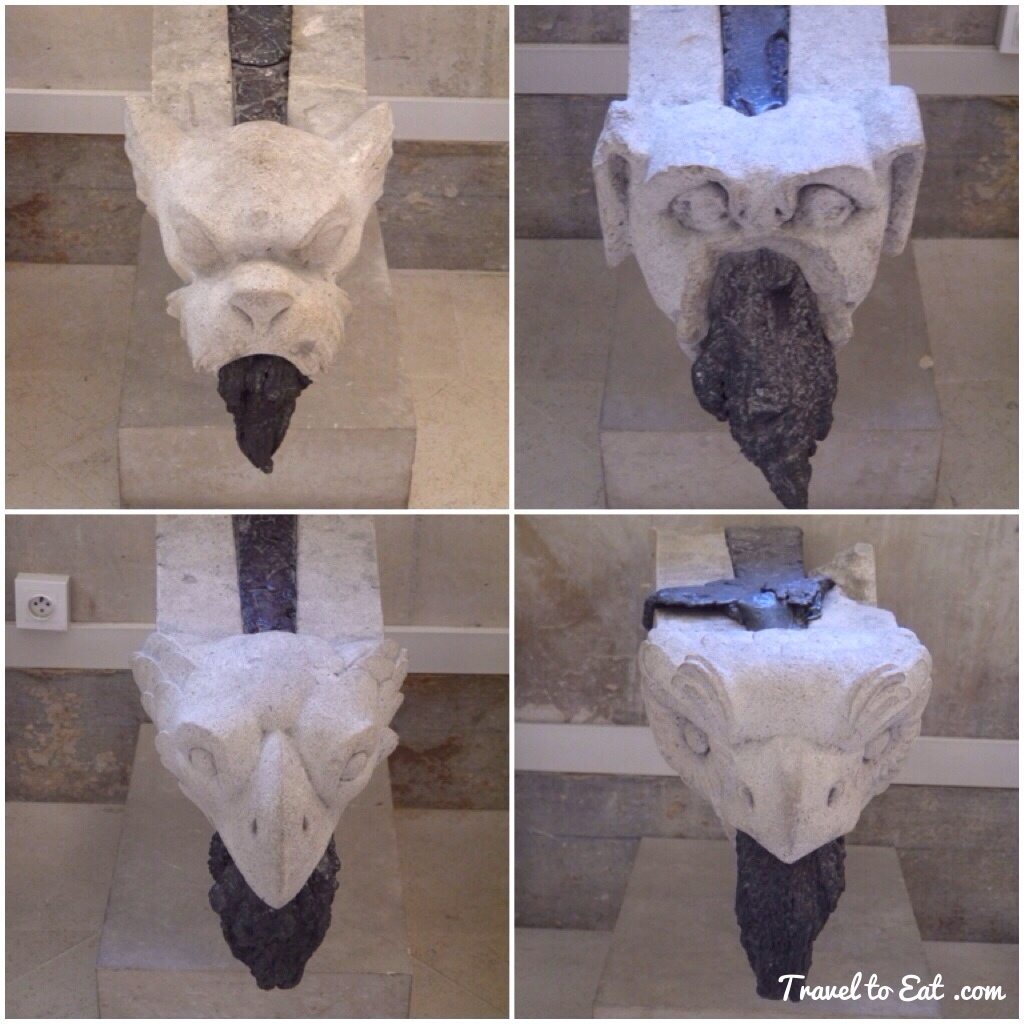
Poo! In the old days you could get a cameo in a crowd scene in one of the big windows or your face on a statue (just don’t forget to pay or you might wind up on a gargoyle. ;) )
It would be nice to be able to present the newly rebuilt cathedral to the world when it comes to town in summer 2024 (with perhaps a formal ceremony at Easter weekend that year). Someone was quoted in the paper here in the US saying that it will take ten to fifteen years, and that’s probably OK too, given the age of the building and the scope of the work.
As for the Louvre pyramid, I M Pei’s design was hated locally when it was first suggested but of course now it’s accepted, even beloved. It’s an anachronism, but it works. I doubt even the original 12th-13th Century cathedral is all of one style, given that styles changed over that period.

 )
)