The subject is of great interest and certainly I have seen an explosion of need over the pandemic.
My narrow interest, not quite a rant, is their choosing to date a rise from 2009. Included in the article however is a series of graphs which show that are based on this data from the CDC. Can’t show the image but here’s the data.
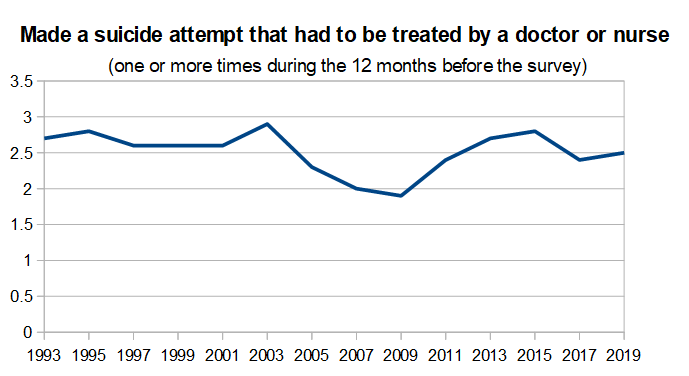
The NYT article talks up the rise in suicidality from 2009. The data however shows the year 2009 and adjacent as being very atypically low for “serious consideration” and concluded “decreased” for attempts and flat for attempts serious enough to need intervention 1991 to 2019.
If I was just looking at the graphs my question would not be what’s gone on since 2009 but what was atypical about that period of time, what explains the low rates then, not the return to previous baseline.
Of course pediatric mental health is important and the pandemic has resulted in a crisis. But the narrative they tell seems based on some selective date usage.
So what was happening around 2009 that had suicidality so low in teens?
The CDC does mention a trend toward increasing suicide-related behaviors from 2007 through the latest available survey (2019). A paywall blocks me from seeing what the Times’s specific take is.
My initial thoughts included skepticism about the validity of surveys that utilize self-reporting, but I see that actual suicide statistics based on death certificates for adolescents and young adults roughly parallel the survey results.
“Nationally, the suicide rate among persons aged 10–24 was statistically stable from 2000 to 2007 and then increased 57.4%, from 6.8 per 100,000 in 2007 to 10.7 in 2018. Between 2007–2009 and 2016–2018, suicide rates increased significantly in 42 states, increased nonsignificantly in 8 states, and were not possible to assess in the District of Columbia due to small numbers. Significant increases ranged from 21.7% in Maryland to a more than doubling of the rate in New Hampshire.”
As to what made 2009 a time of relatively positive mood among young people, the year was noted for a significant drop in violent crime. Maybe spirits were also buoyed by the Miracle on the Hudson and the removal of humpback whales from the endangered species list.
Yes. What is missing is the context that 2007 to 2009 were the bottom of a pretty sharp V.
Let’s see if this works.
Ach still not pulling in the table. Simple click though.
Seriously considered suicide was 29% in 1991. Dropped down to about 14% in 2007 to ‘09 and climbed back to under 19% by 2019. Overall a decrease since 1991.
Similar drop from 1991 to 2007-9 and partly back up for having made a plan. Overall a decrease since 1991.
And while the numbers look flat on each to me the CDC bottom line is decreases in attempts and flat for attempts that needed medical attention 1991 to 2019.
Potential limits of the tool duly noted but it was the same tool. Apples to apples. And looking only at from 2007-9 to ‘19 underpins the thesis of a long term trend, presumably a result of recent increases in loneliness.
I get your facetiousness but there may in fact be some relationship between violent crime rates and suicidality. Maybe.
The transient dip is the weird thing that begs for explanation. I have no good hypotheses myself.
The point of the OP is to vent about picking the frame to support a thesis, and seeing if anyone else can come up with any possible explanations for the dip sharply bottoming out then.
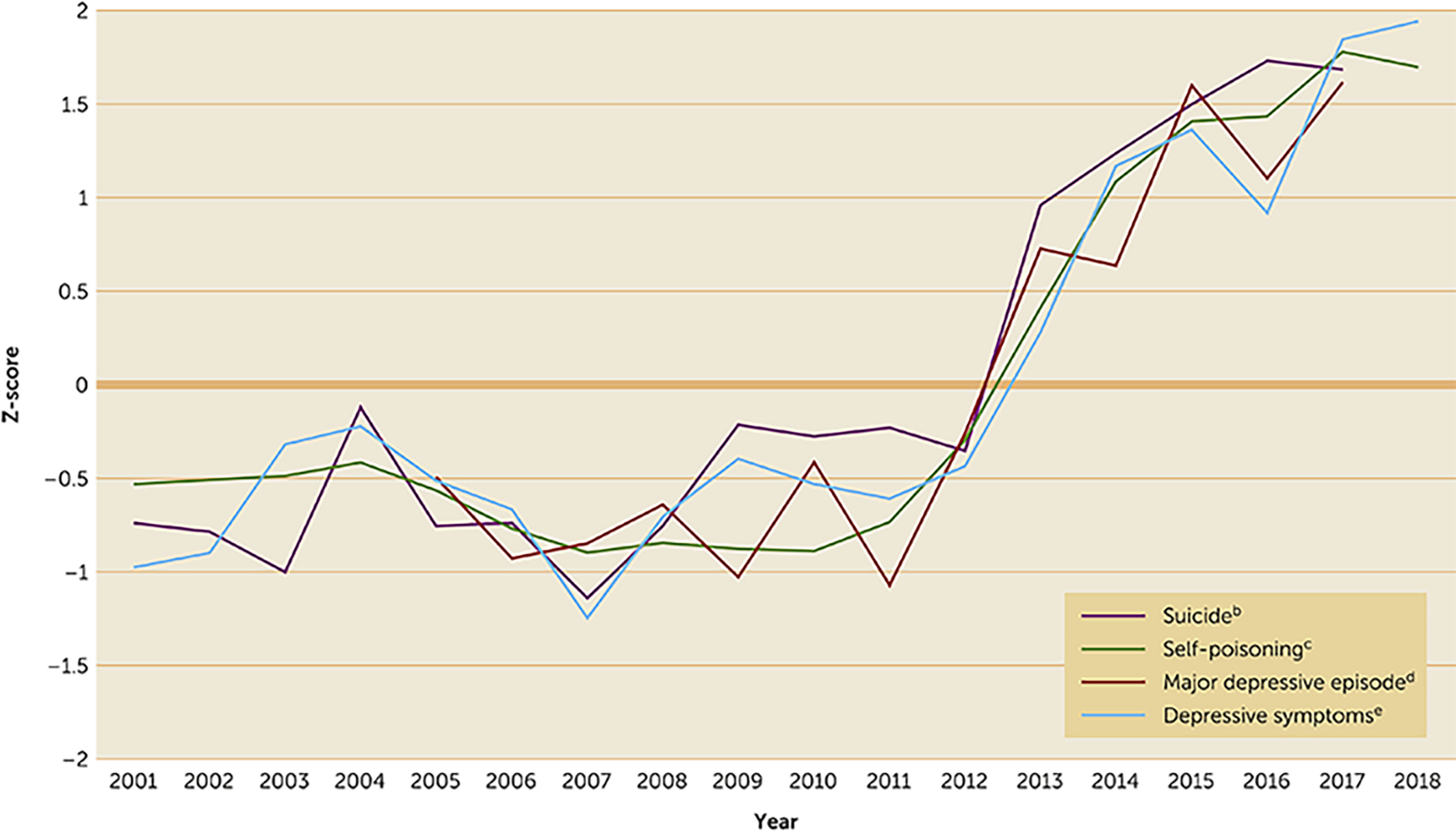
Thus, after improvement or stability during the early 2000s, U.S. adolescents’ mental health worsened considerably during the 2010s. Because these trends included increases in objectively measured behaviors linked to mental health issues (self‐harm, suicide attempts, and suicides), they cannot be dismissed as stemming from greater help‐seeking, awareness of mental health conditions, or willingness to admit problems. Similar increases in mental health issues have also appeared among adolescents in the United Kingdom and Canada (Haidt and Twenge, 2019, unpublished). With such similar trends across many measures and sources, an overwhelming amount of evidence indicates that adolescent mental health has deteriorated since 2010.
Articles like that one are another example of what I am bothered by.
Did you note the sources for those Z scores were? Scattered to find the ones that fit the narrative. Suicide cherry picked for 12 to 14 year old girls. But with text strongly implying for the complete population of teens and young adults.
Again ignoring that in the ‘90s rates had been higher. Conveniently as it does not fit the thesis of blaming loneliness resultant of more on line social lives.
It bothers me in particular precisely because I have been a fan of that hypothesis! But we cannot fudge and selectively frame data to fit our preferred narrative.
Here’s some longer trend data yet. Look at figure one.
The increase in young girls seems real and significant.
And pandemic numbers will blow the roof off the scale. It’s been bad. Very bad.
You think the election of Obama was the turning point for worse mental health?
That doesn’t seem a likely cause though I suppose anything in possible. I suspect the analysis is multi-variate and it is likely not possible to unpick in any detail though the prevalence of social media and associated online pressures could well be a contributing factor and that really picked up around that mid-2000’s period and accelerated from there.
it is but it seems to be rising for all groups and the overall male to female ratio is still around 3:1. I wouldn’t have expected it to be skewed that much.
And it will be interesting (or perhaps depressing, or both) to see what the pandemic period does to those figures.
I believe the poster is suggesting that Obama’s election generated an increase in hopefulness and thence a reduction in suicidality, which turned out to be only temporary as the reality (of blinkered opposition and limited opportunities for Obama to make any real differences) set in.
I’m not sure how you think that that is a poor manipulation.
The fact that they would be straight lines would be exactly why the y-axis is adjusted to accommodate the data.
That more people considered suicide than made a plan, and that more than made an attempt, and that more than needing treatment is pretty straightforward.
Why would different data sets, one with a peak near 30, and one with a peak near 3, use the same y-axis?
Agree that that is reasonable data presentation. Still very important to recognize that while thinking about it is common, acting on it is less so and up until 2019 anyway pretty flat other than the fairly inexplicable dip
For the 10 to 14 yo group the ratio has in fact decreased. Still a make predominance but by less. Girls are catching up.
Anecdotally from practice experience and reports no question pandemic numbers will be large. And I think girls much worse than boys. In my experience online gaming was protective for boys, allowing for the sorts of connections they needed. Girls did less online gaming and, hopefully not being sexist here, have more sophisticated social and friendship needs that we’re not met only by playing a game online together or by social media connections. They more commonly need an in person friend talking about real things.
It could be that we’re seeing two different trends pulling in opposite directions—greater mental health awareness, better prevention and therapeutic options were making a dent in suicide rates since the mid-90s, but have since been overwhelmed by an increase in mental health crises. In that case, the fact that we’re seeing a rise again after so pronounced a dip might point to an even more significant effect than a rise from a previously flat distribution would indicate.
But of course, that’s just post hoc rationalization—constructing a narrative to fit the data. One would have to investigate markers correlating with better mental health care to try and substantiate this—so if the rate of suicide has decreased inversely to the, I don’t know, number of therapy places available or whatever other marker could indicate ‘we’re getting better at treating mental health issues’ up until ~2007, and has since stopped doing so despite continued increase, that perhaps would be worrying.
Well, but the other half of the people (roughly) went for the other team, so if that were the sole determinant, then their trends should reverse in proportion, cancelling out such an effect—unless there’s some relevant factor regarding resilience to mental health issues that differs between both populations. (One possibility being the different age structure of each voting base.)
No. I was responding to Jackmanii and his ideas of what could have happened in 2009 to make it a high year. He included humpback whales and the Miracle on the Hudson. I was saying that I think, if anything, Obama’s election would be the more likely candidate.
Also, @Half_Man_Half_Wit: people who will fill out mental health surveys tend to skew more liberal. Plus I don’t think the hopefulness of seeing the first black president would be balanced out by those who supported the other guy. Unless you’re a racist, I don’t think Obama’s election would increase anxiety, depression, etc.
The main counteargument, which I missed, was just that it started before Obama even was running. So while that may have helped, it likely is not as important as my initial thought would be.
That’s why I phrased it as an initial thought, not something I had spent time on.
I can also imagine a guess tangentially related to @BigT ’s - it seems to me that the election of Obama was a high watermark for acceptance of diversity of all sorts in this country with a cultural backlash occurring since. I’m thinking lots of child and adolescent suicidality is driven by hearing messages of rejection by society and peers during critical identify formation times. The cultural backlash was in broad brushstrokes and not only experienced in rural towns.
Not sure how to even test that hypothesis though.
Of note - adult suicide numbers are associated with opiate use and availability; suicide completion in kids is increasingly by hanging/suffocation, passing up firearms.
No.
The CDC survey data has a consistent high response rate and is generally considered by the medical and scientific community to be fairly free of response bias (and analysis for such is part of the process). This is not an internet survey.
Also note that the bottoming out around 2007 to 2009 also occurred in suicide deaths, a separate data set, and the specific relative rise in suicide deaths among girls 10 to 14 years old began its rise then. Girls 10 to 14 still complete suicide less often than boys in that age group and older children, but they have been catching up. It is a small number but kids in that age group dying of anything is thankfully a small number. Of causes of death for the age group it is way up there.
Sorry I’m late to the party - (but dropping statistics twice in college was the reason I finally transferred out of the Business college! ;))
What do people perceive about underlying trends in depression - as well as other mental health conditions such as anxiety, and PTSD? Are they increasing? Decreasing? Getting more attention? And for what reasons?
My personal anecdotal perception is that you sure HEAR a lot more about such things in recent years than when I was younger (born in 60). But I don’t know whether that means such problems are increasing, whether they always existed but are merely now getting long needed attention, or countless other explanations. And, tho none of the graphs so far go back to 60, the impression is that today’s rates of depression are not necessarily higher than they were pre-millennium - if anything, they have come closer to normal levels after an unusual dip in the oughts.
Sorry if this hijacks the initial intention of the thread, but I thought this might be a better place to raise my questions than trying to formulate a new post.
Many or perhaps even most studies of this sort are based on statistical cherry picking and data mining of one sort or another. Choosing a convenient starting point is one common trick (very common in pushing economic theses, in particular) but far from the only one. Three types of lies …
I think in this particular case, what drives it even more is that when rates were going down, people had a ready explanation. It was based on advances in mental health treatment, education, child-rearing techniques etc. etc. Basically, people promoting various reforms and advances of different sorts and their supporters were only too pleased to see decreases in mental health issues as results of and validation for their efforts. So when rates went back up, does that mean that you decide that the whole decline was actually a blip after all and not due to these things? Or do you say the decline was real and now there’s something else going on?