Plan to see Nolan's The Odyssey this weekend

I’m enthusiastic about this movie.

Sure, it’s a classic genre. What I like about it is:

  1. It’s a great story. There’s good reason they’ve been telling it for 2800 years. It’s not Marvel Universe trivia. There are very interesting plots and subplots.
  2. It’s well told. They did a great job including most of the details while simplifying it enough to reduce it to three hours - a much more difficult task than you think.
  3. I thought the casting was superb. I would not have thought Damon or Leguziamo could act as well as they did. Therzon makes a solid nymph.
  4. The changes made to the story were interesting. Sure, the role of the gods was reduced - how could it be otherwise? The ending was both inspiring and inspired - making real the consequences for the enemy (expressed centuries after Homer in “The Trojan Women”), Judeo-Christian ideas of family and redemption (rather than Greek), and ideas from modern psychiatry.
  5. It looked gorgeous, and three hours passed by very quickly. The plot was complex, was clear without being insulting or unsubtle, was not too ridiculous even if there are inconsistencies under closer examination, and was reasonably faithful to the source. What recent movies compare?
  6. It did not rely heavily on effects and AI. The acting was genuinely good; only a few parts somewhat hammy.
We just got back from seeing it. We had a long discussion with the kids about it. Over the past week I read the Emily Wilson translation, so that is fresh in my mind. I also read her review of it before seeing the movie.

I’m still digesting the movie. It is a spectacle and it has a huge emotional impact. Definitely worth seeing once on a big screen, and I will watch again when it’s available retail.

Some random thoughts, in no cogent order:

Emily Wilson called it “family friendly”. Yeah, no. It’s a hard R rating. Minimal sex; Odysseus and Penelope reclining into a presumed sexual pose that is cut away. And a threatened rape of Circe. But so much explicit violence and death. And much implied death with clever editing avoiding the most gruesome gore. I’d much prefer to see less violence and more sex.

At least one of the soldiers was transformed into a female pig. I wonder how long it will take anti-trans idiots to notice. Especially with the dialogue about the men taking their “true” form.

I’d prefer the movie just completely omit the suitors who sailed to kill Telemachus. The side quest of the Athena shrine massacre was unsatisfying and non canonical.

I like how they handled Athena. They should’ve added more omens into the movie, especially owls, eagles, and other birds in addition to the occasional thunder.

I like the movie’s theme of Zeus’ Law. An excellent interpretation of the original. Some Christian influences showing in it, but tolerable.

Calling all of the slaves “servants” feels like whitewashing. Tyrants like Odysseus gained and maintained their power by pillaging and enslaving. Troy was not an aberration.

The “Trojan” horse interpretation is a good one, looking like it was built from ship parts. The drowning within it is gratuitous. It’s that kind of thing that makes me lose patience with a director.

But, the direction is good. I was not hopeful, after being very disappointed by Oppenheimer. I am not a fan of ham fisted directing. But this one turned out okay, giving space for the actors to be more nuanced.

And the acting was fine. Emotions felt organic and uncoerced.

? I missed that: who drowned in the Trojan horse?

The folks at the bottom while they were sitting on the beach waiting to be collected by the Trojans.

Whoa, gross, yeah, I didn’t remember that. Indeed it doesn’t make a lot of sense in the context of the story. The brief mention of the Horse in the Odyssey doesn’t indicate any drowning, and in the Aeneid it’s pretty clear that the Greeks built the Horse right on the beach, so how would it get sunk and/or half buried in sand?

I liked the Ozymandiasish look of the “abandoned” derelict Horse, but actually dunking it in the water so it drowns some of the hidden warriors is too stupid a booboo for Odysseus.

(Also I was disappointed not to get Laocoon’s warning and subsequent strangulation by sea serpent in the movie. If Nolan can lift the character of the Horse-guard Sinon from the Aeneid, why not the Timeo Danaos et dona ferentes bit?)

When the tides came in it buried the bottom in sand, therefore the bottom was also in water. I thought it made perfect sense and was a really good detail. Normally the horse is just shown as this toy-looking thing on rollerskates. It was cool showing it as an actually massive and heavy thing that sunk in the soft sand. Not sure why it’s gross or gratuitous. You don’t actually see dead bodies.

Hmm, that’s one hell of a sand-shifting tide, considering how much of the Horse was buried. How many tidal cycles have these several dozen Greek warriors spent crammed together in this outsize barrel with no food or water or facilities, anyway?

(And yeah, when ancient builders created massive statues that they wanted to move from one place to another, they did put them on wheeled platforms. I don’t mind if Christopher Nolan decided to go for a different look, but it does take me out of the story a bit to make it so unrealistic and impractical.)

Huh. I missed that. There was the obvious part where Menelaus was nearly drowning, and they pulled him up a little. Clearly he lived because of the later scene with Telemachus. I didn’t catch that there were people below him. Guess I gotta go watch again this weekend.

Missed this first up. Yeah, ISTM pretty gross that the living warriors have spent an unspecified amount of time stuffed in this barrel with drowned cadavers, but that bothers me less than the general question of ”how did it even happen this way given the overall context of the story, you don’t get a huge wooden statue on a beach half buried in sand in just a day or so”.

But Spiderman wasn’t shot in IMAX…?

It was, however, shot in a way that can be used on 270-degree ScreenX screens (which, I assume, are more available than IMAX - being that there’s one in my small town).

The visuals of the Trojan Horse were cool but, while I watched, I felt like something that hard to move risked someone saying “Let’s just break this down into pieces”. The Statue of Liberty, for example, was 350 pieces reconstructed in New York. The horse is a lot smaller but you’d still think someone would say “We could move this a lot faster if it’s in ten sections”.

The classic rollerskate depiction at least makes more sense from that angle.

I was thinking more about Emily Wilson’s criticism. She said on the NPR program Fresh Air that Nolan should have hired a scriptwriter instead of writing it himself

Despite her critiques of the film, Wilson says it’s “absolutely” still worth seeing. “There’s a lot to think about, both in terms of what is this film saying about … war, violence and deception in our times, and also what it’s doing with the source material,” she says. “The actors are amazing. It’s a star-studded cast and they’re doing their absolute best with the script they were given.”

I would think she’d be happy that The Odyssey is getting the big-screen treatment and that her book is selling better because of it.

She is, and she explicitly says this in her review of the film.

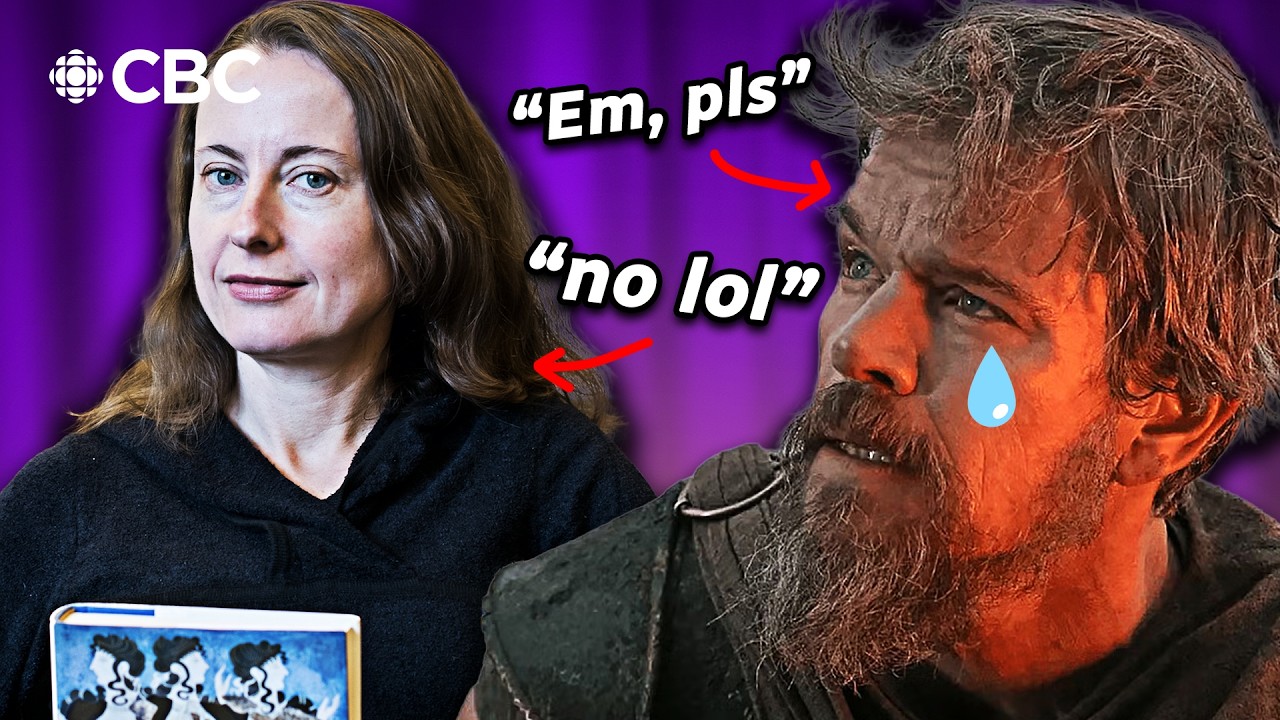
CBC’s pop culture round table Commotion had a discussion of Emily Wilson’s review. Lots of funny shade being thrown in all directions (“I can’t believe she’s making me defend Christopher Nolan.”)

Joyce Carol Oates took a little time out of grinding Elon into paste online to comment quite negatively on Wilson’s review. It’s good stuff…

“Rather than disagreeing with interpretations of Homer in a collegial manner,” said Oates, “this person, who has benefited enormously from Nolan’s film, speaks in the crude language of Maga folks attacking someone with ideas that differ from hers.

…and…

One would expect a translator, of all people, beholden to a text, in service to a text, to be just a wee bit more thoughtful & respectful of others who are acting in good faith just as (she would claim) she is

…with Oates delivering a bit of her own trademark snark.

what I’d read of Emily Wilson’s translation was not for me but assume it was deliberately written to appeal to an audience comfortable with YA (young adult) directness & spareness of vocabulary–that is, with the intention of being marketable, adopted by high school classes.

She sounds like a cranky old fart who did not get the point of Wilson’s translation - appealing to YA readers was not it.

Indubitably. If eschewing recondite vocabulary renders one’s literary endeavors Young Adult, then Cormac McCarthy should be taught in middle school.

Overall I liked it though I was not convinced by the central premise of the breakdown of “Zeus’s law” as embodied in the sack of Troy helping cause the bronze age collapse. It’s an interesting concept , though of course both ahistorical and aHomeric, but I don’t think the film really developed it thematically other than Odysseus just talking about it.
Where the film works is in the setpiece sequences especially the sacking of Troy and the sea voyages. Together these sequences exert a visual and aural power which just keeps building up right through the film. It’s a great IMAX experience and I can only imagine what it’s like in Imax 70mm.

What was the point of Wilson’s translation? I don’t know anything about it TBH.

Based off what she’s said over the years, it’s multifold:
Modernization of the language (but NOT in a YA sense. It’s definitely still a poem in her version which IME is not a common YA format)
Purposefully not presenting Odysseus as a (in modern terms) heroic figure, but getting to the actual Homeric presentation - partly by stripping away previous translators’ hero-worshiping prose
Exposing the central horror of slavery in the text and the society it reflects
Re-examining the role of women in the text - it is in many ways a consciously antimisogynistic telling. Like the way she describes Penelope’s agency. There is a clear intersection with the previous point in the way she doesn’t sugarcoat that the female slaves that are slaughtered at the end are rape victims.

None of that is to “appeal to YA readers” (YA often has very messed up unexamined gender and social dynamics, for one thing)