Here in the Chicago area, many municipalities (including the village where I live) require you to buy a “vehicle sticker” every year for your car, which is effectively a car property tax.
My village routinely checks cars parked on the streets, and in the village’s parking lots (including the one that services the train station) for cars which are registered in the village (i.e., the address on the license plate’s registration), but which aren’t displaying the sticker. No sticker earns you a ticket, as well as a demand that you pony up for a sticker.
Similarly, it appears that they work with the state to get a list of all license plates registered in the village, and match it up to issued stickers – that’s how we eventually got a letter from them, demanding that we buy a sticker for the car we’d inherited from my late father-in-law, and which is never parked on the street or in a village lot.
Is it a set fee? Here in MA there’s an excise tax, based on the value of the vehicle. So you pay much more for an expensive car, but the amount goes down each year. Our cars are both at the minimum because they’re so old.
In our village, there are different rates, but it’s by vehicle type. $50 for a car, $80 for a light truck*, $125 for a heavy truck*, $25 for a motorcycle. They have a discounted rate ($8) for a car or light truck if you’re age 65+.
*- in Illinois, trucks (and maybe vans) get different plates than passenger cars; there’s a further distinction between “B-class” truck plates (under 8,000 pounds) and “D-class” plates (8,000+ pounds).
If that rate is correct, it would suggest to me that other taxing mechanisms, rather than property taxes, are the primary vehicle for tax collection, and funding of government operation and services, there.
My brother lives in a Chicago suburb. Some years back, he mentioned that their house (at the time; they later divorced and sold the place) had a tax bill of about 17,000 a year. That was largely to support the schools, which got basically no state funding. I don’t know what the place was valued at, but let’s guess it was about 750,000.
By contrast, our house which is likely valued at something close to that, has a tax bill of just over half of that 17K.
A couple years back, we looked briefly at purchasing a condo in Vermont. The valuation was something like 190K - and the taxes were about 4500 a year. So, 1/3 of the value of our house, but over half the cost in taxes - i.e. a much higher tax rate.
All in all: 45,000 a year in taxes on a 2.5M house doesn’t sound all that insane. Higher than our house’s rate, but not as high as in other areas.
One issue with skyrocketing taxes as a place increases in value is that you could have a home paid in full, but lose the house because you cannot afford the taxes. California’s Proposition 13 is one such law (taxes cannot increase more than 2% a year regardless of the value increase). California’s tax on that 2.5M house would be capped at 1% of the value, or 25,000 a year. If it’s worth 3M next year, the tax cannot go up to more than 1.02 * 25,000, which I think is 25,500.
Yep. The mill rate in Toronto is just over .6% of the assessed vale of the house. Given our weird assessment system, I think my house is worth 2.5x the assessed value.
We didn’t really pay attention to property taxes until we paid off our mortgage because it was part of our monthly house payment. Our house is assessed at around 500k, and our property tax bill is in the neighborhood of 5k. The property tax as a percentage isn’t bad, but it’s probably tripled since we bought the house in 1999. If our rate were the same as that paid by OP’s SIL it would be around 9k. That’s probably not an exceptionally high rate, although it would probably make us more eager to sell the house and move somewhere cheaper when I retire.
I won’t say where she lives as it could identity where she works (and then identify her), but just to add - she wasn’t really complaining. She’s actually of a socialist nature and is happy to pay her share of taxes, but I guess as she’s paying UK income tax and particularly high US property tax, she’s getting double whammy (plus two girls in US universities, ouch).
Council (property) tax isn’t based on current property value. There are price ‘bands’, which categorise your property in one of six bands, with a sliding payment scale. The band your house falls into is based on the value of your house in 1991 (which is when the council tax was introduced). I know, sounds weird. But basically there’s not a huge price difference between the lowest band and the highest.
Property (known as council) tax goes towards only local services (roads, schools, social care etc). National services such as national government, Police, healthcare etc are funded by income and sales taxes.
I took a quick glance at Zillow and found a home for sale @$2.5M in 60035, Highland Park, Illinois (high end suburb). The tax assessments are $630-660k with taxes $51-54k for 2019-2021.
A Chicago home in 60610 is offered for $2.3M, assessment $200k, taxes $40k.
What’s the taxable value of your home given that you probably have a Homestead Cap if you have a Homestead Exemption?
Here in the a-hole of Texas, there is a house with a Market Value of $487,068 with Homestead and Over 65 Exemptions that will be assessed taxes on $408,162 because of the Homestead Cap. The taxes on that house for 2023 are going to be around $9,512.50, and that’s with the increased school district Homestead Exemption of $100,000, and a school district tax ceiling of $3,320.78 by way of the Over 65 Exemption.
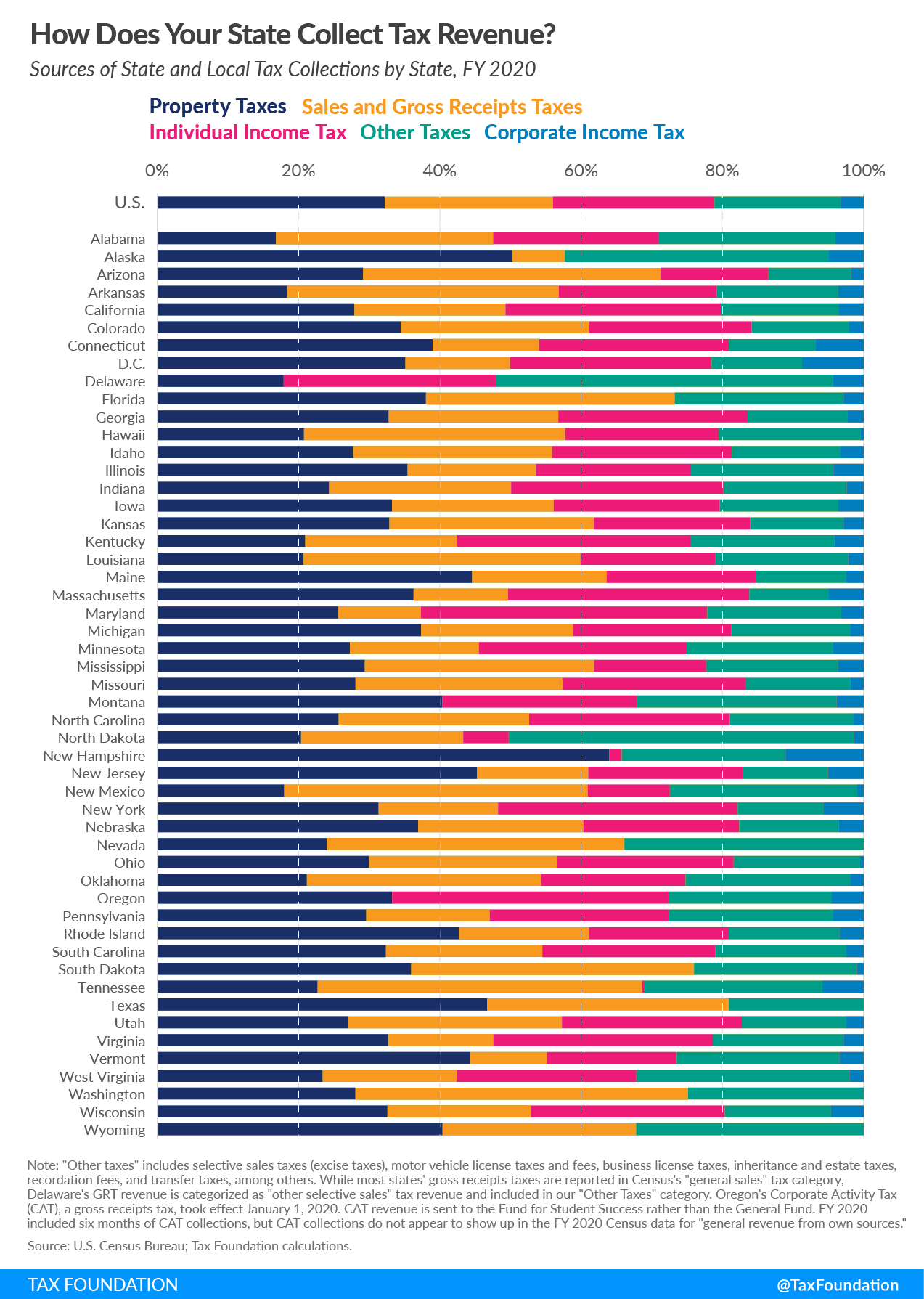
Very illuminating on how much it varies by state. Does this split influence people’s movements between states, or does it all roughly work out the same in the end?
One difference between the US and the UK is how different levels of government collect and spend money. Close to half of government spending in the US is by state and local governments, but about a third of their revenue is transferred from the federal government.
So it appears. The vast proportion of UK tax is paid through national levels of income and sales tax. Property (council) tax is a relatively minor portion, so whether I live in London or Northumberland, the difference in tax is minor.
It can. Say you live on the west side of El Paso, TX and retire. You can move a few miles west into NM, which has higher income tax but lower property tax.
VA, MD, and DC tax based on where you live, not where you work. But I found it difficult to make a general comparison because there are so many factors.