Or it could produce very much wanted sound !
I think they;d be airtight. There is already a company that sells 3d printed
mps which sound great and are used by top pros (Patrick Bartley & Scott Paddock
to name just 2)
What I was listing was what might happen if your printer wasn’t good enough quality. Some prints definitely aren’t airtight. But I’m sure that a company that’s selling mouthpieces would use a high enough quality printer, and do any necessary post-processing.
Hey, if it helps, I’d be happy to print and send you a few? Just send me the links to the model(s) you’re interested in. It probably won’t be as high quality as the ones printed that by company, but it’d cost you nothing aside from a few bucks for shipping.
Sort of. As a test, I took an image like this:

And put it into meshy.ai (or use my referral link for first month for $1). I think you can upload and preview the results before paying, you just can’t download until you do. 3daistudio.com is another similar service.
Anyway, with a click or two, Meshy turned it into this 3D mesh:
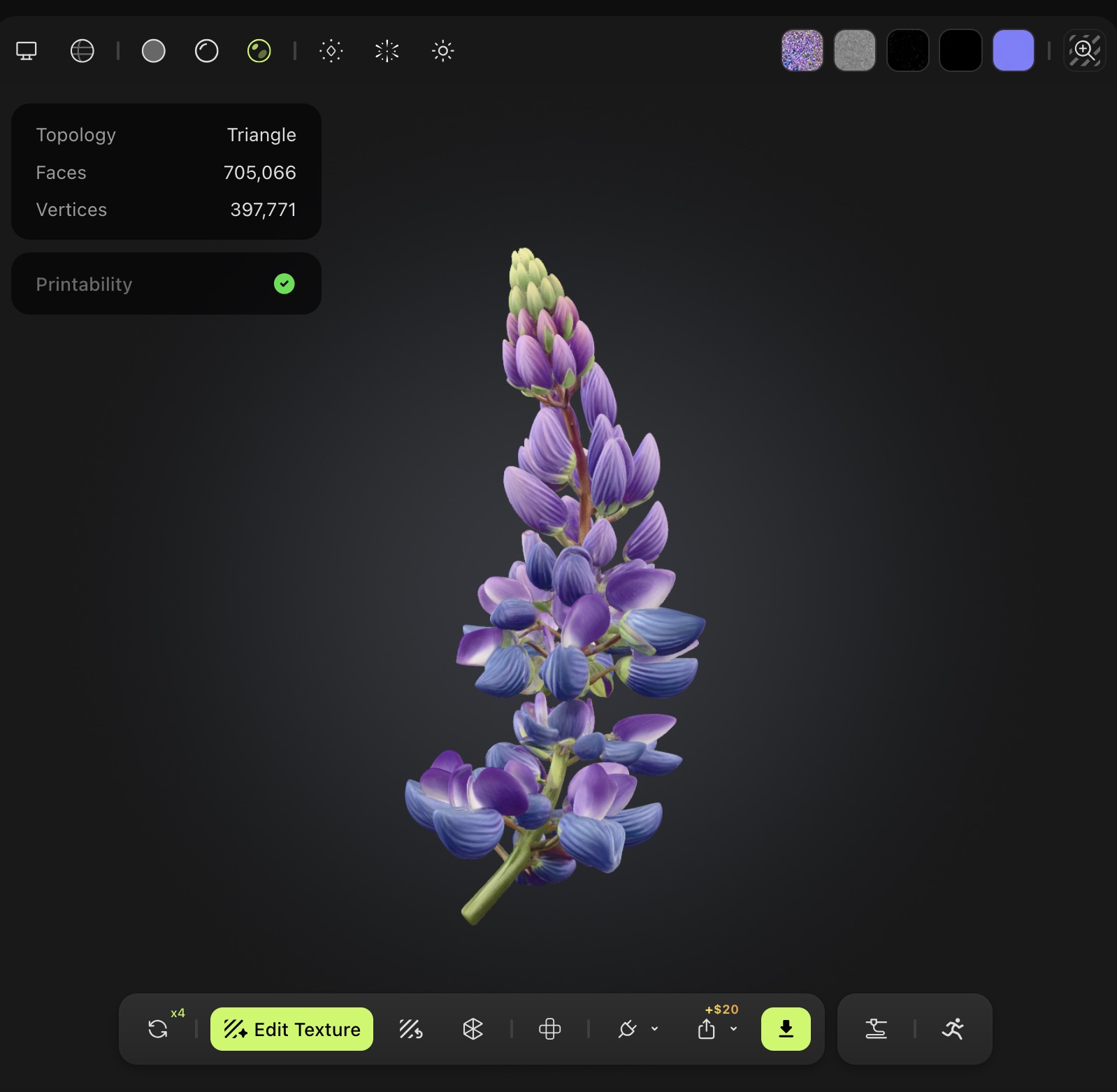
I didn’t have to do anything special. It just one-shotted it successfully.
Here’s another one of my cat:
Also one-shotted.
So at least the 3D model-from-picture part of the workflow works very well with the right specialist models (not a LLM like ChatGPT).
However, the resulting mesh was too detailed to 3D print well. Not just in terms of polygon count (which is easy to decimate), but topology (too much detail that’s hard to turn into filament-sized g-code, not to mention being a nightmare to create auto-supports for) and color (gradients like that would kill any non-toolchanger system, and even after palette-ization, it would still be a lot of nozzle swaps). I don’t know if any model is yet smart enough to then turn a photorealistic 3D mesh into a simpler object designed for 3D printing… maybe? I haven’t looked much yet.
But anyway, if you have any simpler objects you want to turn into a mesh, it might be worth a shot? Feel free to send me a pic and I’ll try for ya.
I design little bits and bobs for Steadicam Operators and, to a degree, all Camera Operators.
One idea evolved in a way that made it clear that 3D printing might be the way to go instead of milling/ water jet/ casting, etc.
My pal was already deep into a Prusa printer. At the time- about…10 years ago, maybe 8- it was state of the art. I went in. Bought my own. Knew nothing of it, but I bought mine set up and ready to print.
And…with his tips and tricks, it DID print. Just fine. Some of the time. But my file took 17 hours to print one unit. I could hardly sit and babysit and watch. And so, after the first few layers, I would leave it alone.
Suffice to say that I wasted a LOT of black filament ( Don’t remember which type now.) Eventually between his efforts and mine I did a production run of about 30 units. Threw out at least that many in failures. It was incredibly labor-intensive, what with wiring and hidden re-settable circuit breakers and industry-specific battery mount plates and whatnot.
I spent about $ 2,100 on the printer and hundreds more on the filament. Then I found a spray paint to use for it designed to stick to pickup truck bed plastic. ( Raw, the units were WAY too slippery to be used. They’d pop out of my hands incessantly. )
Long story short, I lost money on the invention. Still have most of them. The item works, but most folks looking at it didn’t see the value of it. Pity, that.
I sold the printer to my pal, who was in need of a second one.
Lesson learned. Leave that stuff to the pros, let it be done by someone else, adjust the per unit price accordingly.
Thanks ! I’ll look into it further and see if I can come up with something that
looks workable and get back to you.
Cheers.
They claim working at 10 micron precision, which not any tech and not any printer are going to achieve.
Printers have gotten a lot more reliable and user-friendly in the past 10 years. It might be practical now.
Depends on what they mean by that. You’re not likely to find any printer that can lay down a filament line narrower than 50 microns or so, so you can’t make any detail smaller than that. But a printer might be able to place that 50 micron line in a position with 10 micron precision.
I bought an Ender 3 during COVID and learned a lot. But to make it functional I had to replace a lot of things as I went, and spent countless hours gathering dust. Now I’ve got a sort of mental block to start again because I know I’ll have to rewatch a bunch of videos and spend more time tinkering that I just don’t have. I envy people who started more recently as mine was the “best cheap one” then and now there are multiple which are leaps and bounds better. I have a sort of sunk cost fallacy going on - do I try to fix this one up, sell it at a loss, or what. For small one-off printing, the county library does it for free as long as you don’t mind it comes in white. Or the university will print for a small fee more elaborate things. It was a fun hobby but frustrating.
That was my initial fear, too. But Bambu has done a lot to make the experience a lot more user-friendly, and their printers are self-calibrating. The fancier ones have AI-enabled cameras that monitor for print failure too.
With mine, I had some initial frustrations that were largely my fault (trying to print on a dirty bed with poor first-layer adhesion), but once I learned the basics, it’s been a rock-solid machine ever since. And that’s just their basic entry model.
I think there is still a learning curve, especially in the first week or two, but it’s a lot better than it was in the early days, and is pretty much out-of-the-box plug-and-play now (if you get one of the Bambu ones). I think some Prusas etc. still take more assembly out of the box.
Ah, there’s your mistake, then. Ender is the 3D printer for people whose hobby is tinkering with 3D printers: The folks who like fiddling with the settings and swapping out parts and improving things, and all they ever actually print is Benchys and other calibration prints. And yes, there are folks who enjoy that, and more power to them… but if you’re not one of them, you’re not going to be happy with an Ender.
Bambu is the “it just works” brand.
One part of 3D printing that has taken off is commercial 3D printed receivers for guns. If a military surplus, collectible weapon is a full automatic weapon the main part, the receiver, has to be cut into pieces in a specified manner. Then the importer sells everything as a “parts kit”. It can be legally re-assembled on a semi-auto receiver. I am working on one right now. The aluminum or steel receivers are over $300 but the 3D printed version is $60. The one company I like uses carbon fiber reinforced nylon 66 for the filament, very strong. Then they post process to make it tougher and smoother.
They still don’t look like a metal version though. Many people use auto body filler and paint to smooth it out. And this is only for a part of the gun that does not see huge forces during firing.
Isn’t there some concern about single-use 3D printed guns too, that can only fire once or twice before breaking catastrophically? But still make the bullet much harder to trace?
If you want to make a crappy single-use gun, there are a lot easier ways to do it.
Oh?
Probably just the media hyping things up again then, e.g. Print and shoot: How 3D-printed guns are spreading online
Resin printers have a resolution an order of magnitude or more smaller than filament printers; a good one can do ~20 microns horizontally. They’re essentially limited by the pixel size in the video screen that cures the resin; there are no mechanical parts moving around horizontally. The vertical resolution is limited by the precision of the bed lifting apparatus, which is just a big screw, and that can do even better, down to ~10 microns. The 10 micron claim by Syos is probably for the vertical axis. I doubt they’re getting 10 microns horizontally, but they can come close.
BTW, those Syos mouthpieces are priced between about $200 - $400 apiece. You could buy a very good resin printer for the price of a couple of those mouthpieces.
I know nothing about mouthpieces. Is the print resolution a matter of musical differences? Airflow? Mouthfeel? Or is it more of a cosmetic concern?
Is it something you can print on a lower res printer and then sand down?
The Syos web page says the mouthpieces are made of “UPSCAL3D, a new proprietary material” which does not tell us very much. The stiffness of the material is going to make a difference. I am not sure just how sensitive the tone is to the precise dimensions of the chamber, but it seems like an awkward shape to get in there and “sand down” with any degree of accuracy: you have to polish inside a tube with varying diameters and constrictions.
If you have a saxophone and access to a 3d printer, I would go ahead and experimentally try it, though.
Oh, right, I always forget about those. Yeah, resin printers can have amazing resolution. I’ve never been able to find good information on their fidelity, though: If I print a 2 cm cube, how close will it be to 2 cm on each side? Is there any warping or other distortion?
For a mouthpiece, certainly one issue is that you’d want to be sure that you get a snug fit. Too loose, and it’ll leak or fall out, and too tight, and you won’t be able to attach it. Traditionally, this is done with a cork seal between the segments. I don’t know if the 3D printed ones do the same, or if they rely on ultra-precise dimensions.
That’s my thinking !
Airflow can affect the sound.
Regarding mouthfeel, the small amount that actually goes in the mouth can
be sanded if necessary. Many players stick a soft pad to the top where the
top lip & teeth go and the underside will be covered by the reed, so not so
important. Apparently some people sand the table (the flat bit where the reed
sits) when using synthetic reeds (as they’re more rigid than cane reeds) so as to ensure a complete air seal.
All mouthpieces fit onto the neck which has cork glued round it. The cork is
slightly spongy so the fit doesn’t need to be ultra precise. And cork grease helps !
A saxophone’s sound is affected by several things; mainly the sax itself, the
mouthpiece, the reed, and the player’s mouth/embouchure.
So even if I got a syos Scott Paddock signature mouthpiece, that doesn’t mean
I’m going to sound like Scott Paddock unfortunately (unless I’m VERY lucky !)
Some people do that with standard mouthpieces to alter the sound.. It’s a tricky
and time consuming, and not always successful. And it can get very expensive !
Apparently…
UPSCAL3D is a proprietary, non-toxic thermoplastic material developed by Syos specifically for 3D-printing saxophone and clarinet mouthpieces. It was designed to replicate the density and feel of traditional hard rubber (ebonite) but with superior durability and none of the toxic components
 My mouthpiece contains toxic components !!??
Your mouth contains toxic components, too. Everything contains toxic components. That’s mostly just marketing puffery.