Recent-ish 3D printing experiences?

Apparently we haven’t had any threads about this since 2011 or so… anyone interested in it at all these days?

Friend of mine recently sold me his used $300 3D printer (a Bambu A1), and I was blown away by how far the tech (and affordability) has come since the early days of the RepRap and such. The way I remembered them, they were a huge PITA requiring a lot of tinkering and calibration only to get you tiny, shitty models for super niche uses.

Fast forward to 2026 and the ecosystem has completely changed… the equipment is basically plug and play now and automatically self-calibrating, and sites like makerworld.com and printables.com list thousands of models you can download and print for free with just a tap from your phone. You send it off, and a few hours later, it’s done.

And you can now somewhat easily (but wastefully) do multi-color prints too, anywhere from 4 filaments from the lower end models to dozens in the higher end ones, or even full-color prints through a special technique or hybrid 3D + UV printers.

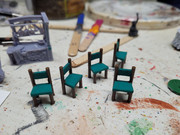
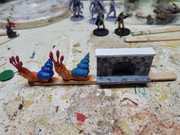
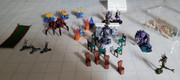
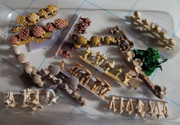
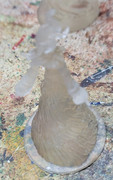
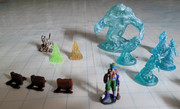
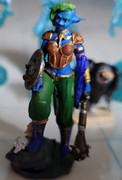
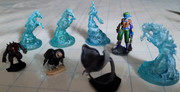
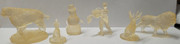
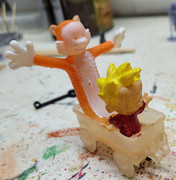
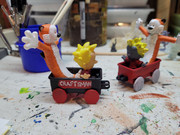
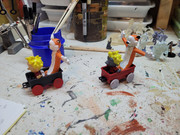
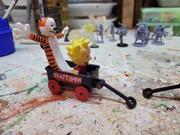
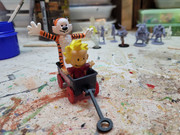
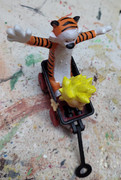
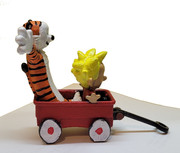
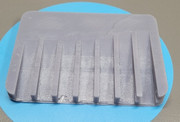
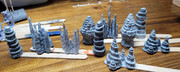
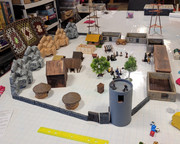
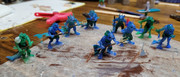
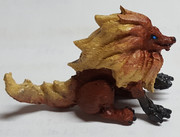
Just some sample prints I’ve tried…
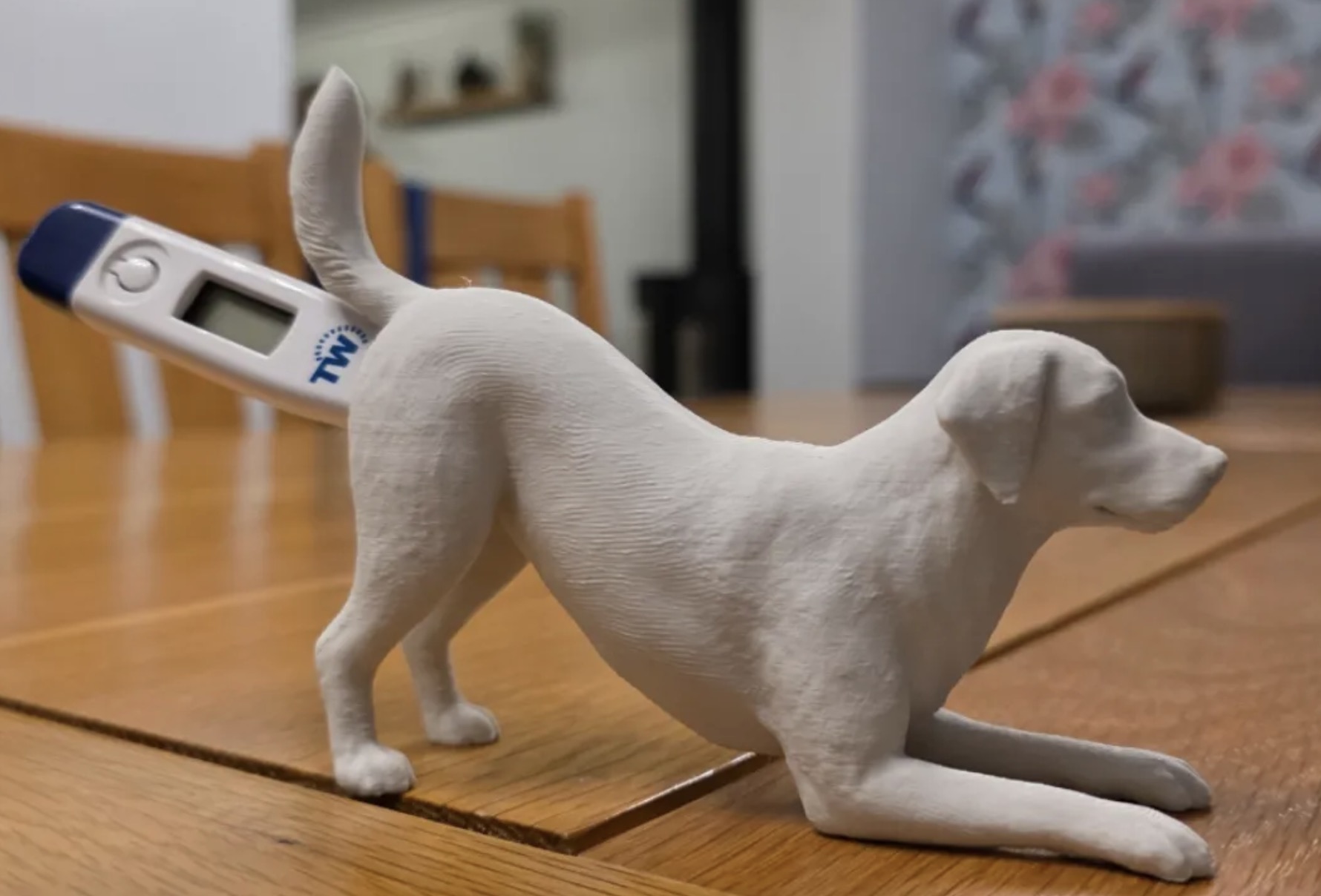
But by far the most popular has been these dog-butt thermometer holders :laughing:

My partner is a vet tech and brought one to work with her. The next day we got requests for half a dozen more… every department wanted one, in various colors.

I’m now thinking about getting more serious about the hobby and maybe getting an upgraded machine to make and sell fun little prints at local crafts fairs and such. But I know a lot of people think of 3D prints as tacky and cheap (which, to be fair, they are). It wouldn’t really be profit-seeking as the main point, just a way to help pay for the hobby.

I’d love to learn to integrate LED lights, robotics, etc. into the scenes to make them more animated, interactive dioramas. But I’m on the fence, myself, about whether the final products would be cool or still just kinda chintzy… :person_shrugging:

Anyone else have thoughts or interest in the hobby at all?

We have a few more recent threads and projects pop up in the tools-electric-diy threads.

I printed up a pair of lady giants yesterday to help fill a gap in my D&D minis collection. I’ll start painting them sometime this week.

Post from 2022,

Thread on buying my resin printer.

I’m still pretty active in 3D printing. I mostly use the Makerbots we have in the makerspace at school, which are mostly pretty reliable, but they’re not like the Bambu printers are. We only have the equipment for two-color prints, but I don’t usually care about color, anyway (and if I do, I add it after the print using permanent markers).

Are you interested in designing things yourself? To me, that’s the real fun part of the hobby.

Ah, very cool, I’ll peruse those! Sorry I missed them in a cursory search.

Why did you decide to get a resin printer… is it mostly for the small-scale details for miniatures? From that thread, the mess seems like a real hassle?

The hybrid full-color printers seems pretty cool for that use case: HeyGears G1 Series: The World's 1st Desktop Full-Color 3D & UV Printer – HeyGears Store

It can print a full-color medium-high resolution miniature by combining FDM and UV printing in the same unit, building up depth and adding CMYK color at the same time. No more painting — we all know how terrible I am at that :sweat_smile:

What are you mostly making on them? Is this for a classroom, or do you just go to the makerspace for your personal use?

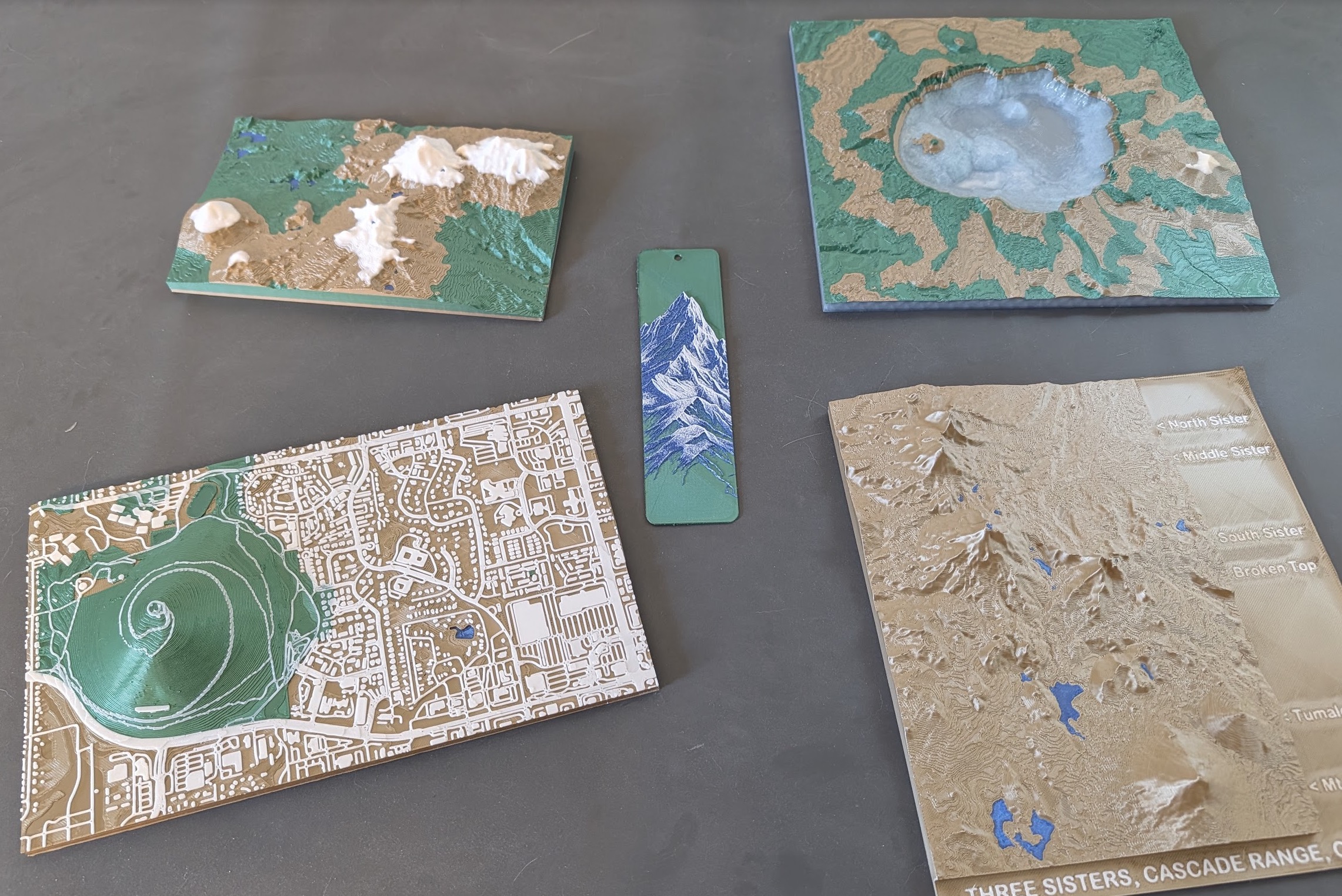
Yes, very much so! But I’m more interested in the potential artistic and cartographic aspects than functional parts — think topo maps, geology layers, bathymetry cutaways, and things like that. Along with the occasional earring for the GF and Batman mask for the cat, of course :laughing:

Hence the desire to upgrade. While my current one can technically print 4+ colors in the same print, it has to purge the current filament with every color change, meaning heaping globs of waste for any color variations that aren’t strictly layer-by-layer on the Z-axis. Nowadays there are several “toolchanger” printers with better filament swapping and/or multiple nozzles. They allow faster and less wasteful multi-color prints.

The one I’m considering right now is Bambu Lab H2C | Bambu Lab US Store because it seems the most reliable and easy to use, among the current toolchanger models and brand ecosystems. It’s not perfect — still produces a prime tower — but should still quite a bit less wasteful than the non-toolchanger printers.

Really what I want to make are multi-color dioramas & topo maps, like of national parks and hiking trails, but with complex layers and colors (at least 6-8). My hope is to start with digital mapping data (digital elevation models, bathymetry, streets, etc.) and turn them into meshes and then manually adjust them and add props and lighting kits. I am not really quite sure the best workflow to do this with… standard CAD like Fusion or Onshape? A game engine like Unreal? Blender? Advice welcome.

I’ll have to read through that longer thread on my lunch break… wonder if anyone’s done something similar already?

Mostly personal-- I have made some things for my own classroom, but I teach math, not engineering, so I’m not assigning my students to use them. My most recent prints include a 3D version of the school’s crest, to display in the makerspace and maybe various other places around the school; a dice rack that I made as presents for a couple of my friends; a new holder for my hall pass (which was also 3D printed, but before I started at this school); and a musical instrument project I’ve been working on for mumblety-mumble years, and really need to get finished this summer.

Unfortunately I don’t have any advice for the topo map application, since I don’t know enough about the data formats typically used by GIS systems. If it were me doing it, I’d probably read up on that and on the details of the STL format, and write some code to generate the STL directly. But there’s probably some already-made tool out there for that: I know I’ve seen others making scale models of topography.

At the time, the Resin Printers were the best option for printing miniatures. Price and Detail. It is extra work. But overall works pretty well. The filament printers have closed the gap and are adding color and even color mixing. The other choice is one like you linked to. I hadn’t seen those yet.

I came up with a pretty good clean-up system and a cheap curing method.

My next printer in a few years will be a color mixing filament. The resin is pretty limited in size. The filaments not so much.


This is the gallery of prints in 2022: It includes a pair of Christmas ornaments. I made 1 for a friend and 1 for me. I haven’t bothered to upload many pictures since then, but I keep printing in small amounts and on-demand. as an example, in a game I play in, the Cleric using a Spirit Weapon in the shape of a Frying Pan, so I made two Spiritual Frying Pan minis. One cast-iron black and one Golden.

Another, very short recent thread on 3D printing:

I have an Elegoo Mars resin printer. It’s much faster than the filament printer I previously had, since it prints a whole layer at a time. And it has much greater resolution: about .05 mm compared to the about .3 mm on my filament printer. The disadvantage is the much smaller print bed, about 4.75 x 2.75 inches, compared to the about 12 x 12 inches I had on the filament printer.

I use OnShape for designing my own prints, which is very fun. I often just play around with modeling stuff in OnShape that I have no intention of ever printing, just because OnShape is so fun to work with.

I just returned from an event for collectors of mechanical puzzles. 3D printing has revolutionized the world of mechanical puzzles, and i returned home with a dozen new puzzles that were 3D printed, most of which were given to me. (Laser cutting also opened up a lot of possibilities.)

I also attended a workshop on making plastic puzzles. Burrtools, the primary software that’s used for designing and solving burr puzzles, now automatically outputs files ready to feed into 3D printers. And the presenter gave away a Bambu printer at the end of the workshop.

Yes, it’s gotten cheap, easy, and fairly mainstream.

I have always wanted to get one but have never been able to justify the expense.
But I have been looking into getting a new saxophone mouthpiece (mp), and they are
not cheap, and you can’t return them due to hygiene reasons :roll_eyes: .
And there is a company that’s started producing 3d printed sax mps which are
being used by some of my sax heros.
And there are already several free models available on the previously mentioned
model sites.
So… I may start looking !

Do not buy an entire printer just for a one-off print!

You can get a pretty functional one for under $300, and put it in a corner of your bedroom. (That would be a plastic-filament-style printer.) I have no idea if that one can make a useable mouthpiece. I’d have thought the printing artifacts would be problematic. (You can see and feel the lines where the filament was laid down.) But it’s entirely possibly for the tool to be cheap enough that it makes sense to buy for a one-off use. I bought an angle grinder i will probably never use again, and I’m quite happy with that choice.

I would say not to buy a 3D printer for any number of uses, until after you’ve used one. There are a lot of publicly-accessible makerspaces, where you can use a printer for just the cost of the materials (which is very, very cheap). Check your local public libraries and high schools and colleges. And if you can’t find any there, there are also companies where you can send them the design and they’ll print it for you and mail it to you, often using higher-quality printers than are usually available to hobbyists.

Not likely to buy a printer, as I have no place to put it, but 3D printing has revolutionized my hobby of building model planes & AFVs by making thousands of different add-on or replacement details easily and affordably available. I just ordered a 1/35 scale C42 radio set and Chorehorse generator for a model of a military radio van I am building, which come as single printed pieces where a conventional equivalent would be multi-piece plastic bits formed in a precision mold costing thousands to create, and therefore only viable if you were going to sell thousands. The 3D print is profitable even if you only sell a few.

Plus, almost all of the work is in the design, and some design changes are really easy. Like, if you’ve already designed the part in 1/12 scale, rescaling it to 1/35 scale would be a few seconds of work. Or you can mirror-image the part, or stretch it on one axis, or the like. With conventional manufacturing techniques, if you wanted to make the same item in two different scales, that’d cost nearly as much as making two completely different items.

I wouldn’t … For a start, it’s very unlikely that the first one (after callibration,
testing etc) would be perfect. And when I’d finally printed one that is, I’d keep
trying and experimenting to find an even perfecter one !
Then there are almost certainly other things I’d use it for.
(Sax mps can be ridiculously expensive, 600-800 GBP, although there are much cheaper ones !)

Has anyone used AI to create the STL files yet?

If so, how did it work?
Was it free or a special service?

I just asked ChatGPT to do so, and it replied :-

I can help design one, but I can’t directly attach a generated .stl file in this chat.

What I can do is create a parametric OpenSCAD model that you can export to STL in a few clicks. To make it playable, I need a few specifications:

Yeah, that does not sound promising. (Not that let’s-call-them-AI tools cannot facilitate designing a model, but ChatGPT is a chatbot model, not a CAD model.)

You can download Freecad for free…

Now, I have no idea off the top of my head if something like a FDM printer is going to be good enough to produce a mouthpiece that sounds good; that may indeed require a bit of experimentation.

“FDM printer” is a very broad category. I have no doubt that there are FDM printers that are high enough quality to do it, and likewise have no doubt that there are FDM printers that aren’t good enough. And it probably also depends on what material you choose: Most of them can print in a variety of different plastics.

The only potential problems I can think of are that, first, the piece might not be completely airtight (this could probably be fixed by coating it with something), and second, moving air across layer lines might produce unwanted sound (though probably at a higher frequency than humans can hear). Or, of course, there might be flaws in the design, but that’d be an issue regardless of the printer used.