Talk to me about ghee -- eating it, cooking with it, tips, cautions

Full disclosure: I’m afraid of ghee.

Okay, not terrified, but hesitant and apprehensive. And not just because it seems you can only buy huge jars of it.

I like butter okay. Especially cold butter spread on hot/warm bread. Or on cold bread. But I’m not someone who likes things swimming in butter or thinks butter makes everything wonderful so double whatever the recipe calls for. I don’t like butter on popcorn. I put sour cream and cheese on baked potatoes but no butter.

The thing is, butter leaves a film and a taste on your lips and on your fingers (in the case of popcorn). Is that because of the milk solids, the stuff that is NOT in ghee? Does ghee have a taste of its own? Do you put it on vegetables after cooking like you do butter? Or spread it directly on bread?

I don’t cook a lot of things in butter because of what I said above. I usually use olive oil or peanut oil if I need a really high smoke point. I make popcorn in peanut oil. I know ghee has a higher smoke point than butter (I’m assuming because of the absence of milk solids).

What brands do you recommend? Even the neighborhood H-E-B has ghee on the shelf now. Do you refrigerate it after opening? Or not, as with oil? What do you use it for? Knowing my ambivalent relationship with butter, please advise.

That’s not true. I know in my local Safeway store, they sell it in little seven- or eight-ounce jars.

I pretty much have only used it in cooking, because of the high smoke point, but it does have a butter flavor - in fact, it’s a more concentrated flavor than regular butter, so if you don’t really like butter that’s probably not a selling point for you. There’s no tang to it like some butters, though, since the lactic acid isn’t there.

It doesn’t need to be refrigerated, even after opening.

I don’t have any recommendations for brands, sorry - I just get whatever the store has.

I only use it for Indian cooking. A classic technique is to fry spices in ghee, then pour the whole thing over dhal, or whatever you are making (well, remove cinnamon sticks and whole curry leaves at least - I also don’t fancy cardamom pods or cloves being left in).

Other than that, I can’t think of any reason to use it - regular butter or oil is fine for Western cooking and eating; ghee doesn’t confer any advantages that I can think of.

If your relationship with butter is a bit fraught, but you would like to moisten/flavorize your bread, why not dip it into a mix of good-quality olive oil and balsamic vinegar?

On brands - yeah, I just buy whatever I can get. And no, it doesn’t need refrigeration.

I buy Spring Sunrise on Amazon. It’s expensive, but top quality, and since you don’t use large quantities it lasts a long time. I don’t use it for everything (eggs, for instance, or as a spread), but it works very well for cooking pancakes or grilled cheese or hash browns. Things get brown without burning, which is a major plus. The only caution I have is not to go cheap, as you truly get what you pay for, and rancid butter is not something you’re going to enjoy.

It’s best stored in a cool location, but not necessarily refrigerated. The lack of milk solids makes it shelf-stable to a large extent. I’ve made it myself, but it’s a tedious chore, and I’d rather not go through all the trouble to save a few bucks.

I don’t understand the apprehension or caution with ghee. It’s just butter with the solids removed, and if you’re really concerned then keep it refrigerated. But I leave butter on the counter in its dish without any issues, and ghee is way more stable than regular butter.

Oh, and one other thing: you need less of it when frying than you do with butter. It’s something you have to get used to .

FYI, this is called tempering spices.

TIL! I understood the process from a cooking chemistry perspective, but had no idea the word “tempering” applied.

Great idea!

I can’t contribute anything particularly useful, except to say I have never cooked with it and am intrigued by it. I find it interesting. So I guess I’m just posting in support of the OP.

This is my favorite way to eat bread.

That’s very helpful to know.

That’s just a peculiarity of mine. As an adult I will eat just about anything, but as a kid I was afraid of certain foods. Like onions, which I love now, of course. I was afraid of a tuna sandwich on toast as opposed to plain white, untoasted bread. When I say “afraid,” I don’t mean afraid like afraid of being robbed at gunpoint, contracting ebola, or being under nuclear attack. I was afraid I would encounter a taste or a physical sensation in my mouth or stomach that would turn out to be unpleasant. <shrug>

I leave butter out overnight so it will be soft enough to spread on toast in the morning, but it’s so warm and humid here, that if I leave it out for more than a couple of days, mold will start to grow in the (covered) butter dish. What kind of container do you leave your butter in when it’s out on the counter?

My late husband was a potter and he made me a cute butter bell, but the ambient temperature of our house was such that the butter didn’t stay hard enough to remain in the bell. It got so soft it fell out. It might stay put here at The Home because, since I don’t have to pay for utilities, I can keep the a/c colder. But there’s the mold issue.

ETA: Maybe I need a ventilated butter dish… :thinking:


These answers suggest to me that I probably don’t need ghee and can do fine with regular butter, olive oil, peanut oil, and the like. Now I am craving a fresh baguette and a dish of olive oil with a dash of balsamic and some oregano in it…


It has become a Thing recently to use coconut oil to cook with, but when I tried it, the smell of coconut oil when it’s heated in a frying pan was beyond nauseating to me.


Fighting ignorance! It’s what we’re all about!

Can ghee ever get rancid? I thought without the milk solids, it’s shelf stable indefinitely.

Bread with olive oil and balsamic is divine. Even better if you can smear roasted garlic as well, but the oil and vinegar on its own is amazing.

In my case I use a covered butter dish, so it’s probably similar to your bell. It keeps it good for weeks. Then again, in my temperature-regulated house it never gets warm enough to melt, just enough to get soft. Mold never grows on it either.

A few drops of balsamic vinegar makes just about anything better.

So far as I know, ghee is just clarified butter like Graham Kerr (The Galloping Gourmet) always used. You make it by melting butter and letting the solids settle to the bottom of the pot. The liquid is then ladled out when you’re ready to cook.

I looooove butter, and I use the clarified stuff to make garlic bread. I always add a couple of squashed garlic cloves and some anchovy fillets to the hot liquid before starting to ladle or dip.

I’m guessing you mean a couple of cloves of garlic, right? Not spice cloves.


Here are some butter dish factoids from Gemini:

When evaluating room-temperature storage, the butter’s moisture and salt content determine its lifespan: [1, 2]

  • Salted Butter: Can be safely left in an airtight dish on the counter for about 1 to 2 weeks.
  • Unsalted Butter: Is more perishable; it should only be left out for a few days before it needs to go back into the refrigerator

@Chefguy I’ll bet you’re using salted butter. I always use unsalted.

Yes, I was changing it when you made your comment.

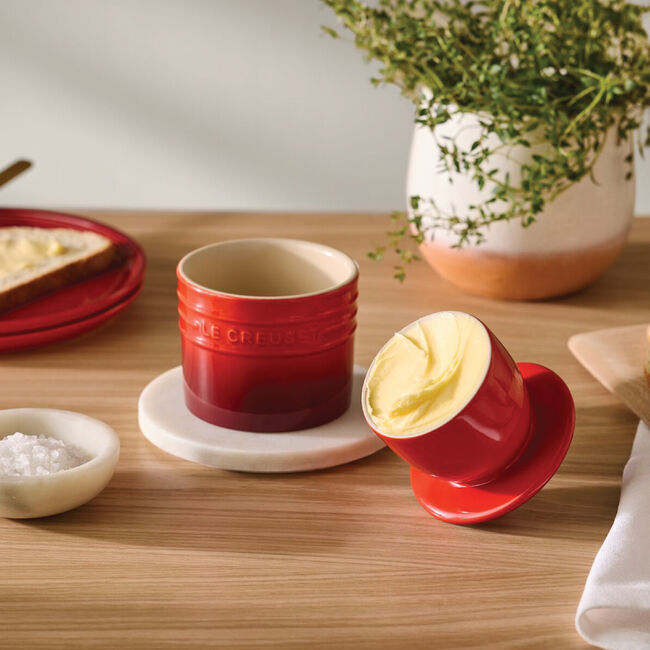
Does this butter bell require you to put water in it? Because mine does - that’s what keeps the butter from getting moldy. In our climate (NC) it’s important during the summer months to change that water out with cold fresh water every day or two.

Mine looks like this:

The only time I’ve ever had an issue with butter falling down is if it’s not soft enough when I put it in.

Anyway, back to ghee: one specific instance in which I like to use in in Western-style cooking is for Wiener schnitzel - the recipe calls for using half butter and half oil in the pan, but the pan needs to be fairly hot so the coating gets crispy without the inside overcooking. Regular butter will burn before I get all the pieces fried, so it works well.

I like ghee for certain recipes I have. I don’t use it often, but when it’s the right ingredient, nothing else will do.

I use it for many things already mentioned, so I won’t recount those.

I’m mostly chiming in to say that one reason ghee has a more concentrated butter flavor is because, in addition to tempering out the milk solids, you’re also eliminating the remaining water in the butter. So the “butter” flavor is more concentrated, but it’s less sharp without the acids. Almost nutty.

I leave ghee at room temperature – with the proviso that my room temperature is about 63F – and I try to use it up within 9-12 months. It doesn’t go bad, but I worry about it taking on off flavors.

First off, I should say that when it’s as warm as it’s been lately, I do keep it in the fridge. The AC doesn’t really cool down the kitchen and even frying an egg sends the temp up to uncomfortable. So the butter is in the fridge this week. Also, different butters melt at different temps. Irish butter gets soft very quickly, so sitting out for just 15 minutes softens it enough to spread (generally), and it usually spends its life refrigerated. American made butter is lower in butterfat by a couple of percentage points, so doesn’t get soft as quickly. I usually use American butter for frying an egg and save the Irish to put on pancakes or for a richer flavor in baked goods. Oh, and when it’s on the counter, it’s in a butter dish made for that purpose (with a lid). Our present one is a ceramic model.

Have you tried lemon-infused olive oil? It’s like crack. I use it on salads, breads, and even mix in a bit with butter for my popcorn. I also drizzle some on an avocado and mash it up with some salt, then spread it on a bagel.

I also highly recommend Graza Sizzle EVOO. A wonderfully earthy oil that is at the top of most critic’s lists.

If it’s like the ones I’m thinking of, yes. I believe they were invented in France.

If you buy cheap, you may be getting a product that has not been properly prepared. If there are any solids or water still in the butter after cooking it, it’s going to be more likely to spoil by the time you buy it.