Oh.
No, É.
(My prior post that Mangosteen missed was also an answer to you, and explains where the É sound came from.)
This reminds me of the title of a Danny Kaye baseball song. 

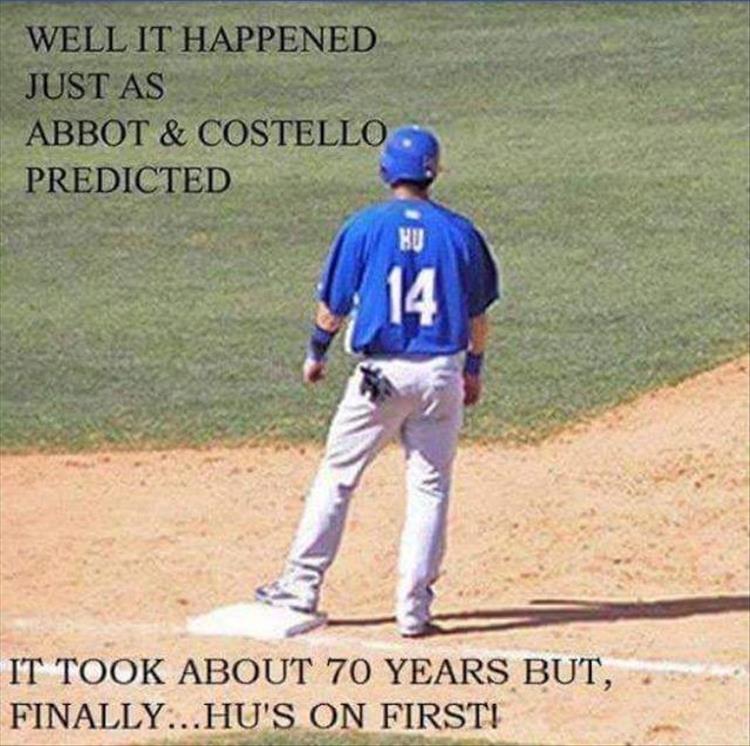
And the Abbott and Costello sketch would make a bit more sense for a Chinese baseball team, since Hu is a family name.
I never thought of that! 
FYI.
Yeah, I’m watching Yuri on Ice right now and 中国 seems to still be dominant.
When I lived in Japan that was how I’d see “China” written, and I believe the Chinese themselves use the same characters for the name of their country. They literally mean “middle/central country”.
I don’t remember ever encountering “Shina” as a name for China before, but a quick Google turned up a Wikipedia article saying this is archaic Japanese and is now considered offensive.
As general note to this discussion, maybe the point was made before but I didn’t see it: the Chinese and Japanese words for a lot of things, including the names of both countries, seem similar because they come from Chinese. The Japanese adopted the Chinese system of writing, and many words came with it. That’s what ‘kanji’ are*. In Japanese, Chinese characters are also used to represent indigenous words, in which case they have a different pronunciation than the one used when they represent Chinese derived words. But for example the Japanese name for Japan, Nihon, is the same as the ‘Chinese’ word, pronounced something like Riben in Mandarin, 日本, no weird coincidence that they sound somewhat similar. Same with 中國 for China in both languages, and lots of other words. One non-insidious reason though to use another word for China in Japanese is that 中國, chugoku, also refers to the region of western Honshu around Hiroshima.
Another twist is that some Chinese character pairings used as words in modern Chinese were coined in Japan. That’s true of a fair number of Western words in the political and technical spheres for which Chinese character equivalents were first coined in Japan in the late 19th century, like ‘democracy’ for example, or ‘destroyer’ (the type of warship). Also note that the China>Japan flow of writing/words sometimes went through Korea which modified some things. Likewise words which are Japanese coinages of Chinese characters are even more widespread in Korean than in Chinese. If a word is the same in Chinese and Japanese it’s almost gteed to be the same in Korean also, but in many cases Korean and Japanese share words where a different pair of Chinese characters are used, or the Korean/Japanese coinage is a less used option, in modern Chinese.
*the differences among modern Japanese forms of characters, traditional Chinese (which you can see I type in) and simplified PRC forms are comparable to the difference in Latin letters between say old Gothic and modern fonts: they are still the same letters, ie 國 and 国, ‘country’, are the same character, . There are a small number of kanji invented in Japan, but when/if Japanese say, as IME they sometimes do, that kanji and hanzi aren’t the same thing they are mainly hanging that on the technicality that the particular forms used since WWII are different. Prewar that wasn’t even as true, and that’s only a few decades ago.
Roderick Femm did actually cover this already.
It’s worth adding that “Japan” possibly also came from yet another pronunciation of the same two characters in a southern Chinese dialect, via Marco Polo.
In 1274, the Great Khan of China “declared his resolve to conquer the island” [of Japan]…
I had found the word Shina in The World’s Chief Languages, by Mario Pei, originally published just after World War II (70+ years ago); I had no idea the word had become “offensive.” The book also said that the Japanese name for Australia was Gōshū; however, I know someone who has a Japanese mother, and he says that that is an archaic name for the country.
Only 70 years:)
I am now envisioning you collecting faggots for your fire with your negro friend while listening to music on your tranny.
So funny I forgot to laugh. :rolleyes:
What’s more, my car’s transmission doesn’t play music. What kind of music does your car’s tranny play? 
We’ll call it a whoosh, then.
It seems to have became perceived as offensive due its use by the Japanese in describing their aggression in China as the ‘China (using ‘Shina’) Incident’, and general preference for the term by the Japanese in the militarist period. Historical Japanese language websites from Japan still use the term, I’m not sure how offensive it’s viewed as in that kind of historical context. But in general it’s definitely perceived as offensive. In fact in the recent controversy over pro-independence Hong Kong elected council members refusing to take the standard oath of office, at least one of them referred to the PRC in his own improvised oath by that term: it was intended to be, and succeeded in being, inflammatory.
Otherwise, there’s a trend in modern Japanese usage to no longer use the two Chinese character abbreviations (coined by the Japanese) for foreign non-Asian countries but instead spell them out phonetically in katakana. So you now rarely see 濠洲 Goshu for Australia, but rather just spelled out オーストラリア ōsutoraria, in katakana. Same with Ah-me-ri-ka instead of 米國 / Beigoku.
Far-right wing politicians in Japan, such as Shintaro Ishihara, the former governor of Tokyo, use “Shina.”
I never heard anyone use it in common speech.