Captain Steeeve with Cockpit transcripts. He says there were 11 instances of mandatory go-arounds that weren’t acted on. https://www.youtube.com/watch?v=Xm6G7EOP5Qc
A question for Commercial pilots. if the plane is on short short final with the nose below the horizon would that give a confusing visual perception of where the touchdown zone is?
I don’t think so. You can tell which bit of the pavement the aircraft is aiming for, i.e., the bit it will hit if you don’t flare, because that’s the bit that stays stationary in your windscreen. If the aiming markers are sliding down the windscreen you’re going high and if they’re sliding up the windscreen, you’re going low. Nose attitude due to excess speed doesn’t really change that except that the excess speed means you float past the touchdown zone once in the landing flare.
I don’t know what other companies do, but where I work we are provided with a diagram of the touchdown zone at every runway on the network. It shows the markings and their corresponding distance from the threshold along with an indication of where the ILS/GLS glidepath takes you (I >), and an indication of where the visual slope indicator (PAPI) takes you (V >). The acceptable touchdown zone is delineated with the red dashed lines. If we have not touched down by the time we’ve reached the end of the touchdown zone (in this case the start of the last markings, the 900m point), that’s a mandatory go-around, regardless of whether it’s a 3600m runway or a 1700m runway.

We know the markings at our regular airports but if we’re going somewhere that we haven’t been to for a while, the approach briefing will include a summary of the method of vertical slope guidance to be used, the expected touchdown point, and the point at which a mandatory go-around will be conducted, e.g., “I will use the PAPI, aiming for the start of the big blocks, and go-around if we’re not down by the start of the last markings.”
Other mandatory go-arounds on short final include seeing four whites or four reds on the PAPI, approach speed +10/-5 knots that isn’t immediately corrected, idle thrust, and not being configured for landing. The 767 guys would’ve had all of these at some point, most likely all at the same time, as they tend to go together.
Really helpful post - thanks.
Small question: why would idle thrust mandate a go-around?
I was going to post that last night, but I thought a pro could answer it better than I could… and you did.
A couple of reasons. Jet engines can be quite slow to spool up from idle thrust. In flight, the idle is maintained artificially high (flight idle) so that the response time is improved, but the engines are still much more responsive when already operating at a thrust setting appropriate for a normal approach speed. So high speed corrected with idle thrust can result in low speed and the engines being sluggish to respond. At 1500 feet that’s not a big deal but below 500 feet it can get ugly.
Additionally. the concept of a “stable approach” is that only minor adjustments should be necessary to maintain the flight path and speed. Idle thrust is not a minor adjustment and is therefore symptomatic of an approach that is either unstable, or is about to become unstable.
Nope. Or at least not at the time they noticed they were screwed and getting screweder.
In most Boeings you can’t deploy spoilers past the first (or somegimrs second) notch of flaps. So if you find yourself high & fast you need to figure that out early. Then gear & spoilers until you’re deep into the prrmissable flap speeds, then drop what little flap you can use w spoilers, stow spoilers, and continue dropping flaps as you burn off speed.
Also, if you drop a notch of flaps up near the limit speed, it’s a long slog to slow enough for the next notch. I forget the specifics, but the 767 had one increment where you needed to slow a lot before you could add the next. Which slowing was excruciatingly slow while sliding down a 3 degree glide slope. And worse w a tailwind or if you’re also steep.
Smart thing is instead to get to the bottom of a flap speed range and get lots of lift drag at high AOA Then hang the next set of flaps and again try for max AOA = max drag at that setting. Lather rinse repeat until all 5 or 6 notches of flaps are out & you’re down to approach speed.
Richard_Pearse:
You can tell which bit of the pavement the aircraft is aiming for, i.e., the bit it will hit if you don’t flare, because that’s the bit that stays stationary in your windscreen
Thanks for your in depth explanation. It’s the stationary view in the windscreen that drove my question. A stabilized approach is nose up. The view is not based on depth perception because that deteriorates significantly after 30 feet. Pilots learn to judge perspective based on a certain view of the runway and that occurs with the nose up. It’s going to be a different view if the nose is down. More of the runway is in view. I think it might give the feeling that the plane is lower than it is and create a disorienting event. This is such a major screw-up that something must have influenced a rejection of all that information.
I’m guessing the Captain was flying and the FO was calling out factors for a go-around. I think if the FO was flying and the Captain was making the same calls then a go-around would have been initiated. To me this sound likes Tenerife all over again.
Ummm?
Tenerife was an overloaded divert airport having planes both taxiing & taking off on a foggy runway. No one landed long & all deceased were on one of the two planes on the runway, not on a road outside of the airport grounds. Other than that, they were very similar in that they both involved an airplane.
I haven’t heard anyone state that a misunderstanding on the radio is was a cause of the crash in MIA last week.
In a totally non-surprising move Amazon [pauses operations with 21Air](https://www.reuters.com/business/retail-consumer/amazon-pauses-21-air-operations-after-miami-crash-wsj-reports-2026-09-14)
I know how to do a hyperlink, no idea why it showed up borked like that
During the approach the entire runway is visible through the windscreen regardless of AOA; none is hidden below the nose. For sure in a high speed low AOA situation the impact point will be sitting unusually high in the windscreen. And yes, the threshold will eventually disappear under the nose, but that’s at around 150 feet AGL on a nominal approach.
It was clear to me that Magiver was referring to the possibility of a Captain in a hurry to get the job done fast, overriding the concerns of the other pilot.
NM. JKellyMap got it.
Keep in mind I’m not married to this idea but the low AOA is a DIFFERENT view that visually mimics a lower approach in a normal nose-up attitude. Pilots have no functional depth perception and rely on past experience of what a normal approach looks like.
I’m just gobsmacked that it got so out of control and am looking for one of the factors that made a bad approach worse. This runway was functionally 8k ft long which cuts down on the wiggle room for this plane. Throw in a tail wind on top of the 30 knots of excessive speed and a really bad approach goes to stupid in seconds.
And the FO being apparently unwilling to question the captain’s decisions, at least not forcefully enough.
Once you’re over the threshold and have commenced the flare you’re just trying to land it. The nose low attitude at this point is a BIG give away that you’re way too fast but it doesn’t really affect your perception of the runway.
I think the captain was just committed to landing for some reason.
I think you’re also correct that if the FO had been flying (I don’t think they’ve officially said who was flying, but it’s a reasonable assumption it was the captain), the captain would have been more likely to command a go-around.
100% agreement there.
This was wrong 12 miles ~= 4 minutes before the runway. And stupid at 5 miles ~=2 minutes. They were already committed to go around or almost crash by then. They just didn’t notice. At 3 miles ~= 1 minute they were in worse shape: it was go around or crash, period. In a fit of seeming obliviousness, they chose crash.
The die was cast by 3 miles ~=1000 feet. Any attempt to land from where they were was doomed; exactly how & where the airplane / wreckage would quit moving was still TBD, but the outcome was a given. Shame they didn’t notice that.
A question for Commercial Pilots. If the FO decides he prefers living, how much of a fight is possible to initiate a go-around. He had all the data to back up the decision.
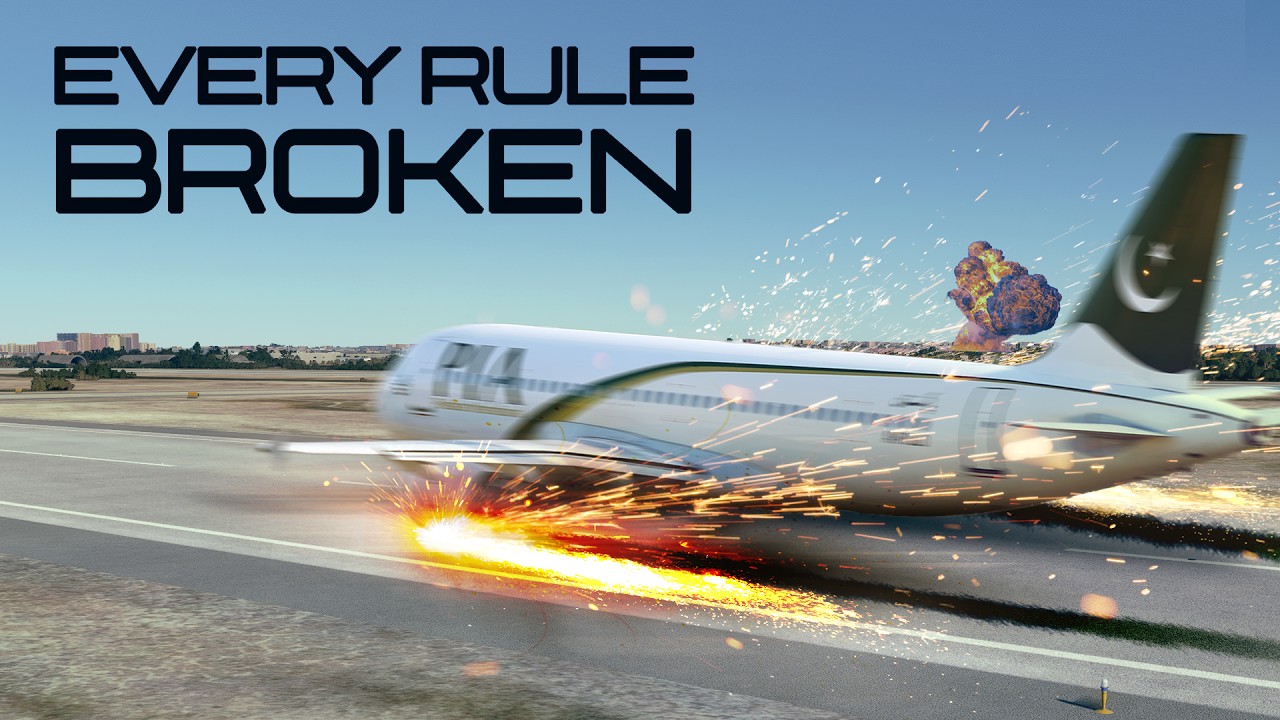
This incident was similar: a captain with get-there-itis forcing a fast, steep-descent approach, and a FO who preferred a go-around. In this case, there was poor communication, so neither or both were flying the plane at critical moments – leading to a gear-up (belly) touchdown.
--INT: PLANE COCKPIT
PILOT #1: Oh wow, I really hope we don’t have a crash.
PILOT #2: Me too.
PILOT #1: But they say it’s safer than crossing the road!
PILOT #2: Yes, but we have to do that too.
PILOT #1: Best not to think about it.
–EXT: OUTSIDE HOUSE
RICK: Oh no! That plane is going to crash on us!
[Shots of each of the four lads looking up: MIKE, RICK and NEIL with concern, VYVYAN with excitement.] [KA-BOOOOM!] [Cut to black.]
Had to look it up. The Young Ones, pilot episode (no pun intended). Will watch!