The recognition comes very late. It takes time to see it, decide to punch, move your body into position while still under g-load, and pull the handle. Then, as @Johnny_L.A said, the seat has to have time and altitude to do it’s thing. And they’re well short of 100% reliable when measured against the goal of returning you to the ground without major injury.
The whole time you’re doing that, the maneuver is getting worse and the ground is getting closer. Lotta ways to see it late, not think about punching, pull for all the jet’s worth and that’s either enough turning to clear the ground or it isn’t.
As always in aviation, the real cure is not cure, but prevention. Knowing that it is inherently very difficult to see the point of no return until you’re well past it, the fix is very diligent use of instrument parameters, not seat of the pants “it looks like it’ll fit”.
This particular case was a bad one in that it looked real solid until he was fully inverted then the slow roll turned into more of a barrel roll. By then there was almost no fixing it.
It’s not clear that Boeing has even defined the inspection procedure in detail yet. All the FAA EAD & proposed AD say is “Inspect according to a method approved by FAA management”. Which amounts to “Do the work cards Boeing will make up. Whenever you get them.”
This accident happened a few miles from me a couple weeks ago (Nov 10 2025) but wasn’t posted here at the time:
Overhead view of the approximate location. The airplane apparently missed all the houses, skimmed some trees, and ended up in one of the nearby ponds. From the various pix available I wasn’t able to figure out which specific house and which specific pond.
The departure airport is about 7 miles to the south-southeast. At King Air speeds, they weren’t airborne long.
The NTSB CAROL database has an entry for the event, but no reports yet. The NTSB event ID is WPR26FA040.
The weather was decent. They got far enough it wasn’t something like jammed controls, forgotten control lock, etc. One of the loose bits of wreckage looks like a nosegear to me. Gear for sure in any case. Strongly suggesting the gear was extended. And they were too far from the airport for it to have been plausibly left down after takeoff, so it almost certainly was re-extended. Which further suggests they were attempting a forced landing. Which suggests dual engine failure; a B100 King Air flies pretty well on one engine. The ways to have dual engine failure close together in time are pretty much empty fuel tanks, fuel tanks with the wrong fuel (e.g. Avgas) in them, or fuel badly contaminated with water or other gunk.
It’ll be interesting to see what little NTSB will have to say once their prelim comes out. Good bet there won’t be much more info released after that.
I saw that on the news. There was a big tumble splash into the pond captured on someone’s backyard camera; amazing that it went between the houses given how close they are. I also heard the divers couldn’t find any bodies but also heard something about they found body parts on the ground, which would indicate a ground strike, which is probably not consistent with the video & lack of damage to the houses.
That was when the Clipper rolled thru up here. While it was cold (training) in, & even worse, getting changed after getting out of the river that night, at least I wasn’t worried about alligators while I was diving.
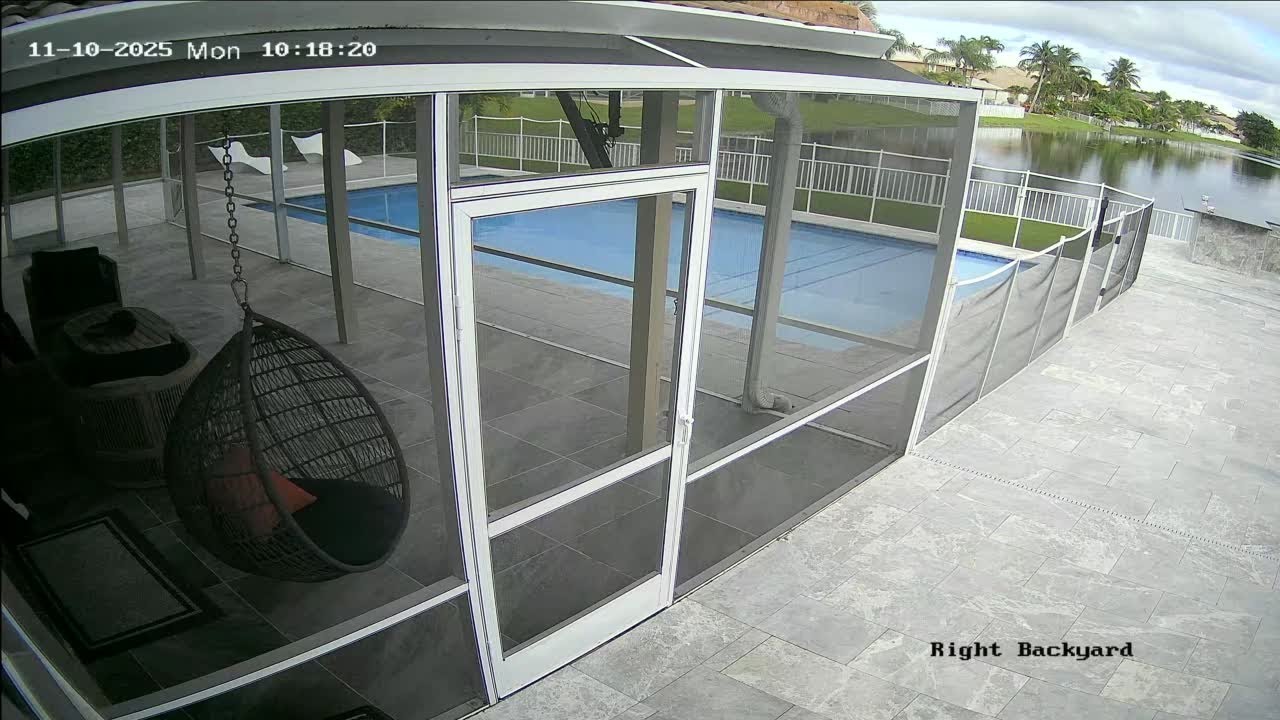
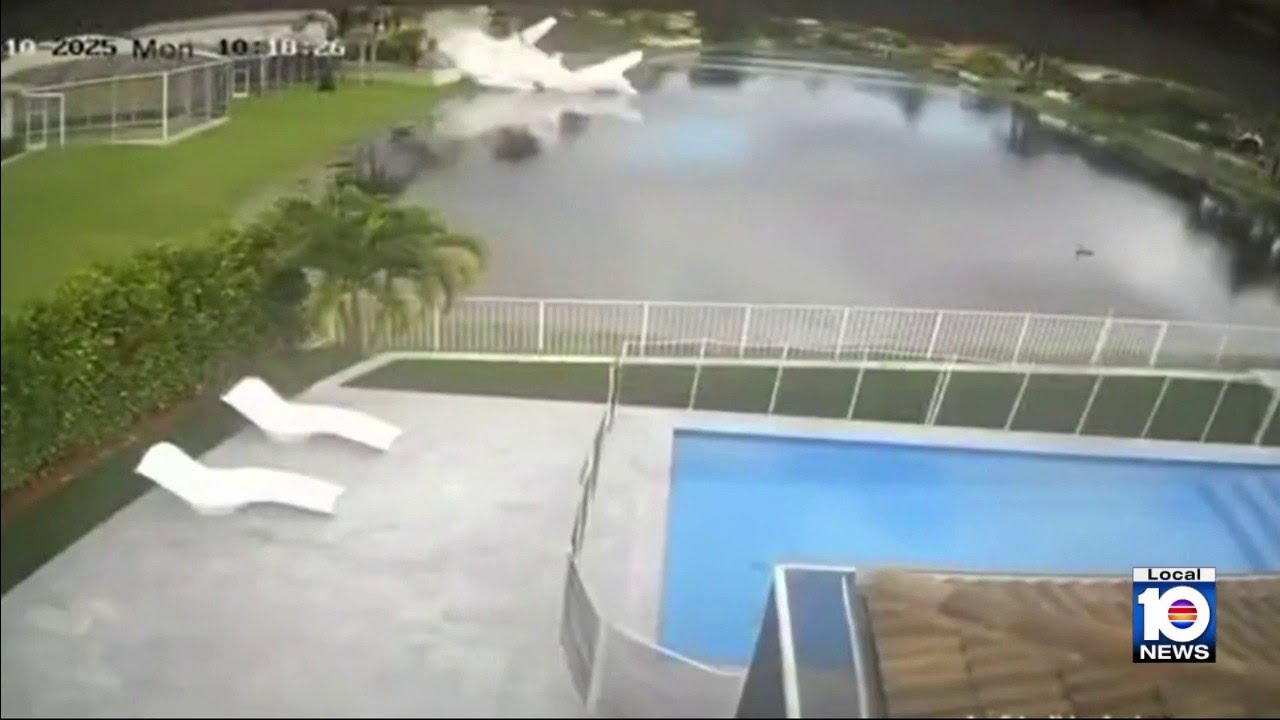
Thanks for the additional details. This is a well-cut vid of the surveillance footage from a neighboring house:
Which gave me enough background to pinpoint the house whose backyard got clipped by the crash. Although unlike the Google pic, that house’s pool was empty at the time of the mishap:
The house with the surveillance cams is the one with the plain rectangular pool at the south end of that short north-south pond.
As to the mishap:
They were in a rather steep dive, 45+ degrees. Not at all appropriate for a forced landing. And I WAG they were going a lot faster than approach speed. They also had at least 45 degrees of bank. All of which suggests loss of control for whatever upstream cause followed by random plummet to impact. Stall / spin? Single engine failure mishandled? Incapacitated pilot and scared non-pilot sitting in the co-pilot seat? Cargo shift and CG suddenly out of limits? Snakes on a plane?
My initial thoughts a couple posts ago about a dual engine failure then botched forced landing seem irrelevant to what I’ve now seen.
It seems they came down close enough to vertical to clear the 2-story house, plow down those 3 palm trees, and impact the backyard about where the fence around their pool was. The crumpled mess then plowed the last 10+ feet into the water and finished shattering there. The impact marks shown in my first cite make a lot more sense given this extra context.
If somebody wants to watch a news report with some good info but also a lot of yak-yak, this is pretty comprehensive:
I had not seen your top linked video; clearly it came down steeply from that video; from whatever other video I saw, I thought it threaded the needle between two houses.
That pond is probably 5-8 feet deep. The underwater visibility is about 3 inches before the impact stirred up the muck at the bottom. Then we add 3-1/2 tons of very sharp torn aluminum, and a couple tons of kerosene.
All that suggests to non-expert me that putting a human in there in a rubber suit is just asking for a maimed or dead rescuer. ISTM, again non-expert, that they’d want a hard-sided suit or an ROV for that recovery effort.
If I was a diver I would be wearing cut-resistant gloves and any other similar accessories. If sonar shows a fuselage then the goal would be to hook up to it and drag it out of the water with a winch. Drain the pond and recover parts for examination.
As for the accident, I doubt there was a weight issue. I would guess the packages were not heavy and consisted mostly of medical items. It’s counter productive to haul cans of food in a small plane. The seats were likely pulled to maximize the load.
It looks the pilot was turning back toward the airport. There should be plenty of security cameras that caught the events as they unfolded.
Go back & reread the last paragraph in my 11:22 post; remember, I am a rescue diver.
We dive in dry suits, but that’s as much, if not more because they are PPE that for temperature, but they keep us dry & warm, as well. In the river last week I could not see my hand 3" in front of my face; especially when going downstream (when the stirred up sediment is traveling with you. It was slightly better when moving upstream.)
Rescue divers are trained to do all searching by feel, basically lying on your stomach sliding one hand/forearm across the bottom while your other hand is holding your tie off line, & then moving in the desired direction.
One body in the water means a minimum of four people, including a primary diver, a backup diver, & a 90 percenter, named that because they are 90% suited up & ready to go. Much like a RIT team on the fire side whose job is to find/rescue disoriented/lost or injured firefighters, the 90%er doesn’t do anything unless the primary is in trouble. In our company we dive with a primary system & a pony bottle on a separate regulator so that if anything happens to my main system I have a fully redundant one with the spare regulator on a necklace around my neck just below my chin. If needed, the 90%er needs only to put on their mask & enter the water. They are also carrying an extra full bottle & reg set to give to the primary so he has more air while they work to remedy any issue, like being caught up in a fishing line or othet underwater obstacle.
Even if there is jagged metal, at the slow speeds we are moving at it would probably result in a bump, not a cut.
Draining a pond may not be cheap or easy, especially if it’s naturally fed; who is paying for it? There may be other logistical issues - can you get a tow truck or crane into those backyards as the homes look kind of tight together. What is a piece blocks the suction?
Good find, thank you. That was a fairly large hunk of wreckage.
FTR, the name of the city is “Coral Springs”, not “Cold Springs”. Although the newscasters, and most locals, slur that into “Corl Springs”, so it’s easy to mis-hear.
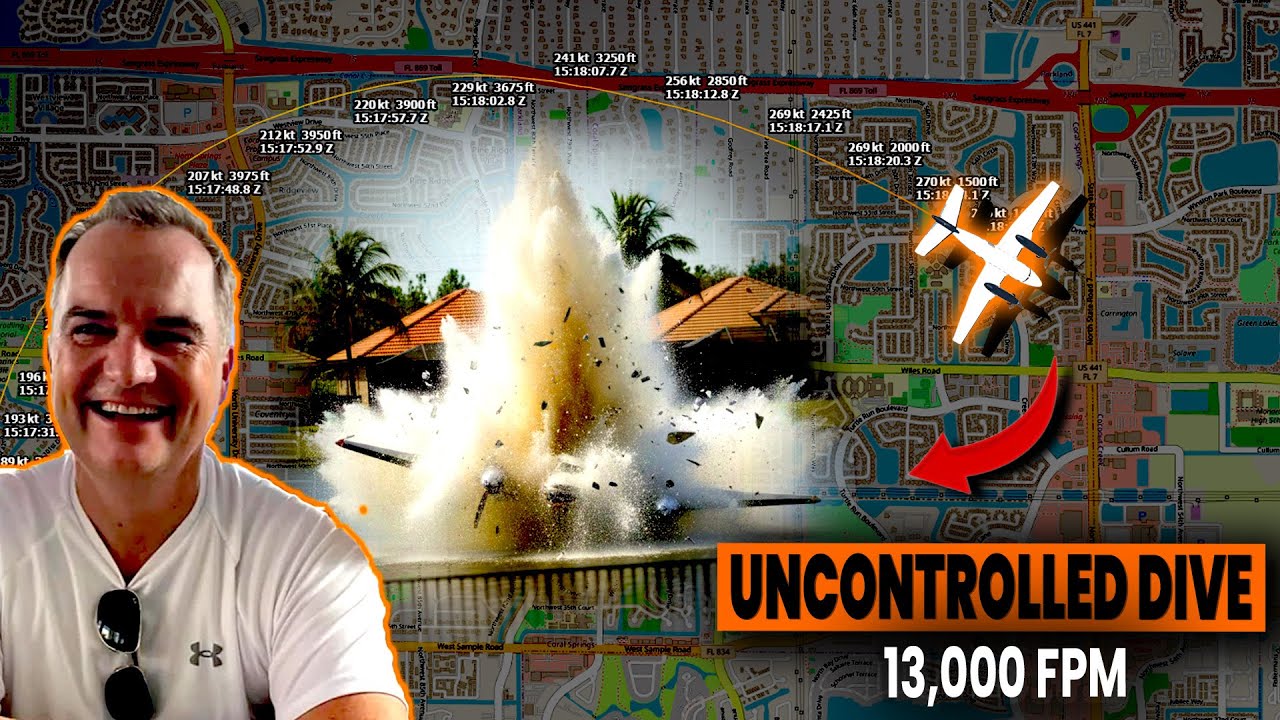
I found this analysis. It’s about 3 minutes of good info packed into 14 minutes of narration. But the short version is the airplane was new to them, had been extensively overhauled ending just a week prior, and they were flying normally and complying with ATC vectors when they began a mild uncleared descent then pretty well fell out of the sky from their current ATC-cleared altitude of 4000 feet MSL = AGL. Those vectors did point the airplane generally towards another airport, but there’s no evidence either ATC or the pilot was thinking about an emergency landing; that’s just how the traffic flows work out in a metro area with lots of large and small airports.
Here’s a minor complaint about the vid that I see in many of these kinds of armchair analysts. They get their recordings of radio transmissions from hobbyists who maintain scanners near the airport. Very often ATC’s radios are loud and clear from the location of the scanner’s antenna. And very often the aircraft transmissions are not. Long distance, low sight angle, lower power aircraft radios, noisy cockpits, etc. That much is physics and completely understandable and expectable.
The commentators then assume that since the airplane’s transmissions were poor to unreadable to the scanner, they were also unreadable to ATC, and that that unreadability is a specific sign of some problem on the aircraft. Mostly nope. That’s a sign of a scanner with an inadequate antenna and/or inadequate receiver sensitivity. Since any given commentator doesn’t control the scanner, there’s nothing they can do to remedy that. But they ought to include that limitation in their thinking and explanation.
Draining a pond can be very different than draining a basement.
1 Significantly larger volume of water
2. May be fed from some source, if so, one would need to dam the source otherwise water may be refilling it as quickly as it’s being pumped out. One can’t just put a sheet of plywood across the fill creek & call it done; either it’ll go around your dam or it’ll backup, creating upstream flooding. If it’s a pond with inflow & outflow, you’d need to create a small channel for the water to continue flowing thru while draining adjacent areas of the pond. There are (marine dredging?) companies that do this but I wouldn’t even have a clue who to call to get someone to come out, much less on an emergency basis. Would they even come out without some upfront payment or at least reasonable assurances of being paid (there should have been insurance on the plane but was there an active policy?)
Ultimately, the bills should be paid by the plane owner’s insurance. Assuming he was married, his wife is now mourning the loss of her husband & child & planning two funerals; her highest priority is not trying to figure out insurance details on he may have owned & used but she wasn’t necessarily a part of. If he was not married, you’d need to figure out next of kin & who is administering the estate before anything can be done.
I have no clue how FL handles paying outside parties for emergency response.
That really is very similar to AA191 and both accidents were caused by failed pylons that had developed cracks. But AA191 was caused by using a non-standard shortcut when servicing the engines, where the engine and pylon were removed as a single unit to save time and money. The non-standard maintenance shortcut had been adopted by AAL, Continental, and UAL.
IIRC the pylon was damaged by a forklift and an aggravating factor was a shift change at just the wrong time, the forklift damage creating a crack in the pylon that worsened over time. To prevent damage to the pylon, the forklift had to be positioned very accurately, and furthermore, the shift change caused a delay that allowed the forklift support to sink slightly due to loss of hydraulic pressure.
The proximate cause of the cracks in this situation was different. The report says it was a combination of fatigue cracks and failure due to overstress.