Not a whole lot of opportunities for that. I have seen a Piper Aztec on floats, but it was a one-off.
There are some Gooses, Widgeons, Mallards, and Albatrosses around, and currently produced water bombers like the CL-415.
“Da plane” in Fantasy Island was a Widgeon, which only holds 4 passengers (plus one pilot, not sure was ever shown)
Brian
I’ll see your Aztec and raise you a DC-3.
Great video. I learned something new. That plane was one of the first, if not THE first to have a remote engineer’s station. They communicated with the pilots via a light panel. In the video you can see the light panel (interphone signaling system) mounted in the center of the common yoke.
UPS MD-11 preliminary report is out. The photo sequence attached gives a fairly clear view of what happened. For some reason the link to the PDF report isn’t working for me anymore.
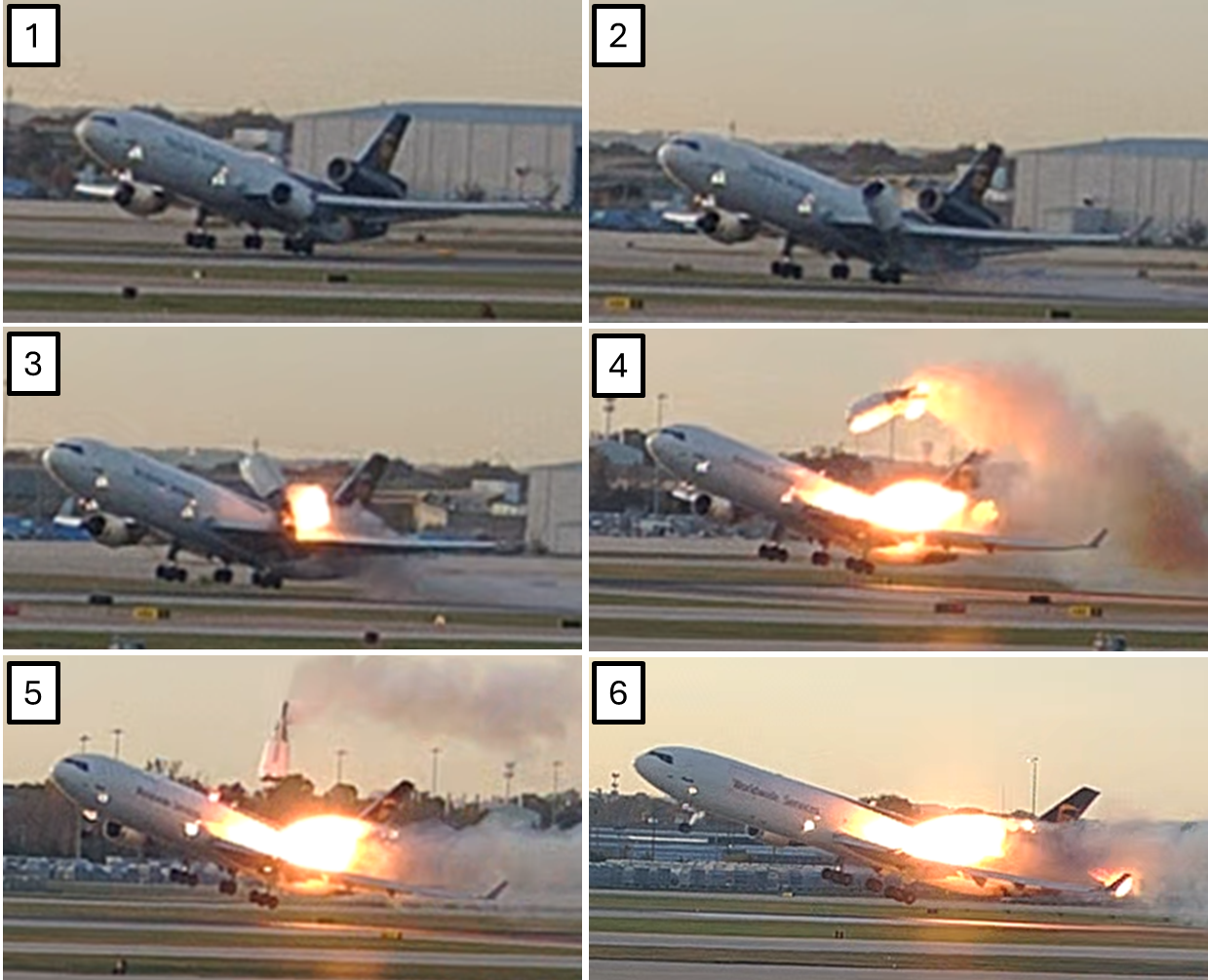
Damn at photo #2 
These photos are harrowing.
Damn, but that looks like what I’ve read and seen about AA 191 that crashed in Chicago so many years ago. The left engine came off, went up and over the wing, and damaged the hydraulics causing flaps and slats to retract. Someone correct me please if I’m getting any of that wrong.
The NTSB investigated that and published their findings for the aviation world to see. It would be especially tragic if another plane crashed because of the same cause.
Report link is working again.
TLDR: They found fatigue cracks in the failed aft pylon attachment of the number 1 engine. There’s no discussion on any subsequent effects of the failure (eg hydraulics, second engine failure, etc).
Naw, photo #4
I’ve seen photos of NASA planes intentionally launching things (lifting bodies, rockets, etc.) with a lot of flame behind them from under a wing
Yeah, that’s remarkably similar to AA191. Hence the grounding of the DC-10s too.
Having any engine fail/fall off just as the main wheels leave the ground is about the worst case situation, and that’s before you consider any wing or tail damage or …
Just from a flight dynamics POV, you’re just transitioning to flight, you’re aiming for an all-engines nose-high attitude, and you’re mentally transitioning from steering looking at the runway to staring up at blue sky with no view of the Earth over the nose as you’re switching to instruments.
We can see the airplane is already rolling to the left from at least thrust asymmetry, plus possibly control or slat problems developing on the left wing as well.
Separate issue:
Photo #6 appears to show a burst of focused flame from aft end of the #2 engine as well. It’s directly behind the left wingtip winglet from our POV. Good eye there @Magiver, for seeing that in earlier less obvious footage.
I find it a little hard to believe #2 could have picked up debris from #1. It’s a long way laterally and not that much farther aft. The debris field probably won’t spread that far that fast. Especially propelled only by mechanical tearing, not some sort of chemical explosion.
OTOH, when the engine came off, its rotors were spinning with great RPM. That plus the engine pivoting upwards as it tore loose suggests all kinds of wild gyroscopically-driven shenanigans will be next. The actual path through space of the bulk of #1 could have gone damned near any screwy corkscrew path.
Another possibility is we’re simply seeing some of the leaking unburned fuel being ignited by #2’s hot exhaust. Sort of an uncontained afterburner. If so #2 may well have still been operating normally and we’re just seeing something coincidental, not a material part of the accident causation.
damn, that nr2 pic really looks like an ill attempt of torque-vectoring a jet-airliner …
That’s what I was looking for. Information on number 2 engine. The PIC was able to keep the wings level by what I would assume is use of opposite rudder but nothing on the thrust output of # 2 engine. Why couldn’t they gain just a little altitude?
It was a surprisingly detailed initial report. I assume the spherical bearings allow the engine some torsional freedom to move under load.
I was also surprised that then engine came off intact because the cowling was found on the opposite side of the runway up-field. I thought that maybe the by-pass fan grenaded and tore the cowling off.
That was my initial impression too. Or forward bearing failure. My guess was the fan fell off and took the core with it as a side effect. Not the different other sequence we see in the pix.
3-engine airplanes have, by the certification standards, very marginal performance with 1 out. Much worse than 2 or 4 with one or two out. Just a quirk of the regs. You’d think that losing half the thrust on a twin- or quad-jet would be far worse than losing 1/3rd on a tri-jet. Not so.
Assuming #2 was running fine …
Had #1 failed earlier, like post-V1 & pre-Vr they’d have held the nose down, gained more speed well beyond Vr before roitating, and then as the far end of the runway was approaching, rotated to the very low engine out pitch target.
Because it failed just after the mains broke ground, they were mentally committed to the all-engines pitch attitude and already most of the way there. At the instant of failure the ideal move (something almost certainly never rehearsed in a sim) would be to push the nose down immediately to the engine failure liftoff attitude. That’s not what happened, and I’m not surprised by that.
Then they promptly mushed, unable to accelerate or climb, right into that building. The moment they began having ground contact, the speed trend was nowhere but down, and they were promptly pulled out of the sky into the buildings.
Assuming the slats stayed deployed, and had they also cleared that very first building, then they may well have stayed airborne long enough to get a few hundred feet away from the ground. The raging unstoppable inferno halfway out the left wing would then have been the limiting factor on how long they could stay airborne. I doubt they bring it around for a safe landing 10+ minutes later. But they may well have survived enough to accelerate and clean up then start back around the pattern towards a landing before the left wing started failing from the fire.
All the above is assuming #2 was running fine. If it too shit the bed, well, … there was nothing to do but ride it in.
We used to practice 2-engine out in the 727. One fails on the runway, so a normal engine failure rotation, takeoff, and initial V2 climb to cleanup / accel altitude. Partway through cleanup, another craps out. That’s the earliest in the sequence that you can survive to fly a traffic pattern and land on one. Upon reducing thrust at the final approach fix to commence the approach, you’re committed to touchdown. There is no go-around.
Single engine ops on a trijet is better than the high/hot light piston twin augmented glide to a crash. But not much better.
Been there. Nothing like looking back and seeing the leaves blowing in the prop wash of the remaining engine. That was in a plane up-modded to 25% more power. The original set-up would not have cleared the trees.
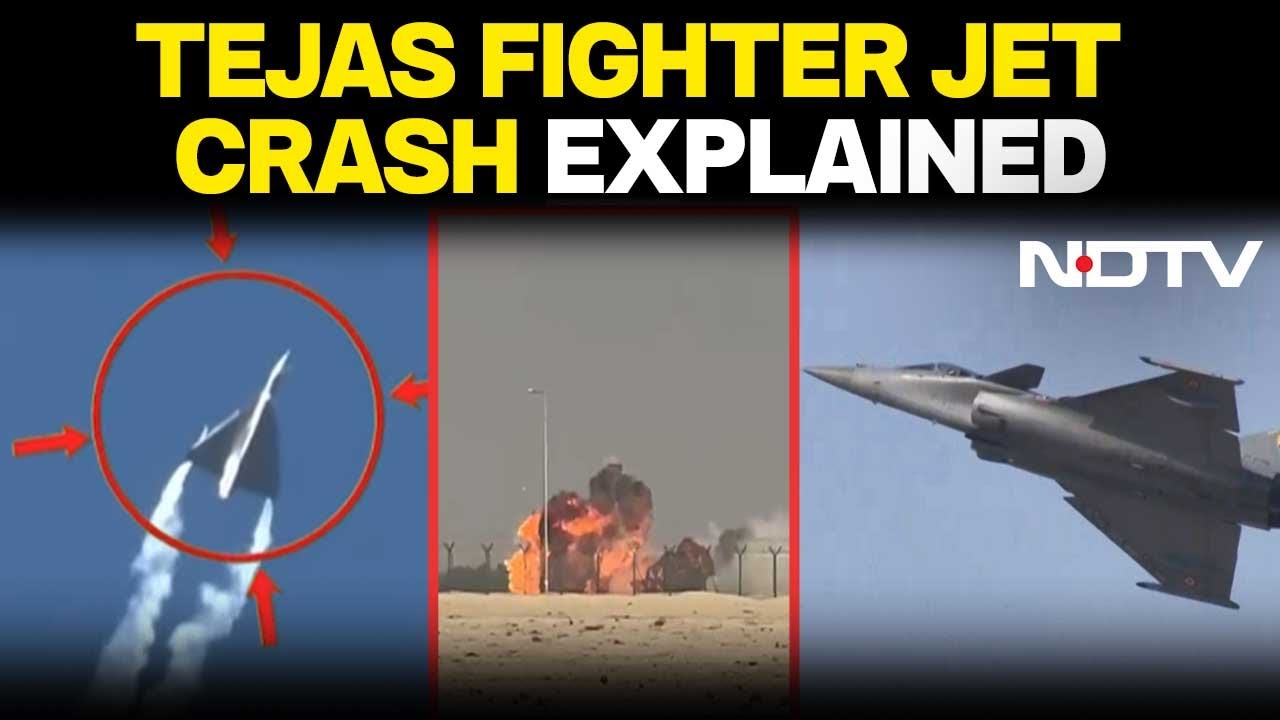
Indian Air Force HAL Tejas fighter crashes at Dubai air show.
Video of the crash here:
Without more extensive vid than @Alessan cite it’s hard to tell, but my take is this bit from the NBC / AP article is misleading nonsense:
The plane appeared to lose control and dive directly toward the ground just prior to crashing inside the grounds of the airfield.
That looks very much like your standard finishing a loop-like maneuver too low and realizing too late that you’re going to not clear the ground. Then starting a last-ditch pull to max Gs, but it’s too little too late and you pancake into a splat.
Nothing there looks like “loss of control” nor like “dive directly towards the ground”.
ETA: Much better vid here:
In it we see the airplane starting mostly level to perhaps slightly descending while performing a knife edge pass. Hard to tell about descent due to the perspective shift. They then roll the long way (270 degrees) to upright. Which after the inverted part begins to “dish out”, meaning losing altitude undesirably and probably unintentionally. Near the end of the roll at just about upright we see the pilot realize the situation and pull, but it was already too late.
What was supposed to be a constant altitude flight path turned into a descending corkscrew. This is called “falling out the bottom of a maneuver.”
The end of that looks just like the one I saw at MCAS El Toro in 1988.
I always wonder why the pilots don’t punch out. At the skill level they’re flying at they should be able to recognize it. Maybe they’re blacking out from the G’s.
Just guessing: The upward thrust of the ejection seat rocket isn’t enough to overcome the downward velocity of the aircraft & pilot. Or, the pilot is sure he can save the ship.