the color-scheme might hold the answer to that question…
Ha! Took me a minute (typo “stipes” for “stripes.”) The only thing I could think of was a lyric from “Driver 8”:
The power lines have floaters so the airplanes won’t get snagged…
(I later learned they’re actually there to avoid cables or wires bumping into each other in the wind, which could cause an electrical short…but it is poetic.)
My bizjet doesn’t have that autoland feature, but it does have something similar called Auto Descent Mode. It’s a hedge against pilot incapacitation, mainly aimed at hypoxia induced by a pressurization failure.
Certain conditions have to met including the plane being above 30,000’ and the auto-pilot being on. If the system detects a cabin altitude above 14,500 it initiates a descent, through the auto-throttle, down to 15,000’. This is a compromise altitude - good enough to breathe and hopefully regain enough consciousness to slap on the O2 mask, but high enough that you probably won’t hit anything.
This is what sounds similar to the Garmin system. If ADM is activated it will conduct the descent without regard to terrain, weather or TCAS detected traffic. All the usual warnings and alarms would go off, but would get no reaction from the automation. In this way, it isn’t really a “smart” system. Rather it’s a hedge against an unlikely, but deadly scenario (remember Payne Stewart?).
Also, ADM can be deactivated if one of the pilots wakes up. All they have to do is turn off the autopilot or select a new mode. We teach new pilots not to do that until after they’ve gotten a few good breaths from the mask.
All this to say, these last-ditch systems are getting more and more capable. But if there’s any sort of standardization to the logic (and I’m not saying there is), they seem to be including a way to interrupt them.
I’ve not flown a jet with the emergency descent / hypoxia button but there’s a lot of talk of adding / retrofitting that in the immediate future. And/or adding the “Pilots appear unresponsive; auto-initiate the hypoxia descent protocol” features.
Which are probably good ideas. They’ll very rarely be used but they will deliver a save from disaster when they do.
Airlines love software gizmos because they weigh nothing and so don’t add to operating costs. Unlike hardware that always weighs something and therefore costs a few cents per mile for every mile for the life of the jet. Which cost can easily exceed to cost of developing and installing the gizmo itself.
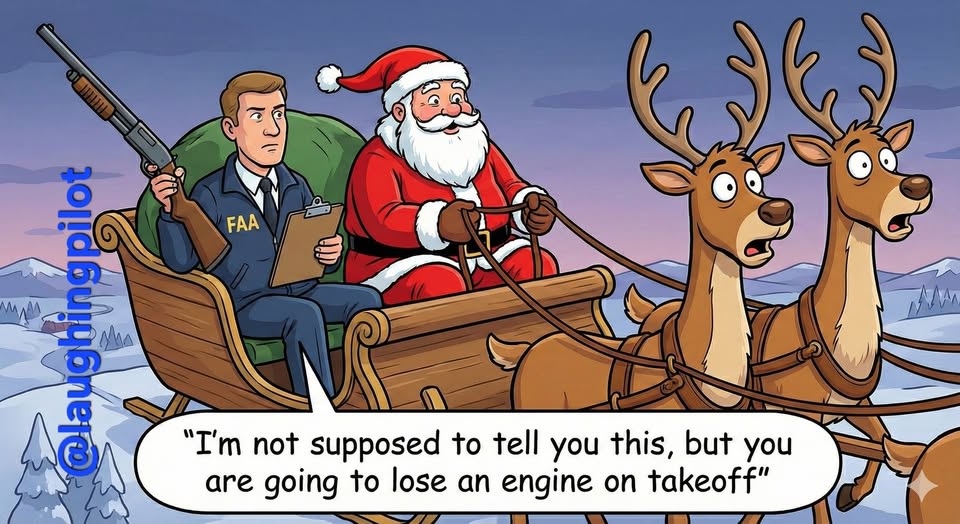
“As every year the FAA, despite government shutdown, decided that Santa and his sleigh had to demonstrate they were able to operate safely in US airspace. The appointment was made, Santa, the sleigh and his reindeer his Dasher, Dancer, Prancer, Vixen, Comet, Cupid, Dunder, Blixem as well as red nosed Rudolph were ready for the test, the inspector arrived on time. As every year Santa looked at him with a suspicious look and couldn’t help to detect a rifle well hidden under the inspector’s coat and thought, oh, not that olde procedure again! Full of power the reindeer began to pull and accelerate the sleigh for takeoff. When Santa rotated the sleigh for takeoff all reindeer suddenly stopped pulling…”
Includes links to previous Christmas stories.

Flying Wing next to early B-36 without jet engines added.

This gives an idea of the size of the Northrop YB-49
Helo mid-air outside of AC, NJ; one fatal, one w/ critical, life-threatening injuries
Initial story here & here
You don’t see Enstroms very often.
I’m reminded of an Inspector Clouseau bit:
Butler: That was a rare and priceless Enstrom!
Clouseau: Naaahht any meeehhhrrr.
Midairs are always a bad way to go. Sorry for them and their surviving families.
Sad that they were all scrapped. How cool it would’ve been if they at least saved one for the Air Force Museum. The Castle Air Museum has a few chunks on display:

my thoughts exactly. They could have parked all of them in a bone yard for little or no effort.
Historical preservation was not a big idea in the post WW-II era. Businesses don’t care and government didn’t need to. Damned shame.
History now, other than for online artifacts, is little better preserved. We don’t learn.
I saw something unusual the other day. I was looking at random planes on flightradar24 and saw a 747-400F. Nothing unusual except it showed no data related to the plane. No origin, destination or registration. I could track it’s flight on the map but that was it. It didn’t even track out of the origin airport but I could tell it was LCK because of the altitude and location of the plane. It’s mostly a freight airport. It flew to JFK by way of CLE. It went to a freight ramp in JFK.. I’ve just never seen a commercial plane flying incognito.
The other pilot died yesterday. There was video on the news of one of them spinning down out of the sky, as in no working tail rotor.
Possibly a non-military government flight of some sort?
Even sensitive military aircraft identify themselves on some level.
Something a bit strange [i am thinking of so many instances where the pilots didn’t realize other aircraft was near them]:
Two men who died after their helicopters collided midair in New Jersey over the weekend both earned their private pilot licenses over a decade ago and would often have breakfast together at a cafe near the crash site before taking to the skies from the local airport.
Authorities on Monday identified the two New Jersey men as Kenneth Kirsch, 65, and Michael Greenberg, 71.
The pair had dined at the cafe together prior to collision.