It sounds like they were flying in formation.
Perhaps. An alternate explanation is they both took off separately but both flying to the same destination via approximately the same route.
Both assumed the other was nowhere nearby until suddenly they weren’t.
Back when I used to fly the Grand Canyon, the several competing “airlines” (read fly-by-night air tour operators) would launch 10 or 20 airplanes as fast as the tower would clear them for takeoff. Mostly various models of Cessna 402 plus a few PA-31 Navajos. They’d all launch off from Grand Canyon (GCN) and fly the exact same VFR eyeballed route to the exact same destination (Then-McCarran LAS) at the same VFR hemispheric altitude.
You would see a lot of airplanes randomly converging towards another, or slowly passing one another. It’s real easy to have all eyes forward, and nobody aggressively clearing their 3 to 5 or 7 to 9 o’clock regions. And the region from 5 to 7 is simply not visible from the cockpit. Nor is the area more or less directly above or below.
I never saw or heard of a midair. But IMO it’s a miracle they didn’t happen. “Big sky little aircraft” doesn’t work all that well once commonality of mission herds them all into a small sliver of sky.
Just now read of an interesting 737 accident that occurred in Vilnius Lithuania in Nov 2024. Swiftair Flight 5960 - Wikipedia. The Preliminary accident report is a pdf here:2024-12-18 Boeing 737-400SF EC-MFE Interim Report. The preliminary report sets out the salient facts but offers no conclusions.
Wee hours, snowy night in Europe with clouds and icing everywhere, reasonably high time Captain monitoring & newbie FO flying. The Captain was a management pilot and didn’t fly very often.
It’s a short & busy-ish flight. They’re doing fine until partway through the descent when they make an unnoticed switch error. They intended to turn off the engine anti ice, but instead turned off the B system hydraulics. The switches look & feel the same and are adjacent on the overhead panel above the FO’s head. Fine 1960s ergonomic design. Since the FO was flying the B-side autopilot was in use and when they turned off its hydraulics it disconnected with the usual alarm. Which they immediately noticed, and after the autopilot refused to reengage the FO began hand flying. For whatever reason they didn’t troubleshoot why the autopilot had dropped off.
I personally have had this happen. My FO was flying and chose to turn off their own anti-ice rather than asking the pilot monitoring = captain = me to do it. They reach up by habit & feel, grab the wrong switches and click-click. A couple seconds later as the hydraulic pressure decays suddenly the autopilot drops offline and there’s alarms & idiot lights. Kinda startling. Anyone who flies the 737 for enough years either does this, or watches the other person do it.
It’s a more common FO error just because of where the switches are versus that person’s head and eyes. The Captain has the advantage of viewing those panels obliquely and at a distance where it’s all visible in one look. For the FO, if they look up at it, the panel is close enough to their face that it’s easy to tunnel vision on either the right or the wrong thing. The common Captain mistakes involve the switches directly over their head.
The correct response to this goof is for the flying pilot to keep flying by hand and for the other pilot to assess the situation, read and heed the idiot lights, reset the misset switches, reengage the autopilot, and take the lesson learned to the debrief at the bar later.
The wrong response is to shrug your shoulders about this mysterious seeming autopilot malfunction and press on with the FO now flying by hand for the rest of the flight and even more task saturated. With no B-side hydraulics. And no awareness of that fact. And with anti-ice on that they now think is off, but that’s a much less harmful error.
Anyhow, they get down close to the airport and the flaps aren’t responding. Because they’re the main thing on the now non-functional B-side hydraulics. So now they’re not slowing as expected, get even more behind the airplane, don’t notice they don’t have the flaps they should, and fall out the bottom of the approach into the trees. perhaps they’d realized they had a problem and were starting a go-around when they had a low altitude stall spin and/or a contact with terrain. The preliminary report is ambiguous on that point. In any case, this whole thing is a big Oops from a teeny cause. Which is also pretty typical.
The fact the captain kept mis-hearing radio calls and screwing up radio frequencies only added to the confusion. He was only 48, so whether that was bad hearing, lack of proficiency, or fatigue from the late hour we can’t say.
We also can’t say whether the newbie FO was doing well, or was himself a goofball so most of the Captain’s attention was devoted to backstopping (and maybe teaching) through a constant barrage of goofs and general cluelessness.
But it all gets started when somebody grabs the wrong switches, flips them, and nobody picks up on their mistake. I doubt we’ll ever know which pilot grabbed the wrong switches.
How do you not know you’ve lost hydraulics and thus check the switches?
The flight controls are mostly not hydraulic. And are redundant with the other A system.
The airplane hand flies normally on just 1 system. The autopilot also works fine on one system, if you select the autopilot on the side with good hydraulics.
Yes there are idiot lights. But if you don’t go looking, you’re not going to see. Further, under 1960s cockpit design, some amber lights signal normal but uncommon situations, while others signal malfunctions. Requiring high levels of proficiency or diligence or both to suss the meaning from the pattern of what’s lit & what’s not.
This is a lot of why 737s are not a good fit for computer era glass cockpit subway motormen promoted to airline “pilot”.
Those guys knew the B side autopilot dropped off & would not reconnect. They seemingly did not make the jump from “autopilot doesn’t work” to “autopilot doesn’t work because of an onside hydraulic failure”.
Nor did they seemingly have the thought “I just flipped a switch & something bad happened immediately. I wonder if there’s a connection?” Which is, or ought to be, part of Jet Driving 101. If something goes wrong, you probably caused it.
The preliminary report doesn’t have a CVR transcript so I’m guessing about what they understood or misunderstood when. But they flew a long time with an easily corrected issue. Strongly suggesting to me that it was unrecognized. An issue whose 2nd & 3rd order consequences killed them.
But that doesn’t really explain the next part. If the flaps don’t extend then it’s on to plan-B for the landing approach.
It’s happened there at least twice, unfortunately. Thirty years apart, almost to the day:
Thanks Elendil_s_Heir. I thought there were 2 tour flights that collided over the Grand Canyon. The 1956 example was just 2 commercial flights maneuvering around weather that just happened to collide over the Grand Canyon area.
We’ll have to await the final report for more. There’s only so much extrapolation we can do from the few facts presented.
The flap quadrant was damaged in the crash enough that it wasn’t 100% obvious where the handle was at impact, but the better evidence is for flap handle up. The flaps themselves were definitely fully retracted. Throttles were found full forward.
A surveillance video shows a steady glidepath descent followed by a very abrupt pitch up followed very quickly by impact before much (any?) altitude was gained. Was all that a controlled deliberate go-around started too late, or just a panic yank & shove as they saw trees in the headlights, or the start of a post-stall gyration interrupted by ground contact? No way to know … yet.
Both of those events were turning points in aviation.
Whether the 1956 event was crews avoiding weather, or somebody doing a maneuvering “tour” of the GC for passenger entertainment has never been determined. The formal investigation’s conclusion included that possibility, but didn’t defend it. It was a fairly common practice at the time that on good weather days, airliners would sort of zig-zag along the canyon to provide a better look to people seated on both sides of the cabin. How much those flights did that on that day will be forever unknown.
But the hue and cry over the carnage showed it was clearly time for FAA to develop real-time radar surveillance and real-time direct radio contact between airplanes and ATC over the bulk of US airspace at airliner cruise altitudes. A watershed event which set the stage for how ATC has been conducted worldwide over land ever since. And is now increasingly being conducted over the open oceans and remote areas via ADS.
The 1986 event was a watershed event of a smaller nature.
Prior to that accident, the low altitude strata in and above and around the Grand Canyon were uncontrolled airspace and the air tour operators were free to mill around as they saw fit. Different companies flew different routes with differing degrees of standardization. It was just a Wild West melee of many airplanes in a confined space. A crunch was statistically inevitable and in 1986 the luck ran out.
That accident led to the publication of eCFR :: Special Federal Aviation Regulation No. 50-2, Title 14 – Special Flight Rules in the Vicinity of the Grand Canyon National Park, AZ (Special Federal Aviation Regulation No. 50-2, FAR) which governs all aspects of flight by both tour operators and random private planes within the airspace near the Grand Canyon.
The Wild West was turned into a fairly tame VFR parade of follow the leader along a prescribed route from one end to the other. With different routes and altitudes for helos vs fixed wing and different routes for various sections of the canyon. And compulsory radio calls at key landmarks so folks could better know who was nearby.
What the SFAR did not do, which is what I alluded to in my earlier post, was regulate anything about the tour flights returning from GCN to one of the four Las Vegas area airports. Those were simply ferrying the people, or occasionally empty planes, straight back home with no deliberate element of sightseeing; just transportation across the desert Southwest with a window seat for everyone.
VMC, VFR, “see and avoid”: the triad of “not ATC’s problem”. Which system works well enough in low traffic density environments and less well embedded in a cloud of like-minded airplanes. I’m not suggesting that operation needs active ATC control and IFR positive spacing. I am suggesting that, at least in my brief era there, the traffic volume made the next mid-air a matter of statistical certainty … eventually.
ignorant Q: would it be helpful if the “cockpit” reads back what the pilot/FO does “hydraulics system-B disengaged” …. to add another layer of “smack on the rear of the head - safety” or would that be more dings/beeps/dongs/info overload.
(i am old experienced enough to know if something seems like a good idea to me in a field where literally 1000s of top-talent-eng’s. are working, there is likely a REASON for not doing it (vs. plain oversight))
Probably more overload than help. And definitely not a candidate for retrofit into a 1960s design like the 737.
Remember most airline flying is done with a continuous radio chatter in your ears. That you have to talk to your crewmate around or over. And listen to carefully in case it’s directed at you or relevant to you. Adding yet more voice channels you’re trying to process is almost certainly going the wrong way. Especially since that computer won’t have any way to know if listening to the radio right now is important.
Have you ever been on a phone call talking to a customer service computer: “Please say your account number … Please say your date of birth …” while another human walks into the room and starts speaking to you, unaware you’re “conversing” with a computer? Works terrible, doesn’t it?
We’d be having that sort of problem happen a lot if we had talking cockpits.
Most of the existing audio alerts are distinctive noises that are mercifully brief. Enough to tell you “something has happened; do something about it.” The annoying and IMO unhelpful ones are the ones that will not shut up and can greatly interfere with both thinking & communicating with your crewmate. I’ve long advocated for a big “silence all noisemakers” button. To be used only when the noisemakers are getting in the way, not just routinely bopped whenever a noise sounds.
Over the decades there have been many approaches to presenting visual alerts to the crew. The 737 represents the 1960s approach. There are better ways now, but all suffer from balancing info overload with not sweeping minor issues out of sight and hence out of mind.
There are situations so time-compressed that darn near nothing mechanical is more urgent + important than basic yoke and throttles steering. And there are situations so leisurely that the most minor of nits can be called to the crew’s attention for action. Having the computer “understand” that continuum and adjust its verbosity accordingly would be neat. But it’d probably be easier to just automate away having pilots at all.
thx!
also me introspecting: most of my flights (as pax) are transatlantic - so with long periods of nothing going on (where such a system would make more sense (and my flight pattern became in implicit pre-conscious premise))… whereas I am pretty sure that 90+% of all flights are short/cluttered/busy/time-compressed already enough that this might be a net-negative, as you clearly explained.
Now, if we could have cameras pointing towards the wings … I am sure THAT would be a big step up

In the age of steam gauge retrofit, a gauge can be replaced with an identical footprint digital gauge that allows for an infinite number of bright red “do something” alerts complete with words of wisdom to follow.
As for similar switches near each other that’s a no brainer. Replace them with mechanically differentiating switches.
Considering the effort that goes into an entertainment screen for each seat… It WOULD be nice if a plane had the vehicle presence of a Tesla with the same number of cameras.
All of which requires Part 25 level re-certification and retraining of the crews. Vast money, as in billions of dollars.
The whole point of the MAX was to create a minimum change variant as far as the cockpit & flight crew were concerned. Because the cost to do a thorough modernization would not pay off until a few thousand new ones were sold. For a product that’s already real long in the tooth, that sales requirement to breakeven was not a realistic business case.
Airbus has been killing it with their almost-common cockpit. Boeing wanted in on the same action. I suspect every human-piloted Boeing going forward will look a lot like a 787 on the flight deck. That’s advanced enough they can make variations on that theme for another 50 years. The 737 is too far behind the state of the art in cockpit design to make catching it up a plausible maneuver.
just a little bit of fun for you ..
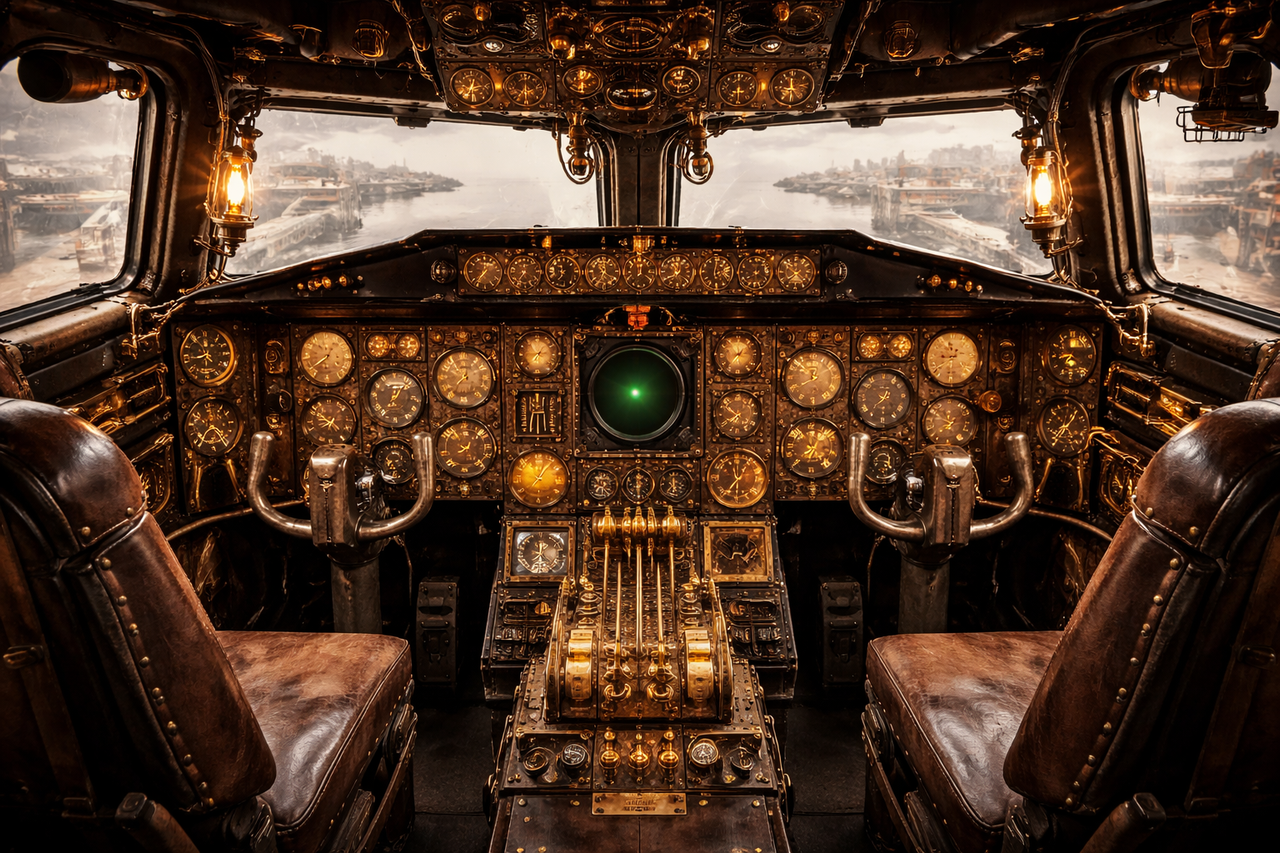
Captain Nemo would be proud.
I like the lanterns.
Yep; the lanterns are the chef’s kiss on that one. A steampunk DC-4ish.
The scene out the windows is hard to parse but fits stylistically too.
Tres cool! Thank you.
I watch Mentour Pilot videos once in a while (I even have one of his T-shirts!) but this is one of the most harrowing ones I’ve yet seen. It occurred in May, 1996, out of Miami.
It seems timely because of discussions about the Switzerland night club fire and how quickly fire can spread and how deadly it can be, and so much worse on an airplane. It’s also a good example of the Swiss cheese model of accident causation – so many things went wrong simultaneously that could have prevented or mitigated this tragedy, many of them due to airline cheapness and staff incompetence. Anything on fire in an airplane is a Very Bad Thing, but what was on fire in this case was one of the worst possible things – oxygen generators in the cargo hold, mislabeled and improperly shipped without the safety pins to prevent accidental triggering of the exothermal oxygen-generation reaction. And also the absence of either fire detection or fire suppression in the forward cargo hold.