Yup. MAKING oxygen and STORING oxygen are two very different things (as I learned from that MentourPilot video).
Wow, a paragraph from the Wikipedia entry for ValuJet, which ceased to exist as a brand after merging with AirTran Airlines the year following this accident:
The company was founded in 1992 and was notorious for its sometimes dangerous cost-cutting measures. All of the airline’s planes were purchased used from other airlines; very little training was provided to workers; and contractors were used for maintenance and other services. ValuJet quickly developed a reputation for safety issues. In 1995, the military refused the company’s bid to fly military personnel over safety worries, and officials at the FAA wanted the airline to be grounded.
Not exactly complimentary!
AirTran itself was acquired by Southwest in 2011. SWA I guess is a decent enough airline and certainly quite large, but even it seems to have a reputation for operating by yahoo wild-west principles. The SWA pilot caught on a stuck hot mic whining about the goddam liberals in the Bay area while taxiing in SFO seemed to typify a redneck culture.
Fire in the cabin is the only scenario that had me waking in a cold sweat in a random hotel room.
Cargo fire detection and supression long preceded Valujet. Like installed early 1990s from an accident in the late 70s.
But no sytem, then or now, can deal with an oxygen-fed fire. Nor from a mass lithium ion battery fire. Those are both hull losses for sure.
The only question is whether we can find an airport (or ditching site) within WAG 10 minutes. And 5 would be better. So we can get some people out before it becomes unsurviveable.
So it’s all the more notable that this ancient DC-9 didn’t have either of those things. Not clear if ValuJet was flouting regulations or if formal regulations weren’t yet in place in 1996. From the Wiki quote, sounds like the FAA regarded them as something of a rogue airline.
Didn’t SWA get some sort of sweetheart exemption from the Rules for something-or-other? My memory is vague.
They did.
Exemption from pilot exterior preflight inspections, exemption from the 250 KIAS below 10,000 MSL speed limit at HOU, their original hub. And exemption from knowing & tracking which pax is in which seat.
All are safety shortcuts with no countervailing public benefits. Only private cost-cutting benefits.
They also set the pace on outsourcing maintenance of whole airplanes and components to 3rd world unregulated cheap-ass suppliers. Now everybody does it. Because they have to to match SWA’s costs.
This is the one I remember.
I think I remember that.
I didn’t even know that was a requirement.
Flammability is a hell of a discipline. Everything is tested, everything passes specific criteria to show that the material should prevent being ignited or prevent fire propagation (and I mean everything installed….wiring, carpeting, insulation, sidewall panels, seats, veneer, electrical and computer components, everything…) and yet…fire wins. The stuff that makes the stuff we use in this world to make other stuff can burn.
Aviation safety is built around preventing the fire in the first place because as @LSLGuy says, once a fire exists, your options are limited. And now passengers are each walking around with 1-4 devices with lithium batteries that can each take an aircraft down if something goes wrong.
It literally keeps me awake at night (then again, so does everything, Yay insomnia). The best solution I’ve thought of is issuing (or making passengers buy) fire bags but I don’t see regulators trying to increase operator or even passenger costs, certainly not the FAA. I’m idly wondering if I should buy myself one.
Worse than that - those bags many carriers use are only somewhat effective on a lithium battery fire. What you really need to do is immerse the device in liquid. There are now a number of commercially made solutions, such as this:
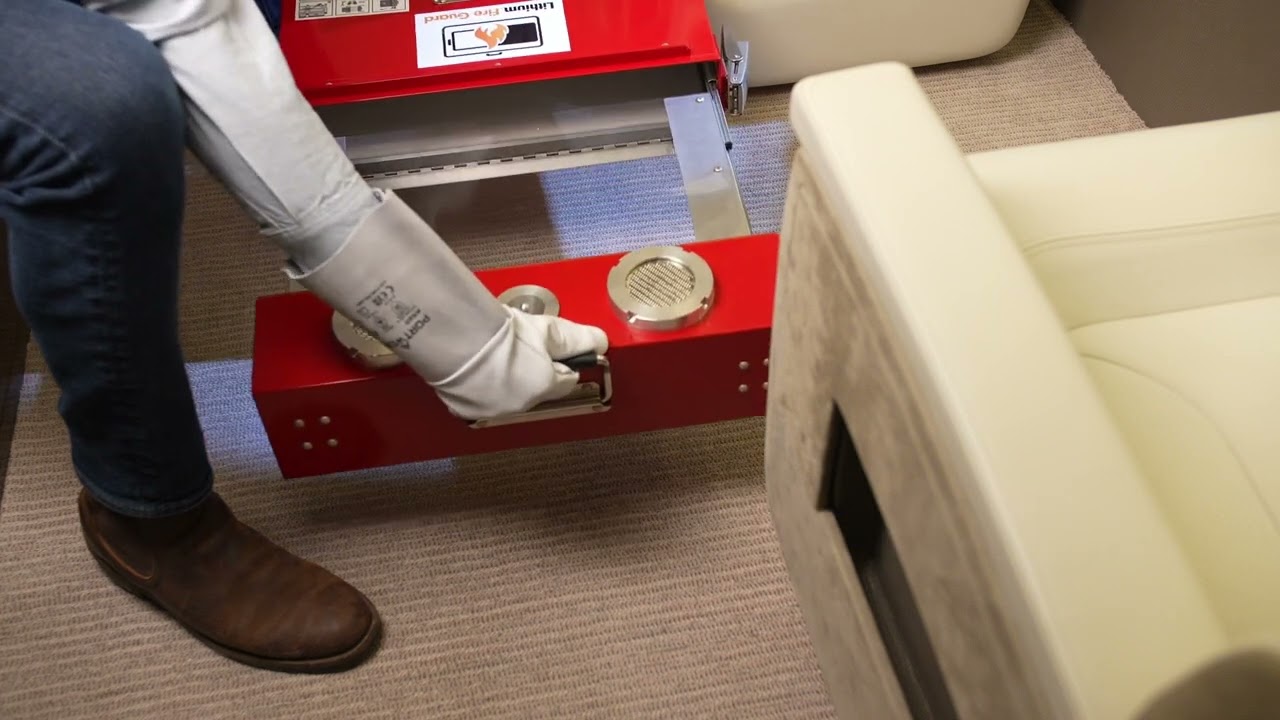
Also important to know is that, perhaps non-intuitively, piling ice on a lithium battery fire will only make it worse. The ice acts as an insulator and can actually cause it to flare up. Can’t find a good video of it just now, but I’ve seen it in training and it’s dramatic.
Thanks for all that, LSLGuy. Very interesting.
I figure “somewhat effective” if a passenger has one might buy time to get the device immersed, but the bag may hinder further cooling too. I’m going to go down a spare time rabbit hole on this question I’m sure!
It’s been a while but I have read the advisory circular for cabin crew to basically get it underwater. In a drink cup or water pitcher and then just drown it in water, soda, wine, whatever’s handy.
I’m on the airworthiness and not operational side of things, so the physical definition and limits of the plane and not “what button to push" and I kind of feel like this is an issue where the two worlds haven’t fully aligned yet.
ETA: that box is really cool. I’m not aware of a requirement to have one onboard, but it may be Part 91/135/121/125 etc and not part 25, which is my workspace)
Easy-ish for a smaller phone. Drops right into a metal coffee pot or lav sink. Which can be quickly filled from the adjacent water spigot.
Much harder for a tablet or laptop. And marginal for a 2025 state of the art large phone. There are no existing basins large enough onboard. Some sort of non-flammable high temperature resistant fabric bucket with spring-loaded pop-up sides would be ideal. Net of needing 4 or 6 quarts of liquid to submerge the flaming e.g. iPad.
When a new gizmo is invented, the typical deployment scheme is they become required on new-production airplanes as of date X, and retrofitting of old airplanes must begin by date Y to complete by date Z. With X < Y < Z, and each date chosen with an eye to both manufacturing capacity and ramp-up rate, and number of aircraft taken out of service per unit time. Assuming the gizmos are available in great supply, easy retrofits can be done across the industry at the rate of many airplanes per month, but something taking a long time and extensive mods has to be metered into the fleet much more slowly to not wreck the productivity of a de facto utility that much of the rest of our GDP depends on.
IIRC …
When I started airlining in 1989 all the airplanes I flew, 727s, did not have cargo fire suppression / detection. By the time I left the 727 in 1998 they’d all be long-since retrofitted. IIRC it was roughly 1992 that my carrier got them. We generally were pretty good about adding safety features early versus dragging our feet to the last minute.
I suspect, but do not know, that ValuJet was waiting to the last minute. I’m quite confident they weren’t lying to FAA. FAA may have been lazy, but it wasn’t stupid. The mishap airplane may have been unluckily the last to not have fire detection / suppression. Or maybe none of their fleet had it … yet. I know I don’t know.
I am confident that even current, much less 1990 era, fire suppression would have done just about bupkiss to stop an oxygen generator fire. Much less dozens of them going off in a chain reaction. Exothermic chemistry plus pure oxygen = slow acting unstoppable fire bomb.
I don’t care to look up this specific case, but speaking generally it’s possible that there was no retrofit requirement at all. A lot of regulations demand new construction safety standards that never get rolled back, because doing so makes very little economic sense or simply isn’t possible without rebuilding the entire aircraft. There’s also lobbying….
A toilet? I’m only semi-serious in that suggestion. I’m sure someone somewhere is researching things, I’m just not on top of the technical knowledge and I haven’t seen rulemaking to this effect recently.
In our current context, an airline lavatory toilet doesn’t have a liter of water standing in the bowl. In my experience, it’s empty until you flush and it all drops through the flap into a tank.
Maybe that counts, but that also sounds a little scary… having a burning LiIon battery stuck halfway to the sewage tank.
Toilets aren’t a terrible idea as to size. But …
Toilets don’t have a sealed bottom. If you pour liquid in, it goes down the drain. So we need a quick and easy to deploy tightly sealing drain plug.
A modern vacuum toilet uses very little liquid per flush. Like 1/2 - 1 cup. Even with a cork, flushing isn’t going to provide enough liquid fast enough. So not much better than an emergency bucket into which you pour beverages.
It’s been a lot of years since the toilet basins were metal, typically thin stainless steel sheet. They’re plastic on anything newer than about a 727 or 737 Classic. So either we retrofit them with metal basins or need a plastic basin able to withstand lithium battery fire temperatures before the quenching liquid is added. Good bet current plastic basins don’t meet that spec, so we’re retrofitting either way; plastic or metal. IANA materials engineer, but after watching a vid of a battery fire slagging a car’s metal structure, I suspect there is no plastic capable of withstanding those kinds of temps.
ETA: @gnoitall makes an excellent point I had not considered when writing the above.
Any hot slag or lithium compounds getting below the basin plug into the downstream plumbing has a lot of potential to propagate a fire into an inaccessible location. Which would be very bad.
I wasn’t thinking using the toilet flush water, just as a vessel to contain a larger volume of liquid. The drain isn’t open until you flush.
The materials would only meet compliance to 25.853(a) which may not be quite enough for this purpose.
This is really just spitballing as I watch a hockey game, so hardly a developed concept. Just idle “working with existing things, where could this fit?”
I think other solutions like the box in the video are much more viable options.
Is using water the recommended method for Lion battery fires on planes? If the water gets into contact with the Lithium compounds things can get a lot worse.
The current transport Canada guidance:
4.4 Cooling of batteries experiencing thermal runaway
(1) Cooling battery cells in a PED to limit thermal propagation to adjacent cells is critical to extinguishing a high energy fire, whether prior to thermal runaway or after flames have begun to emit from a device. Current best practices often recommend cooling the cells by dousing the device with water or other non-alcoholic liquids. Dousing with liquid is intended to ensure that the device is saturated internally, which cools the battery cells. However, as more water-resistant devices enter the consumer market, cooling the device with liquids may become more challenging.
From here: Advisory Circular (AC) No. 700-065
The FAA has similar guidance though I don’t have the reference handy.
As @mnemosyne said, current guidance is douse with any available liquid, water being typical. I recall that one of our resident firefighters weighed in in a thread about EV fires and said that’s their technique; just flood it with water and wait for it to finish. They have no expectation of putting an EV fire out; they’re just trying to manage how much heat it applies to whatever’s nearby.
You’re certainly right that pure lithium metal reacts badly with water. I’m not enough of a chemist to know for sure, but it appears the lithium compounds commonly found in batteries are already in a reacted state and tolerate water well enough If you have contrary info I’m happy to learn otherwise.