Maybe Amazon Air will pick up those MD-11s. They’re probably for sale cheap.
Yes, I’m kidding; the entire type for all operators is probably going directly to the scrap heap.
Not because they’re that awful, but because the minimum cost to re-engineer far exceeds the fleets’ collective value. In a way, it’s not so different as the many early-gen jet airplanes grounded by increasing noise standards in the late 80s & through the 90s. Lotta reasonably safe reasonably cheap mileage left in them, but the cost to make them quieter exceeded their remaining revenue & residual value.
And then all the rubber and all the electronics and all the delicate mechanical instruments are left to bake in the Tucson sun, with interior temperatures rising to 150 degrees. Day after day after day. For decades. The aluminum survives fine. Everything else is pretty rough.
There’s a reason it took NASA 2 years to get one airplane flying again. And it wasn’t because they’re in great shape when they’re first towed out of their spot in the boneyard.
Consider also that within reason they picked the best of the litter to revive. If they now need to pull another one out of storage, logically it will have to be one of the runners up from the last “beauty contest”. Plus it’ll be another 14 years older than the last one was when it was revived.
The idea of the Boneyard as a source of war emergency materiel was being technologically obsoleted almost from the day it opened after WWII.
For recently mothballed aircraft, it’s a good source of otherwise unavailable spare parts. But real quickly all the serviceable Gizmo X’s have been scavenged and then that entire fleet isn’t going anywhere until new Gizmo X’s can be reverse engineered and produced.
After that it’s a great source of museum pieces. And cool Google maps overhead pix.
From what I’ve read, there was enough of a market for a wide-body, tri-jet airliner, but not enough for two. McDonnell Douglas and Lockheed both tried to capture that market at the same time. Both got enough pre-orders to go ahead with their projects, but both companies were hurt when they wound up splitting the market.
I’m trying to remember which airlines committed to each plane. I think it was Pan Am, TWA, and Eastern went with Lockheed, American, United, and Northwest with McDD. I seem to remember the airlines playing both manufacturers against one another to get features they wanted in the final designs.
Delta was the other major at the time. They chose the L-1011.
The L-10 had a lot of schedule problems to first flight because Rolls Royce chose that moment to go bankrupt, leaving Lockheed with an engineless airliner for 2 years. Which eventually proved to be a fatal wound for the L-10 program and for Lockheed as an aircraft manufacturer.
Which delays drove a bunch of demand into McDD’s waiting arms.
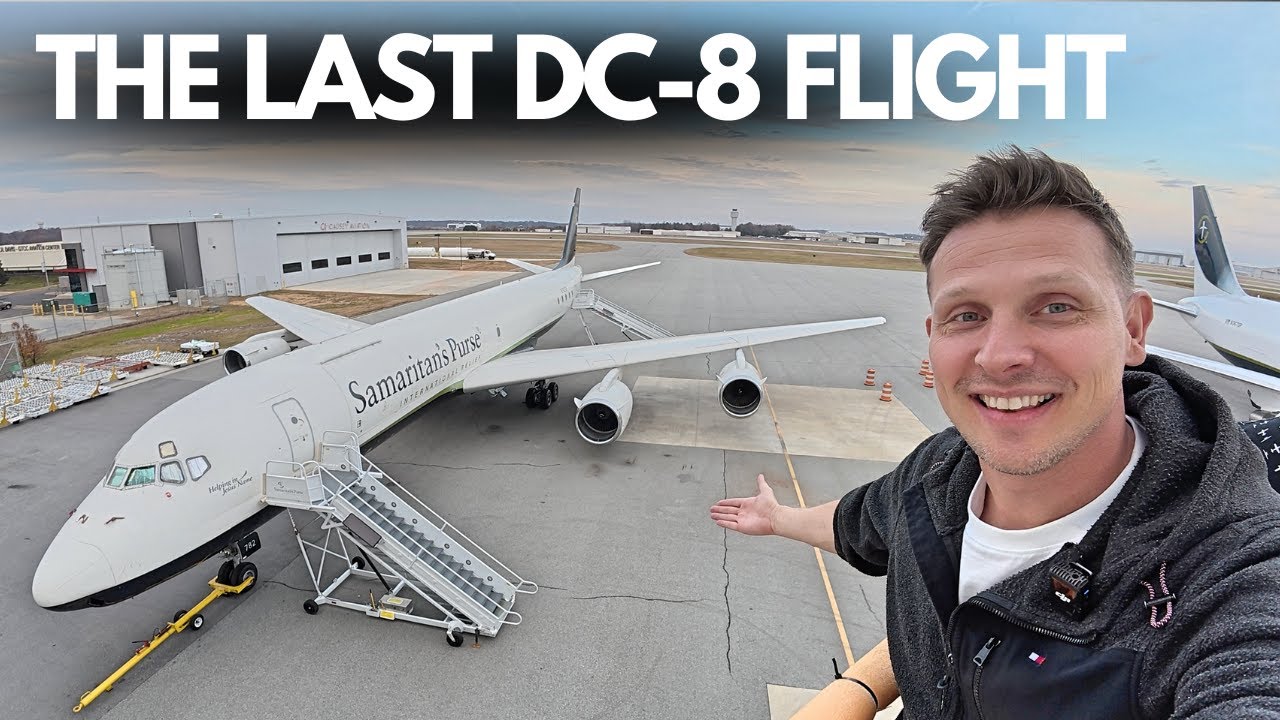
Last month, Samaritan’s Purse, the humanitarian relief organization, retired their DC-8 combi. This YouTuber got to travel along with them on its final flight.
I believe there are only 2 DC-8s still in active service in the world, one in the Congo and one in Peru, both freighters.
I didn’t know United flew Tristars, but you’re right, got them when they bought out some of Pan Am’s Pacific operations. Sold them after only a couple years.
Damn but that vid is chopped up into micro cuts. Annoying to watch.
The scoops are there, but the very shiny dark blue paint hides them well.
I didn’t watch the whole vid, but the scoops are very briefly visible between 2:10 & 2:15. You’ll probably have to watch that bit 4 or 5 times to see them. But once seen they’re obvious.
Once you’ve seen them, the left one is very slightly evident in the preview still image as a slight bulge in the chin.
A background question to an issue that’s got in the news these last few hours: Our favourite US President is threatening additional tariffs on Canada, and decertification of Canadian aircraft types, over claims that Canada maliciously refuses to certify certain Gulfstream types.
What’s the technical and regulatory background on this Gulfstream issue?
The Gulfstream aircraft in question aren’t even fully FAA certified yet - they are on a temporary FAA extension (due to expire this year IIRC) while they work out getting the systems that prevent fuel icing certified. Normally, Canadian certification follows FAA certification as a matter of rote. It’s political posturing and Trump BS.
Canada has an additional regulatory requirement related to cold weather (525.1301-1) which does not get a lot of leeway. Transport Canada spends a lot of internal effort on that review. Now, this is public information. If you want to sell the plane to a Canadian owner so it can be used in the country, your airworthiness professionals know about this regulation and make sure it’s part of your certification plan and design requirements long before you actually build any parts for the plane. None of this is unusual whatsoever.
Concurrent validation is difficult to pull off, but can be done. It’s likely that TCCA Validation could occur shortly after FAA Approval because the project is being worked on parallel at both agencies. I believe Gulfstream got same-day validation approval from either TCCA or EASA for the G800 but I could be misremembering.
Trump’s post is just so incredibly stupid. Go on, piss off all those rich people bribing you who fly around in Bombardier business jets by grounding them. Nevermind the CRJ, Dash8, Bell helicopters, A220 (even the ones built in the USA are a Canadian type certificate), etc etc. Just fucking stupid.