The Great Ongoing Guitar Thread

Well done - and so glad I’ve been a positive influence! :wink: Yeah, there’s a fine line between acquiring the right tools and a case of GAS. Having a Strat, an SG and a Tele - heck, man, that’s just common sense! :wink:

So - do you play slide - or are you looking at trying it, now that you have an SG like Mr. Trucks? Amp and pedals used?

ETA: E-Sabs - interesting news from GFS. The one comment I would make is that if you get a set like that (which sounds like it would be pretty cool) you really need to mod the circuit (or have it modded when the pickups are installed) to ensure that the bridge pickup is wired to a Tone control. Many Strat models do not have that - and with a pickup that hot, I would want to be able to dial down the tone control to be able to roll off the highs and get a great rock rhythm tone off the bridge…

I own a slide, but to say I play slide, would be generous in the least. Only been back playing 5 years after a 15 year hiatus. I try get better every day(and I have, from terribad to somewhat competent), but truthfully, if I spend the next 30 years just rocking out in my bedroom, I’d be cool with that.

You’re unfortunately not going to be able to geek out too much on my equipment. Vox 30 watt amp(garage sale special) and just a distortion pedal. Also have a Fender modelling amp, that I play around with a bit when I want to have fun with any effects. My lack of knowledge of pedals and amps is frankly, embarrassing.

All good - not looking to geek out; just wanted to understand if you had gear that would help you enjoy your SG and perhaps be friendly for slide.

Dude - you’re playing; that’s pretty much the Win any of us are looking for - it’s all good!

Well, you might not want to be so quick with that tone control. I’m learning* how to make pickups. From what I’ve read, as you increase the windings of the pickup, the output increases, but the resonant frequency of the pickup lowers, so it gets more bass response. Think of a P-90 vs a Tele pickup. But you seem to mess with the tone control more often than I do in general, so YMMV.

*I got my first roll of 42AWG wire today. All I’ve made so far are horrible, weak test pickups with wire that is too thick, and too little of it. I’m off to get the equipment to make a winder in a minute. There’s no way I’m doing 4-8k wraps of wire with just my hands, which is how I made the first two.

Nars Jr. is home from college and was looking for ways to save money. I suggested learning to play the guitar (he made an extremely meager attempt once before) instead of going out on the town every night. It worked!! Now I have somebody to learn/play with. Of course, his saving money will end up costing me as GAS sets in, but you only go around once in life.

Yeah, we may be talking past each other, or discussing different things. In previous threads, I have commented that folks like EVH don’t “need” a Tone control on their guitar because they are basically goosing their amps (Eddie used a Variac) which has the effect you describe - rounding off the highs via signal boost.

But - dude, most folks don’t play that loud or crunchy. Also, the trick is to make sure your components are musically inefficient - i.e., when you roll off the Tone or Volume, you aren’t chopping off the signal; the roll-off is organic-sounding(?) - old school parts are valued here because they aren’t as precise and hardline as newer components.

So - P-90’s are a perfect example - a super-wound hot output single coil. At 10 on Volume and Tone on the guitar, it is a squealing mess, suitable for Hendrix-meets-Jack White lead work. If you roll the Volume down to about 8.5, you “take some hair off the tone” so it is more big-chunky rock goodness. If you dial the Tone down to about 7 - again with decent components - you take a bit of ice-pick out of the Tone and it is left a bit rounder and warmer.

Are you manipulating highs? Sure - but the tone sounds complete and sits in a mix perfectly.

How’m I doin’ here?

ETA: Nars - very cool; sharing music with my kids is pretty much *the best *as far as I am concerned.

Increasing the output of a pickup increases the mids to the detriment of the highs and lows. The resonant peak does get lower, but the midrange spike is what makes the typical overwound pickup sound. It’s nowhere near as simple as turning down a tone pot. Overwound pickups are muddy, not bassy as such. They’re muddy because all you can hear is mids, not because you’ve subtracted the high end.

Aww, you’re doing just fine at schooling me in the fact that “Different Strokes” is more than a sitcom.

You’re probably right, my average stroll with the guitar probably involves more hydrazine than yours does. I tried your (and others’, I think) earlier advice with tone knobs on the icepick SX, it cured the icepick a bit, but then there was nothing left to like IMHO. Strings did take care of it. This has matched my experience for most guitars. If it’s not my Goya with the funky tone knob arrangement, I want them all the way up. I have several guitars that when I re-wired them, I just ditched the tone circuit. Why put something back that I never used? After removing the circuit, I usually liked the guitar’s sound even more. Age and quality of components do not seem to matter in my case, my collection has spaned from 60’s Gibsons and Japanese craziness to modern quality guitars. If I didn’t like the guitar’s sound with the tone all the way up, I’m gonna like it even less after I turn it down. I’ll adjust that by switching between pickups or changing the tone settings on the amp, which don’t have the same effect on the sound as the knob on the guitar.

Again, I’m not right. They keep putting tone knobs on guitars for a reason, they’re just not doing it for me.

But, one thing I don’t understand, and want to know more about, is the term Musically Inefficient. I’ve heard it in reference to speakers and amps as a measure of how efficiently they generate db per watt, and generally, more inefficient ones sound better. Used that way, it makes sense to me, sorta. But a broken amp seems like it’d be the most inefficient, and they sound horrible :). I did a quick search for it just a moment ago, and didn’t find anything useful. Got a link to where I can get an education?

Thank you for the expanded info. I knew they sounded different, and preferred one over the other, now I know why. I hate midrange, which explains why I don’t like overwound pickups very much either.

So what kind of tone are you going for, scabpicker? Example band or guitarist’s tone that you want to/do sound like? What kind of amp are we talking here? Also, do you use any always-on tone pedal?

For the most part, I’m the guy you don’t want testing the amps at Guitar Center (I am aware of this, and don’t). Jack White isn’t a bad example of the kind of tone I shoot for. I thought he had great tones throughout De Stijl. When I found out he used the same model Silvertone 1485 that I do, it made me happy. I always love it when I find out someone I like uses the same equipment I do. :slight_smile: Then the White Stripes got really popular, and I realized I was gonna have to pay more than $125 if I wanted another one. :frowning: It’s a pretty big, thick sounding amp.

No, I don’t have any pedals I leave on all the time right now. The Silvertone is reasonably sensitive at drum set volumes, so I can go from rather clean to pretty broken up with just picking force and a dip of the volume knob if I have to be totally clean. If it requires more than basic rock and roll distortion, I’ll use a pedal of some sort. I used to use a Super Fuzz for this task. In retrospect, it’s usually overkill.

Another tone I’ve always loved, and recenty re-discovered is Bob Log III’s. Crunchy, and punchy, but with some sing to it as well. Through the magic of YouTube, I can see he’s using a Teisco Del Rey wired with just a volume pot on a Silvertone archtop. The bridge of the Goya’s been the same pickup wired that way for 20 years now, and that’s the guitar that I kind of try to make all my others sound like if I’m not happy with them. If you can imagine that tone in a solid body, with a little more neck pickup boom from a P-90 with seriously weird (but actually used) tone controls in the neck, that’s usually what I shoot for. But like the Silvertone, I can’t get the Teisco pickups (as easily) for a song anymore.

I got fixated on those pickups from a Teisco hollow body I still own that has 2 of them. It’s a roaring monster that nothing else quite gets to in terms of sound, but it’s kind of impossible to manage live. Which is where I do most of my playing. It’s 3/4 size, hollow, made out of (I think) 1/4 inch plywood (and with a broken control plate from using it at shows). it’s a flimsy toy that has to be babied and wants to wail at the slightest provocation. In a solid body, those pickups are a lot more usable at the gain/volume I usually end up playing at. I’m just not willing to cannibalize guitars older than myself anymore, unless they are ready for the fireplace.

So, after I get a pickup that works at normal volume levels, I’m planning on building a magnetometer, and thoroughly testing the pickups I have. My goal will be to make something that lies between them and a Danelectro pickup in terms of sound.

tl;dr: I wanna be Jeremy Spencer.

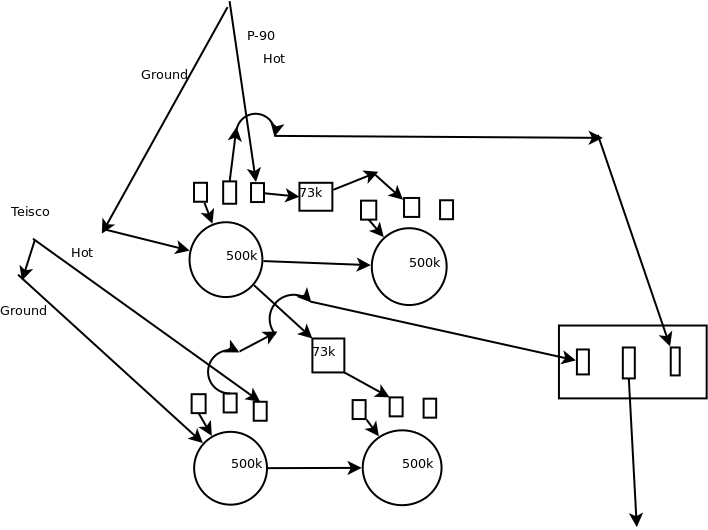
And I don’t know if I’ve mentioned this before, but if anyone would like to take a stab at telling me how that tone circuit on my Goya works, I’d be happy to post a diagram of it’s wiring. I got it to a sound I liked and started re-wiring other guitars before I realized that it’s truly odd, and I’ve never changed the tone circuit from the previous owner’s setup. I love how it sounds, and I know I’m the equivalent of a monkey that knows how to solder. It’s magic, don’t mess with it.

I know I’ve said this before: it was wired by a mad genius. It’s got two tone caps and knobs wired to one volume knob. Both knobs all the way up, the guitar is honky and almost silent. Both all the way down, and it’s boomy and quiet. Work the knobs around to different values, and it comes alive. I usually have one set on about 2, and the other all the way up (that’s probably the equivalent to a normal guitar with the tone all the way up, but which knob is 2 and which is 10 matters), but it honestly sounds good (to even me) with the tone knobs in lots of places, even with just the P-90. Both knobs maxed or floored are pretty useless, though.

Anyone wanna take a stab at it?

Yeah - I am totally not your guy for deciphering circuits :wink:

Hmm, from the sound of it, you love a big messy tone that you can control - between mentioning De Stijl (just listening to it yesterday, along with a few of the originals done by Son House and Blind Willie McTell), and such, you like a big squeal.

Okay - cool. You mention rolling off the Volume to clean up your signal - you get the principle of knob twiddling. You are just messing with a meat cleaver of a tone and I was giving suggestions related to fine-tuning a “finer blade” of tone. If you are targeting Jack White and have the gear to make it happen, then yeah, my knob twiddling will only influence the tone so much.

In terms of musically inefficient, really quickly: I am not a scientist or engineer, so this is my layman’s attempt to articulate it. Instruments that produce their tones mechanically - e.g., a flattop acoustic guitar via picking/strumming - are built in a way that reinforces some harmonic tones over the main note and dampens others. If you get a good example that reinforces good tones super well and dampens the clashy harmonics well, you get a guitar that is very musical sounding - you can build chords and the notes blend well and clash less. Cool?

Now go to digital. Early CD’s sounded awful because they could reproduce everything - you wanted some of the damping provided by analog recording - or, at least, you needed to re-master the CD version so it sounded more like an analog recording with its inherent damping.

Well, in a guitar circuit, you have Volume and Tone pots. These days, similar to the CD, components are being built better. If you take a generic pot that is supposed to work in any electronic circuit, when you twiddle it’s dial it is supposed to cut off any signal above its current setting - and modern pots are pretty darn good at that. Too good - they lop off everything tonally. Old pots didn’t have as fine of a cut-off line - there was a general decrease or increase, but some frequencies were dampened less and some were dampened more, given the materials used.

That “blurrier” cut-off line may be inefficient from an electronics-component standpoint, but it sounds more musical - it is a subtle thing. When I have spent time with modern guitars vs. ones with old components, it is NOT like drinking a fine wine vs. drinking crap and saying “oh, it’s obvious!” - it is more subtle. When you do bends, or grab a couple of strings and play a ZZ Top blues lick where you have notes rubbing up against each other (that cool lick in La Grange that they do right before they take it down to just drums again, for instance) - it just sounds…better. You sound better and you find yourself liking your playing more.

99% of the crap online, as Shakester points out regularly and correctly - is crap. 99% of the discussion of components is beyond crap. But the basic principle that some components sound better in a music circuit is true - but it can really vary based on the experience of the player, the tone they are going for (you really like wide-open, squealing tones - so a more tightly-controlled rock/crunch tone does you little good), etc…

How’s that? Shakester - I suspect you’ll have a comment or two. I have no clue about that Goya circuit - at the very least you would want to take a pic of your control cavity to share - not enough to go on from your description, even for me…

My only comment here is that I don’t use the tone pots on my guitars either, but I do like having them there. That’s because they make a difference to the sound even when you’re not using them. It’s an extra bit of capacitance in the circuit, what it does is cut a bit of the “presence” AKA the upper mids.

Pickups are designed and built for a circuit that contains tone pots. Subtract the pots and you get a little peak in the upper midrange - which some people like. It does tend to clean up the sound a little bit, and it’s a fairly subtle difference, not a night/day thing. Certainly there are people who prefer to take the tone pot out of the circuit, and it’s a perfectly reasonable thing to do. And you can just detach the wire to the pot and leave it and the knob alone, which looks nicer than an empty hole in your guitar top.

As for the Goya setup, I would guess that the tone pots are wired in parallel and they’re doing something with the phase of the signal. But I don’t know enough to figure out how that would work or if that’s actually what’s happening. An actual electronics expert would have a better idea.

Just a shot in the dark, but maybe one tone knob is a high cut/low pass filter and the other is a low cut/high pass filter?

Ok, here’s a diagram of the wiring of the Goya. It also has grounds running from the volume pot cases to the ground of the switch, and a ground running to the bridge. I figured those were redundant to draw, though.

Guess away, I’m not smart enough to prove you wrong. If I ever end up taking to a shop, I’ll ask them. I’ve asked general electronics folks who did not specialize guitar pickup circuits (one built tube amps) and have gotten a response something like “audio circuits are weird, especially guitars”. The person who wired it knew a few things about electronics, but I saw him get out of his depth on a few projects. This could be the worst possible way to wire a guitar, but I still like it.

WordMan, that does make sense as a list of individual things, but I’m still not really working it into a cohesive concept, other than “What sounds good to an engineer does not necessarily sound good to a musician”. It’s a simple enough of a concept, and absolutely true, but doesn’t seem to have much predictive value. Maybe I’m hoping there’s more to the idea of “Musically Inefficient” than there is. So it goes.

Exactly - use the Rules of Thumb that work for you. As I said in my prior post, it is not a night-and-day difference. It is a difference I hear, given the type of music I play, the way I play, and the gear I use.

Oh, one other topic: do you play with P-90’s? If so, have you put a square of foam cushion under the pickup? I was having problems with squealing feedback (vs. normal P-90 raw tone) and found that mod on a guitar message board. I got a hunk of foam cushion, cut out a pick that fit the cavity and was maybe 1" tall, stuff it in there and screwed down the pickup. Worked like a charm.

Ok, more trial and error for me, then. I do pity the poor engineers, engineering devices to taste rather than physical principles makes this a black art. NO SLEEP FOR YOU, YOU WICKED ENGINEERS!

Ok, maybe I don’t pity them, but they have a problem.

Oh yeah, I’m a single coil guy. I loves me some P-90’s, second only to those Tiesco pickups. I’ve got several guitars with them, but I’ve never had feedback problems with one. IME, P-90’s are usually better than most other single coils in that respect. I’m interested in the problem the foam cured, though. Your description sounds like nasty old microphonic feedback, was this a hollowbody? Had the pickup been potted? Was the pickup vibrating against its case? Would it arise on it’s own, or would it only happen on the decay of notes? Did you ever like how it sounded? (Hey, sometimes broken stuff sounds great in its own limited way, I gotta know.)

I’m sure it’s a microphonic feedback -it was an old non-potted P-90. And no it didn’t sound good at all - once the foam was in place, all of the pickup’s raw goodness came out - the other stuff was noisy squeal…

Huh. I take it the boxes above the circles are the three lugs on each pot. And a wire going to a pot and not to one of those lugs is to the pot’s body, i.e. ground? And the ‘73k’ is a capacitor of course, though I’ve never seen a 73uf one used.

So the top tone circuit looks perfectly normal on that basis. The bottom one OTOH makes no sense as there’s no actual signal going to it; a wire goes from the P90 volume pot’s ground to the lower capacitor to the lower tone pot, and the side terminal of that pot leads this signal back to ground. This would do exactly nothing. Are you sure the lower (Teisco) tone leads are shown correctly?

So I just got got the SN-2, and it’s way convenient, but I’m not very impressed re tracking or accuracy. It’s better tracking than my Korg CA-30, but that’s like saying someone is more handsome than Don Knotts. I’ll get the SN-8 (which I should have done in the first place, since they’re the same price) and report back.