Weird, I would have tried to pot the pickup, possibly changing its character a little. Good trick to know, as it’s easily undone if it doesn’t cure the problem, unlike potting.
Your interpretation is correct. I could be wrong on the values of the caps, they’re very old and hard to read.
Well, I told you it was weird. I do believe the diagram is correct, I’ll double check it in the morning when I get home. If it’s wrong, I’ll post a correction. Yes, it doesn’t look like that pot should do anything. I assumed it was a “Tom experiment” that he had gotten out of his depth on when I first started comparing that guitar’s wiring to other guitars. After playing the guitar for years, I now think he might have been onto something, but don’t know what. I assure you that moving the “Teisco” tone knob does affect the tone when the P-90 is included. However, it works in reverse of a normal tone knob. It gets brighter as the knob is turned down. That makes me think Ranger Jeff might be right in thinking it’s a low cut/high pass filter, but I don’t understand how it’s doing that. It seems to do nothing when the Teisco pickup is selected by itself.
I honestly thought that knob didn’t do anything for years. It didn’t have a knob on the shaft when I bought it, and still doesn’t. When the “correct” pickup was selected, it didn’t do anything, so I turned it down and left it alone. Someone who was borrowing my guitar commented that the tone controls worked very strangely. Indeed, they were right.
All right, I’m done the recording part of the sessions. (Just in the nick of time, too - I’ve sneezed six times since I started this post. God damn grass pollen!)
So, now, the check list consists of -
Edit what I have into complete, polished tracks. For each of the 16 pieces, there are at least 3 complete takes, plus partials of anything I didn’t nail in the complete takes. There are a couple of overdubs to do - one piece called for a 24th fret harmonic, followed by a 31st fret harmonic, and rather than catch them on the fly like I’d do in performance, we recorded an entire take of nothing but repeated harmonics. I’ll take the very best of each and stitch it over. There’s another place where using a 4 string capo rendered an entire passage much safer, but that necessitated transposing an open low ‘E’ up an octave. I have a take of nothing but low 'E’s, and I can stitch it over as well.
It is strange to me to be doing this to pieces that I’ve performed live - I’m trying to think of it as like the difference between a live stage performance, and the video/film representation of that performance. There’s a reason they don’t film Shakespeare using a single, stationary camera at a live show. I’m still thinking of it as ‘capturing the very best version of each bar’, but it’s curious to think about what it’s going to be like when I go to perform these pieces live now…
Editing is hard, too, because I know how I want these songs to go, and all I can hear are the places where I am weighed in the balance and found wanting. My vision of Hell is being trapped where I am forced to listen to my out-takes, over and over again. Gahh!
2) Secure the rights. I’ve never done this before, so this is a whole new territory for me. Still, there are four composers involved, and I have to make sure everything’s nailed down so I don’t get presented with a C&D order.
3) Make my decision about making physical copies. On the one hand, just selling it as a digital download through iTunes, Amazon, Chapters/Indigo, CD Baby, etc. is way less hassle and expense. On the other hand, there is a certain advantage to selling your CDs in the lobby after a concert - it’s something you can sign, for one thing. In the classical demographic, there are a lot of my potential listeners who don’t download their music, for another. I’m still making up my mind here; also, I don’t have the biggest piece of information, which is what is it going to cost to produce physical CDs. It might be fun to do a vinyl album version, but again - what is the cost/benefit? I’m trying to channel my inner Ferengi.
4) Sort out an intermediary to get the stuff on iTunes, etc.
Timeline - hope for end of July, settle for August, end of September is more likely…
Congrats on finishing in time. Your description of the process is great, because it’s very different from how I’m used to making a recording. The most overdubbing/editing I’ve ever done is adding an entire extra part to a song, never stitching together different takes. Are you completely mixing/mastering this yourself? If so, you are braver than I. I have been whupped in the “let’s both try mixing this song” contest to consider myself as even having a good ear.
That said, I can’t imagine what this is gonna be like:
Because hearing myself screw up makes my brain get a splitting headache for a millisecond. In the studio, I usually only hear my mistake once, then I get to punch in and fix it, or re-do my whole track. With the current band in the last session I got to listen to one of my mistakes (totally the wrong note, hit loud and strong) five or six times before I got to fix it. It was torture. Listening to some live tracks that we did recently so I could name them before they went on the website was a similar experience. It’s certainly motivated me to hammer the set list before shows.
My vote here is to go ahead and make CDs at least. If you want to make nice memento, or you have an audiophile audience (classical usually is), the vinyl pressing might make sense as well. The price goes up per unit for smaller pressings, but small pressings are available.
Again, you’ve got a different audience than I have, but IME, if you can get people to show up and pay to watch you, you can sell merchandise to them. The small bands that I’ve known that can do that have made 3 or 4 times what they made at the door with merchandise at a good show. But, a lot of that is t-shirts. I don’t know how much the classical crowd buys that kind of merchandise. The bands I’ve known that had great turnout at free shows (they get paid off the bar total), but had trouble getting people to show up for pay-to-enter shows had mixed success with their musical merchandise. But again, anecdotes don’t equal data, they may have been ambitious with their pressing sizes, and I may just not have talked to the bands with the opposite experience.
And at least since #3 isn’t absolutely necessary at first, if you make a little extra cash off #4, you can use it to finance a #3 (but then you’d better do something nice for the folks who bought #4, hoo!). The upside of never doing #3 is, without a physical product, you don’t need to find a label, or find your own distributor and do your own promotion if you want to sell it outside of shows.
And, squeegee, I double checked the Goya. That wiring diagram is correct.
No, ‘editing’ in this case means making the decisions about what section of what take to use. Someone who knows what he’s doing will be doing the actual cut-and-pastes along with the final mastering. I just need to give him the list, eg. Take 1, 0:0235 - 0:1562; Take 3, 0:1424 - 0:5840; Take 2, 1:06 - end. It’s making the decisions to make that list that’s the hard part.
I’ve loaded the tracks into Garage Band (that’s where I’m getting those ridiculously precise numbers), and I’ve been using it to make sure I’m not suggesting something completely unworkable (“Did you not realize you played Take 17 faster than the previous take? And how could you not have noticed that you re-tuned between 14 and 15, making the two takes incompatible because the 2nd string magically gets sharp and then in tune between bar 108 and 109?”), but by and large I find this cutting and piecing together sport is best left to the pros.
I did an album of original songs just for fun in 2009 and then completed another earlier this year. I looked into the idea of releasing them as physical product just for kicks. I’m pretty much totally unknown with few live opportunities. I did do a gig with a friend’s band in March and so I had a small quantity made for that but otherwise it’s really not worth it for me to go physical.
For physical product your choices are to do a small quantity short-run or go all the way with full replication, which usually requires a minimum order of 500-1000 copies depending on the company you use. With short-run, you get CDRs (eg. burned cds, which you could do yourself with your computer if you really want to). Full replication means they actually create a stamper of your disc like a commercially available audio compact disc. As scabpicker said, the price/unit is smaller when you replicate but if you sell only 10 copies that leaves you with stacks of unsold inventory.
Some look down on paying for a CDR so keep that in mind…some feel that the lifespan of a CDR is considerably shorter than a professional stamped disc. Not that you would necessarily declare to the world that you are selling CDRs.
Anyway, I wound up also putting my stuff on bandcamp and cdbaby (and of course cdbaby sends it out to iTunes, amazon, spotify etc). I did bandcamp because it’s free and they offer lossless downloads, which cdbaby has only very very recently begun doing.
If you’re playing live a fair amount then yes get some physical product made up.
Ok, I agree, let the pros drive. Beyond the normal mixing concerns, I would think that editing together a solo acoustic performance is harder than editing together a rock or dance performance, since there’s far less in the way of acceptable sounds you can smooth things out with (effects, etc.). But I imagine that’s why you have the extreme time accuracy in your edit notes. I don’t live in the 21st century when it comes to recording for release yet, all of our stuff is going to analog tape. It doesn’t allow what you’re doing without someone like George Martin on the payroll. To be honest, I’m a bit envious. Software editing is sweet, and you don’t lose perfectly good takes because the tape you’re recycling has a bad spot. I’ve used GarageBand and ardour for writing, but there are members of the band who would straight up leave if we forced them to record digitally with the intent of releasing it.
I also want to further temper my vote for CDs, because I think I sounded more gung ho earlier than I feel. Deciding if and what to release is never easy. My current band is probably of the “can fill out a free show and get paid better off the bar” variety rather than the “can charge cover and make more than the bar” variety right now. Even so, we’re probably going to do a vinyl release with the studio’s label sharing the costs and splitting the production run (to be honest, I am unsure of the particulars at the moment, I am guessing). We play fairly often, so I am supposing if we split 1000 singles, it should be easy to sell them. LPs, not so much. Since the label would be doing promotion, and you do get slightly more notice for doing an LP, I’m not going to argue if (as I’ve overheard) they’ve decided to do an LP. They’re a good label, they’d be putting their money where their mouth is, and they do good promotion and great work musically, but I still have my doubts about it. I don’t do this to be rich, but I don’t do it to blindly waste money either. If I was in what I think your position is, and bankrolling the whole thing, I’d be much more nervous.
And I just checked prices. IIRC, CD’s have gone down a hell of a lot and vinyl is only slightly higher than it was (good lord, you can still get cassettes made). However, the last time I looked at the prices of these services, you couldn’t comparison shop on the internet, iTunes didn’t exist, and we didn’t dream of being able to afford commercially printed covers. We may have been getting gouged, or the on-line competition has driven them down.
But now I feel all record-industryish, eww. Let’s talk about guitars.
I do have one minor edit on the Goya, I was wrong on the cap’s values. I need bifocals. They’re .47uF, which is what you’d expect for a guitar that came with humbuckers.
No, I haven’t knowingly wired another guitar this way.* I only have one other guitar with the 2 pickup/2 vol/2 tone setup, and it hasn’t been touched electronically. I’m sorry if I gave you that impression. However, once I have conquered making decent pickups from scratch, I’m planning on making a lap steel. It would just take a few minutes more to wire it that way.
*Years ago, I may have unwittingly wired a friend’s guitar this way. They gave me a pile of parts, and wanted a guitar. At the time, I may have copied the Goya’s wiring out of ignorance. The guitar in question is long gone.
And my guitar acquisition syndrome marches on. I just won a Danelectro Longhorn bass on Ebay. I’ve wanted one for years, it’s a perfect bass for a surf band, and they’re so inexpensive it’s almost a crime to not own one. The seller is local, so hopefully I’ll get it in time to try it out and possibly use it for the two shows we have booked for next week :).
Looks fun. I’ve had two wahs, an actual Cry Baby and later an Ibanez model that I still have. I never got along with either and perhaps wah isn’t for me, but I hope you give that thing a workout.
I’m off to a meeting so can’t suss this out. It starts with a downstroke on the 1 count of each measure and has a picking pattern - for straight strumming you would have to fit within that.
As for the F - play whatever works! Seriously, it can be messy for a bit; figure out the groove first…
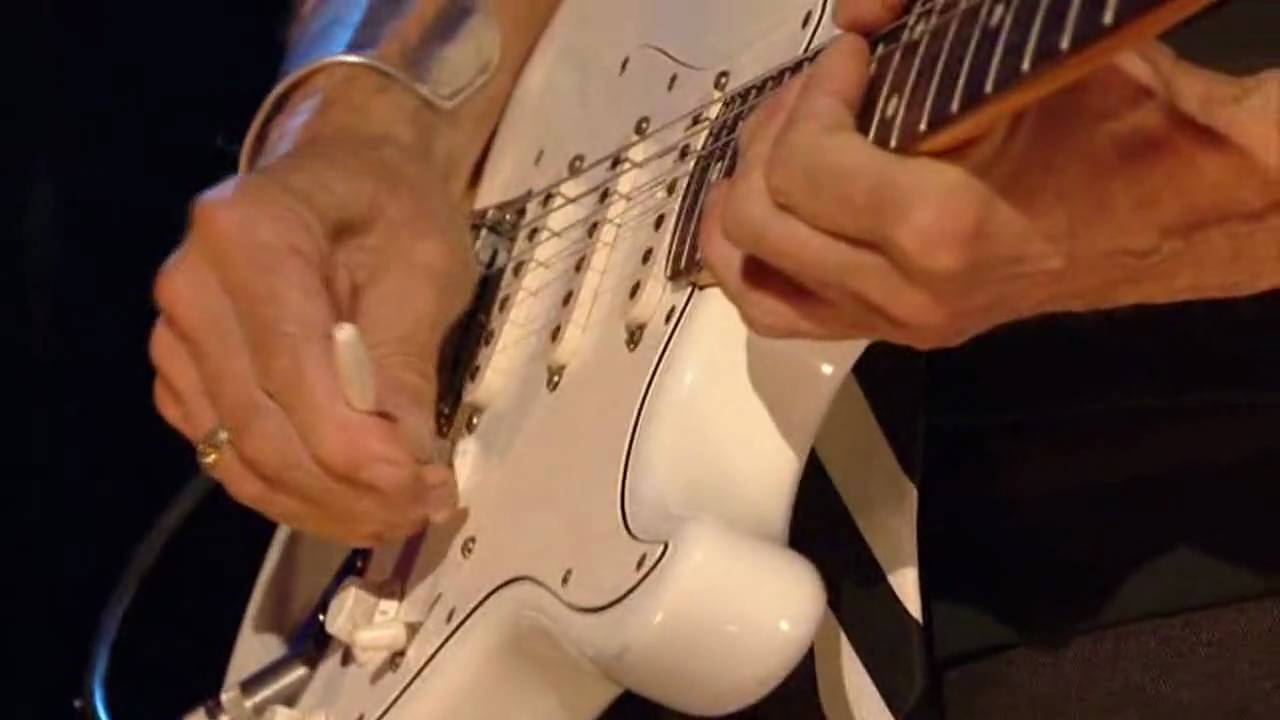
Apologies if this clip has already been posted before, nothing came up in a search. But, I saw this link on another board I frequent and was just blown away.
Jeff Beck doing, “Somewhere Over the Rainbow.” Like only Jeff Beck can.
His control of a whammy(and volume control at the same time) is mind boggling to me.
I struggled with all barre chords for a solid six months. I normally played a Fmaj7, or a different fingering of F as a cheat around. And then one day the hand just went down in the right place and the F barre sounded perfect.
My practice routine was to normally do about 20 minutes a day, switching between various open chords and the F.
Yeah, well, his is Jeff Beck. No one else can do what he does.
And your comments on Nars and the Pesky F (sounds like the name of a cool kids book) are pretty much in line with my toss-off comment. Don’t expect perfect at first - and DON’T spend all of your time stopping and correcting your fingering. The groove matters more than chord precision. Fake your way through an F as best you can while maintaining the groove - over time your chords will improve…
Never mind. Preparatory exercises for the execution of barre chords.
Start with fingering the C Major, A Major, G Major, E Major and D Major chords in 1st position with 2, 3 and 4. Learn how to preserve the arch in the fingers, the straight, relaxed wrist and the transference of the weight of the left arm from the shoulder onward into the tips of the fingers. No gripping is required - on a well set up instrument, the weight of the arm coming through the fingertips should easily suffice to bring the string in contact with the fingerboard, pinching it behind the fret for a clear, clean sound.
Slide those chord shapes up and down the fret board. Make sure the arch is preserved and that the positions of the fingertips remain directly behind the frets. Above all, ensure the sound is clear and clean. This is a good time to work on the principle that fingertips on unwound strings can maintain more contact than fingertips on wound strings. This is a fun time to work on glissandi. Alternate between playing only the closed strings and playing both the closed and the open strings.
Start with playing the 2-string barre on the top two strings at the 9th fret. Above all, get the 1st finger used to its new system of support in a flat position. The weight of the arm is what brings the strings to the fretboard, not gripping. Try this 2-string barre at any fret from the 5th to the 9th. (Up to the 11th on a steel string acoustic)
Play the E shaped ‘power chord’ at the 8th fret, fingering and playing only the bottom four strings. Move this shape and play it anywhere from the 5th to the 9th fret. (Up to the 11th on a steel string acoustic)
Now, barre at the 8th fret. Barre in such a way that only the 1st, 2nd and 6th strings sound a clear note; the 3rd, 4th and 5th should be dull thuds. Make sure the first finger is arched.
It may take time for the top two strings to make a good sound - that pad is uncalloused, and a bit soft to begin with. Patience. Above all, resist the temptation to grip. The weight of the arm is all that is required - no extra force is called for at this or at any other time.
Shift that barre to any fret between the 5th and the 9th.
Now add the 2nd, 3rd and 4th fingers in an ‘E’ shape with the barre at the 8th fret. This produces a chord of C Major. Make certain there is no gripping and no pressure on any of the fingers. (Complete fingering description - 1st finger barres the 1st, 2nd and 6th strings at the 8th fret, 2nd finger is at the 9th fret of the 3rd string, 3rd finger is at the 10th fret of the 5th string, 4th finger is at the 10th fret of the 4th string.)
A useful exercise at this point - hold the fingers in position and lift the weight of the arm until one or more notes changes from a clear, clean sound to a thud. Bring the weight back until the notes all sound cleanly again. This helps explore the minimum energy required to get a clear sound, and refutes the notion of unnecessary gripping.
Now play this same shape at any fret between 5th and 8th.
Same procedures are repeated for the C Major shape, the A Major shape, the G Major shape and the D Major shapes.
Only after the student has demonstrated the ability to apply this technique without tension or gripping do we proceed further down the neck to the positions at the 1st through 4th fret.
In the meantime, it is recommended that the student use alternate chords such as d minor for F Major, or alternate fingerings such as the E Major shaped power chord (1st finger at the 1st fret of the 6th string, 2nd finger at the 2nd fret of the 3rd string, 3rd finger at the 3rd fret of the 5th string, 4th finger at the 4th fret of the 4th string. Do not play the 1st or 2nd string) or the 2nd inversion F chord on the middle 4 strings. (1st finger at the 1st fret of the 2nd string, 2nd finger at the 2nd fret of the 3rd string, 3rd finger at the 3rd fret of the 5th string, 4th finger at the 3rd fret of the 4th string. Do not play the 1st or 6th string.)
Barre chords present an ergonomic difficulty, and should be approached with the greatest attention on the part of the teacher. Many bad habits take root at this point in the student’s progress. It is left to the teacher to determine the best balance of technical study and appropriate repertoire to bring the student successfully through this transition.
Le Ministre de l’au-delà, my “teachers” are Justin Sandercoe and Marty Schwartz Youtube videos. Unfortunately, they won’t respond to my emails. From where I live, an IRL guitar instructor would be at least a 60 mile drive each direction, so the interwebs is all that I have.
Having said that, I really do appreciate your taking the time to reply and will do my best to incorporate your advice into my practicing.