I started playing the Fender Custom Telecaster FMT HH. The big C-shaped profile and 15.75" radius feels like a baseball bat. Nut Width 1.625". That’s wide for electric!
Plays great in my big hands. I’m still experimenting with my sound. I’m not impressed with split coils. Yet, although I may find a use for that option.
It’s incredibly light and comfortable. Hollow body cuts a lot of the weight.
I couldn’t find a capo on Amazon. Shubb is great and Kyser. Neither supports a 15.75" radius. The Kyser Fender Electric is for 9.75" radius. Yeah any capo will squeeze the strings and make them sharp. The capos for electric don’t squeeze as hard.
So $80 for Thaila (directly from them) and its custom radius pads. One is for 15.75" radius. Free shipping. Maybe I’ll get it before Christmas.
So tonight I played a benefit toy drive at Top Ten Records, a pretty neat local record store/library/historical landmark. We were probably too loud for a record store, my ears are still ringing. But they seemed like they were going to invite us back for a third year after the show.
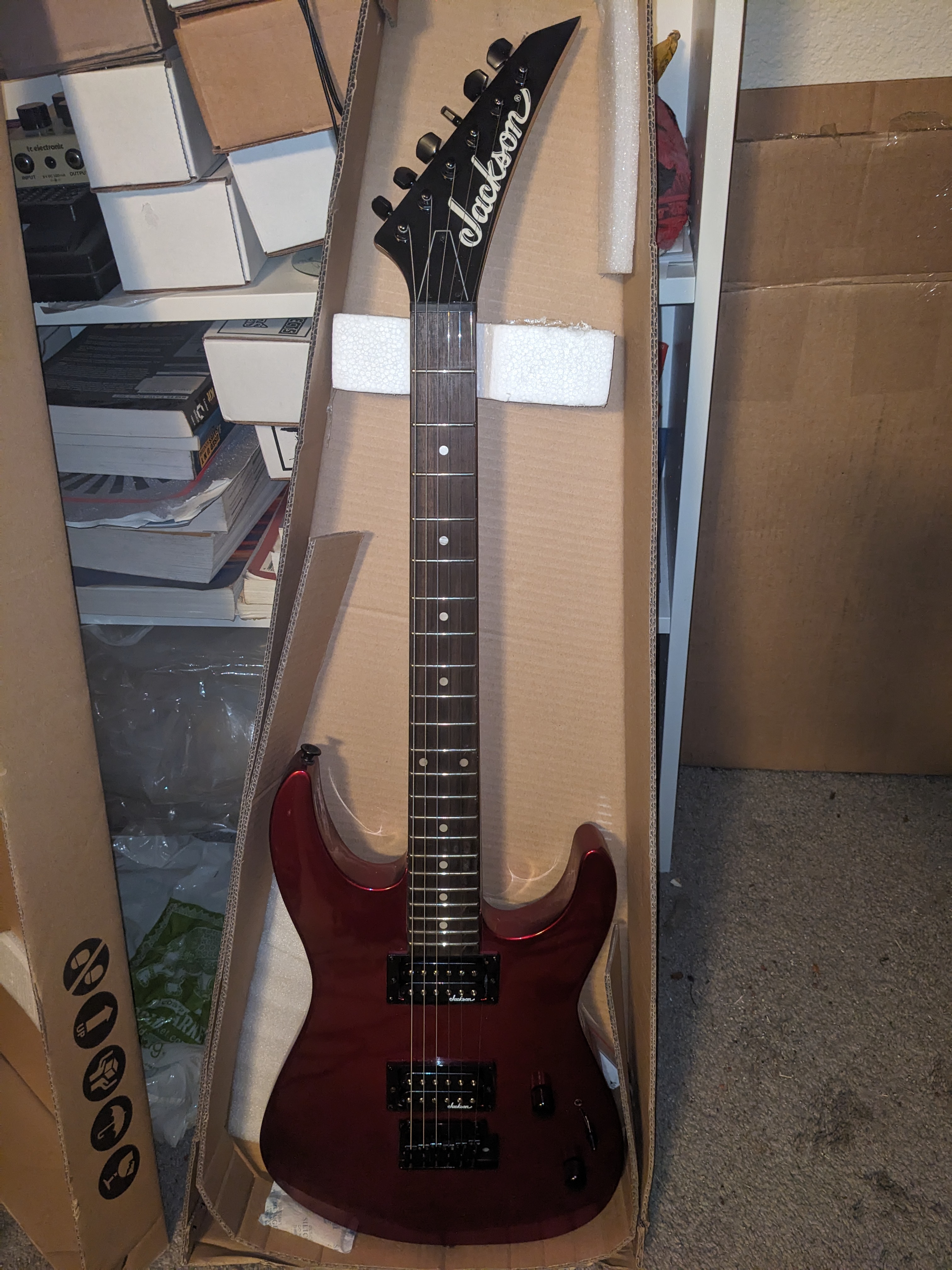
Anyway, they had a raffle, and I bought 6 tickets for 5 simoleons. I put them in various bags they had for the raffle awards, and they had one for a Jackson guitar. I put a ticket in and thought “Heh, I want it, but I certainly don’t need it. I’ll probably win it.”
Sure enough, I did win it. Oddly, I have 20 something guitars, but I’ve never had an actual functioning super-strat. I have two that started life as one, but their poor necks were abused beyond anything besides a complete replacement before they were mine. So they got set up for slide guitar, and that’s what they’ve been used for. So this is probably my real first long-term relationship with one of the major “Flavors” of guitars. I almost certainly wouldn’t have bought it for myself, and I’m likely to loan it out, but I very well think I may keep it. If nothing else, it is pretty.
Congratulations Scabpicker. You can never have too many guitars.
Since you got it for almost nothing. It’s worth $250 for a Plek job and setup. It can and does turn a mid priced guitar into a much higher priced model. The low action might even impress you enough to take it on stage. It depends on whether you like the pickups.
I had to restain myself from asking Sweetwater for very low action. Our humidity in the summer and dry gas heat in winter would require tweaks to avoid buzz. I told Sweetwater Luthier discretion which is still lower than Fender factory setups.
Mostly I’d agree with you, but I will say that the MFD humbuckers in my most recent G&L split to a very clear, bell-like single coil tone. I know the MFDs use a little different technology and that G&L does the tone circuit a little different than what’s traditional, and wow, it actually works.
I like the coil split (coil tap?) positions on my Ibanez RG - they don’t exactly sound like actual single coils, but they have a nice “quack” like positions 2 and 4 on a Strat and are a very usable sound in their own right. Definitely not “bullshit”.
Ok, I’ll give you that the coil split on my PRS actually sounds good. My understanding is that both coils are mixed in, one of them at 50%. I still don’t use it very often
I can hear a clearer sound in the split coil mode. Brighter. I need to try it for awhile and decide.
I’m not hearing any hum from this guitar. That’s using the Vox Amplug2 headphone amp.
I’ve been playing acoustic too long. It’s screwed up my muting. On acoustic relaxing my fretting finger mutes and I can press back down without making any sound. On electric the pickups try to hear the note unless I change how much I relax that finger. It was frustrating me last night on a song I’ve played for years.
Am I odd that I usually keep my switch in the middle position? Both pickups on.
The bridge pickup by itself seems harsh and jangly strumming. Might be good for bluegrass. Compete with the banjo.
The neck pickup by itself sounds good for lead. But I’m lazy and just keep them both on.
The middle position on an HH guitar is often the sweet spot, especially if you can balance the volume and tones. I’ve got an Epiphone 335 that sounds great with both pickups on and the bridge backed off a bit.
I just got done with my first bit of hands on time with it. Believe it or not, this guitar needs nothing as far as the fretboard goes. The set up is great, action is nice and low, frets are well dressed. The finish is pretty dang nice, too. There was still some buffing compound spots on it, but they wiped off easily enough. The pickups actually sound pretty good.
The expected bad news: Without a locking nut, that vibrato arm is really a “let’s knock this guitar out of tune” arm with anything but the most gentle usage. If I keep it, it will probably get one.
So, obviously built to a price point. But yet again, I’m amazed at how much guitar $160 gets you these days.
I have an old Kramer bass with an aluminium neck and head.
I have always though this might come in useful as a defensive weapon if I was playing in a tough room and the punters invaded the stage.
Haven’t actually had to put it to the test, though I do recall a gig where the room erupted into one of those classic movie brawls where everyone is throwing punches and hitting each other over the head with chairs etc.
Fortunately the band wasn’t involved with any of the combatants. Once the cops had cleared the place out we did think about starting the next set with “Saturday Night’s all Right for Fighting”, but decided it would be in poor taste…
The Kramer is actually quite a good bass, though rather susceptible to temperature changes; ideally you want to get it in tune in the room well before the gig.
It’s a 450B. Quite conventional shape body, I’m afraid.
It actually plays and sounds like a fairly traditional bass; I’ve often used it as a second intrument for quick instrument changes when I need to rapidly swap to a different tuning. And a few times as the main gig axe when other instruments were in the shop for some reason.
I found out quickly how different standard radius 9.5" or 9.75" feels compared to 15.75" on my new guitar.
9.5" is a gentle curve. You can lean your fretting fingers in a chord a little without slop.
15.75" is much flatter. It’s great for lead until I started playing chords. Where is that buzz? I had to arch my fingertips and get them vertical. No leaning means no slop. I’ll adjust in a few weeks and be a better player afterwards.
Going back to 9.5 or 12" radius will be easy after playing on a flatter fretboard.
If you press the Tune Mode Button once, the cur-
rent tuning will be displayed ("--  E  --" for stan-
dard tuning). Pressing the Tune Mode Button re-
peatedly will cycle through the following tunings:
Display
Mode
--- E --- Standard tuning
Eb
All strings tuned down 1 semitone
D
All strings tuned down 2 semitones
Db
All strings tuned down 3 semitones
C
All strings tuned down 4 semitones
B
All strings tuned down 5 semitones
F 1
Capo at first fret
Gb 2
Capo at second fret
G 3
Capo at third fret
Ab 4
Capo at fourth fret
A 5
Capo at fifth fret
Bb 6
Capo at sixth fret
B 7
Capo at seventh fret
But the pedalboard version does drop tunings, too, and from what I understand you can combine drop tuning and downtuning, e.g. Drop C.
A pedal like that is crucial when the song is a half step too high for the singer. It’s such a pain carrying a 2nd guitar on stage tuned down to Eb. A lot of hit songs were recorded that way for the vocalist.
Hehehe, ok. There was a flying V aluminum necked Kramer that was offered locally a few years ago for what I felt was the very reasonable price of $699, and I’m still kinda kicking myself for not grabbing it.
Nothing wrong with a conventionally shaped one. And yeah, it’s a bass. Other than the aforementioned sensitivity to temperature, they behave like you’d expect a bass to behave. But I still think they’re sexy as hell.
I can’t recall seeing this Plek demo posted. It demystifies the machine. Plek is primarily a scanning tool and optional fret leveler.
Everything is controled by a well trained Guitar Tech. The guitar is scanned and graphs are created that show the height of the frets. The Tech sees that a Truss Rod adjustment is needed. Scans again. Sees a little twist in the neck. Wood does that. There are a few high frets.
Tech sets up the fret leveling on the machine. Strings come off. Machine scans again and then grinds only the necessary frets. Scan again. The Tech installs strings and ends with a traditional setup.
We need a drinking game for everytime they say Scan Again. That’s the whole point. Redundancy is up to the wazoo on this machine. Guitars are safe in them.
Biggest detail! A honest store should only charge a 30 to $45 scanning fee when the guitar only needs a Truss Rod or Nut adjustment. That’s always done by hand.
The large $250 to $300 charge is for Plek fret leveling. That should only be done when the graphs say it’s really needed.
Three of my guitars were PLEKed back when I lived in Seattle near a shop that was so equipped. Two guitars were recently setup, leveled and finished by hand. I’d be hard pressed to know which was which if I came to them blind. One of the hand-setup guitars is probably the nicest playing instrument I’ve ever played so there’s that.