After the Massachusetts election, some liberals here pointed out that MA’s system has many of the same features Obama wants for the country. The Daily Show recently had a segment about how Hawaii does too (mandates for those employed, and so on).
What, if anything, can the experiences and health care laws of individual states, even ones not mentioned above, tell us about what may or may not work nationally?
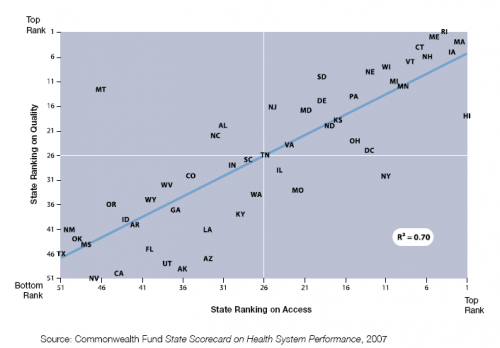
Well, going by this PDF (page 11), and this graph, the top guys for care and access are Vermont, Connecticut, New Hampshire, Maine, Rhode Island, Iowa, and Massachusetts.
Within the entire US, the greatest spending is $6,683 per person in Massachusetts and the lowest spending is $3,972 in Utah. Ignoring that even Utah is paying 25% more than any European country, I think we can still say that spending as close to that as possible evidence of doing something right. Frankly, Massachusetts sucks on that scale, since there probably isn’t a significant difference between it and the others I listed as being in the top. Iowa and New Hampshire, coming in at about $1000 less per person than their competitors might have something to teach. I have no idea what that might be, though.
And even then, we’re still $2000 higher than need be, compared to the rest of the world.
What we have seen here since the introduction of the individual mandate (with employer penalties for not providing health insurance) is improved access to health insurance, but soaring costs, because the supply of health services cannot keep pace with the [now funded] demand. For example, nurses salaries have risen 40% in the last five years. The average nurse’s salary is now over $80,000, one of the highest in the country. And nurses in Mass have the lowest patient workloads in the country.
I looked over a budget for one of the largest hospitial organizations in Mass early last year. Physician salaries were rising at a rate of 8% per year for the previous three years.
And the insurers have been announcing huge increases in premiums (one of the biggest announced a 37% increase), because the government is cutting back reimbursements for the state programs and for uncompensated care at the same time as those programs are exploding due to high unemployment.
So most of the increase in spending is reflected in higher compensation for the health care providers, and a much smaller portion going to more care being actually provided.
Basically Massachusetts response to having some of the highest healthcare costs in the country was to introduce a plan that increased access (funded demand) without doing anything about costs.
Not that I don’t think health care costs in MA are unreasonable high but I think that assessment unfairly correlates MA’s health care costs with our health plan. MA’s costs may have little to do with the health plan offered.
MA is more expensive when it comes to anything. Compare the costs of milk and bread and you’ll likely find higher costs there as well. I wouldn’t take ‘MA has a overly expensive food distribution system from those numbers’.
Boston has some of the best hospitals in the world. People fly in from all over the world to have access to those doctors and pay a premium for it. When comparing averages those people are going to inflate the numbers.
Our pediatrician charges $130 for a visit. In Atlanta it is $92. I am talking about the amount that the insurance company pays, plus my $20 co-pay. Nursing costs in Mass are much higher (like more than double) because not only are the hourly costs higher, productivity is lower.