We are all familiar with the popular misconception of the evolutionary chart, with a gibbon followed by a chimp followed by an Australopithecus followed by a neanderthal followed by us.
But even when we are told “it was actually more complicated than that”, I think the image in most of our heads of the last common ancestor of humans and chimps basically is a chimp.
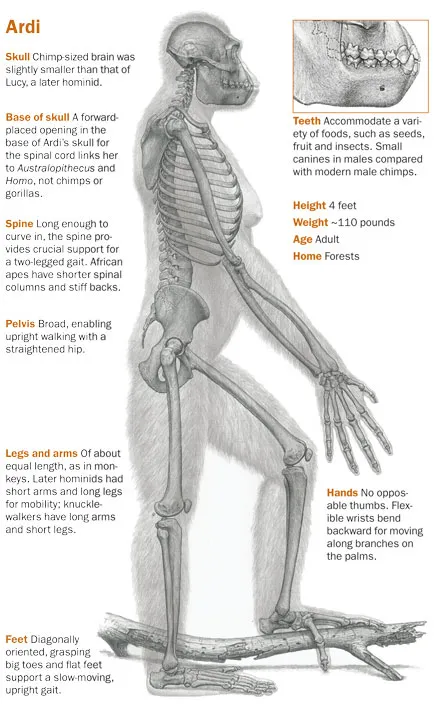
However, my understanding is that there is a serious problem with this image, and that is knuckle walking. Chimps and gorillas appear to knuckle walk in totally different ways (in terms of how they shaped their hand bones to allow them to knuckle walk); but neither human no chimp ancestors nor any other known Miocene apes appear to have knuckle walked.
Which raises the question. If the human/chimp last common ancestor didn’t knuckle walk, how did it move around?
From what I can figure out, it may have been a chimp-sized but gibbon-shaped tree dweller that would have potentially been bipedal both on branches and on the ground; we think of humans as “coming down from the trees” and of chimps as staying in the trees, but in fact we are both terrestrially adapted from completely arboreal ancestors?
I was going to ask why we don’t have anything filling the “chimp sized gibbon” role today, but I guess that’s sort of what an orangutan is?
I guess it seems a bit counterintuitive that our closest relatives (chimps/bonobos - the Pan genus - followed by gorillas) are all so terrestrial but our most recent ancestor was probably more orangutan-like. But is that because the tree dwelling great apes died out while the land dwelling ones survived? Except that there used to be terrestrial apes in Asia who went extinct, and apparently arboreal apes in Africa who went extinct - what was different about the jungles of central Africa and southeast Asia that meant that different types of apes survived in each place?