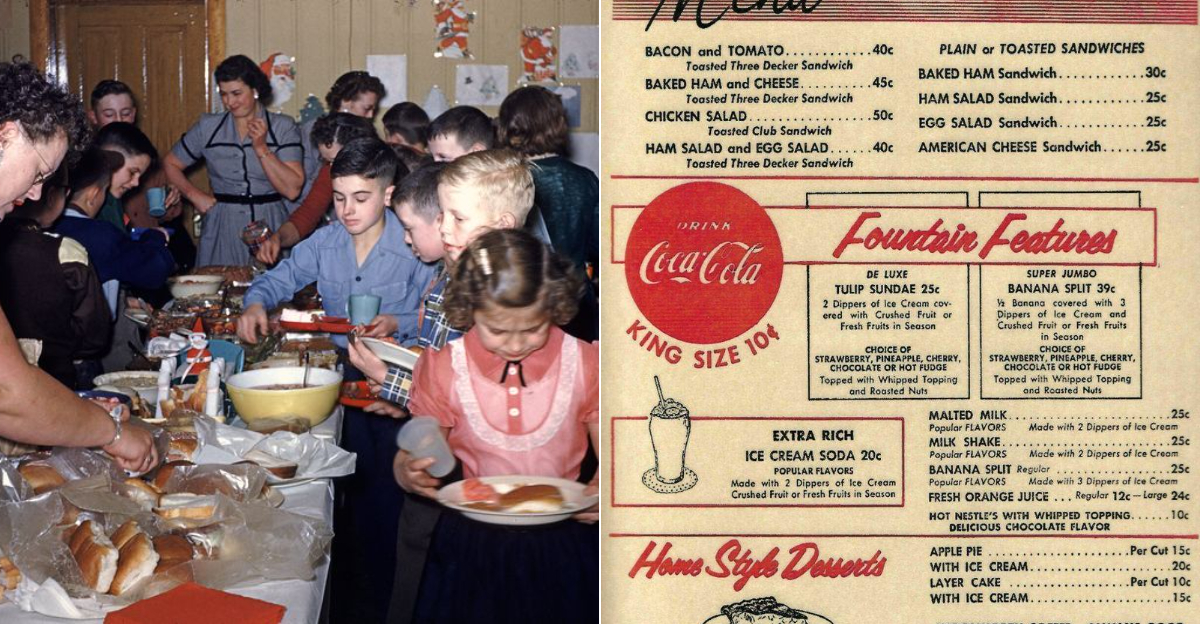
When I lived in Bremerton, WA we had a (very small) chain of restaurants called “Crazy Eric’s”, and in the mid 90s you could get a whole bag full of burgers for a couple of dollars. A burger wasn’t significantly more expensive than what it would cost at McD’s in the 50s. But that place was an anomaly. (And a real godsend to a starving kid making minimum wage like I was.)
These days, looking it up online, a burger is like $1.50, which is still pretty good compared to most places.
My point is that you have typical prices, but also outliers in fast food joints.
If you look up what the paper order tickets looked like in the early years, ordering a dozen hamburgers had its own checkbox. I don’t think patrons really thought about ordering meals and were more likely to order a sack of a dozen hamburgers and a few fries for those who wanted them or the like. Maybe dad would have 3 hamburgers, mom 2, the kids one each, save some for later sort of thing.
My uncle would signal 10 fingers to the line cooks at McDonalds when he’d take my sister and I for a treat when one opened up on the Berlin Turnpike (CT). The 3 of us would devour all easily. Sis and I were 10 and 13 yrs at the time.
Yes. According to Bill Bryson (Made in America) the burgers sold by the original McDonald’s when Ray Kroc bought the business from the brothers had two-ounce patties. This enabled families to order a dozen and eat however many suited them.
Good question. I had thought there was a surtax intended to discourage people from consuming unhealthy fast foods, but apparently there isn’t. Perhaps something like that had once been proposed but not enacted. So McDonald’s and other sellers of prepared convenience foods costing over $4 charge the combined federal and provincial sales tax, increasing the cost by 13% in Ontario. $4 and under, the provincial tax is waived but the 5% federal tax still applies. There is no tax on basic normal groceries.
People might have ordered them by the dozen rather than counting up who wants one burger and who wants two - but people also ate less in the past. When I started my first fast food job in 1979, a regular soda was 12 ounces- now that’s an extra small. The largest soda was 21 ounces- now that’s a medium. It was not unusual for adults to order a burger, small fry and soda ( or sometimes coffee, something you don’t really see anymore). That’s actually been my normal fast-food meal since then , even when I wasn’t on Ozempic or anything else. Once in a while I’ll have a Big Mac or something similar, but that’s maybe once a year. To a certain extent, the amount people eat depends on what is presented as a normal serving size - if the smallest non-kids meal burger is 1/4 lb, that’s what they will order. And if they order it, most people will eat it.
Really? Because as I remember, the “classic hamburgers” currently have 1.6 ounce patties; ten to the pound, in other words. If they were two ounces then, they were made smaller at some point.
The thing that McDonald’s calls a “hamburger” or “cheeseburger” today is pretty much the kids’ version, as included in the “Happy Meal” or by itself. If that was the McDonald brothers’ original basic burger, it makes sense that it would have shrunk as it began to cater almost exclusively to kids, and Big Macs, Quarter Pounders, and the like began to dominate the menu.
I will say that my dog and I were both big fans of the basic kids’ cheeseburger. We both had them as a treat once in a while. These are not legitimate burgers in any proper meaning of the word, but there’s something compelling and almost addictive about the sheer junkiness of this junk food! My dog fully agreed! Since he lacked the dexterity to hold the burger himself, I held it for him as he took great big bites out of it!
I mean to price compare to today’s closest equivalent. According to my McDonalds app, a Cheeseburger, small fry, and small coke (ordered individually, a Value meal combo defaults to med fries and drink) would run me $6.77. Not a huge increase, as far as inflation goes.
There was a San Jose/Bay Area chain in the 70s called Munchies that had burgers for 10¢ (later went up to 15¢). They hit the spot if you were broke and had the namesake condition after partaking.