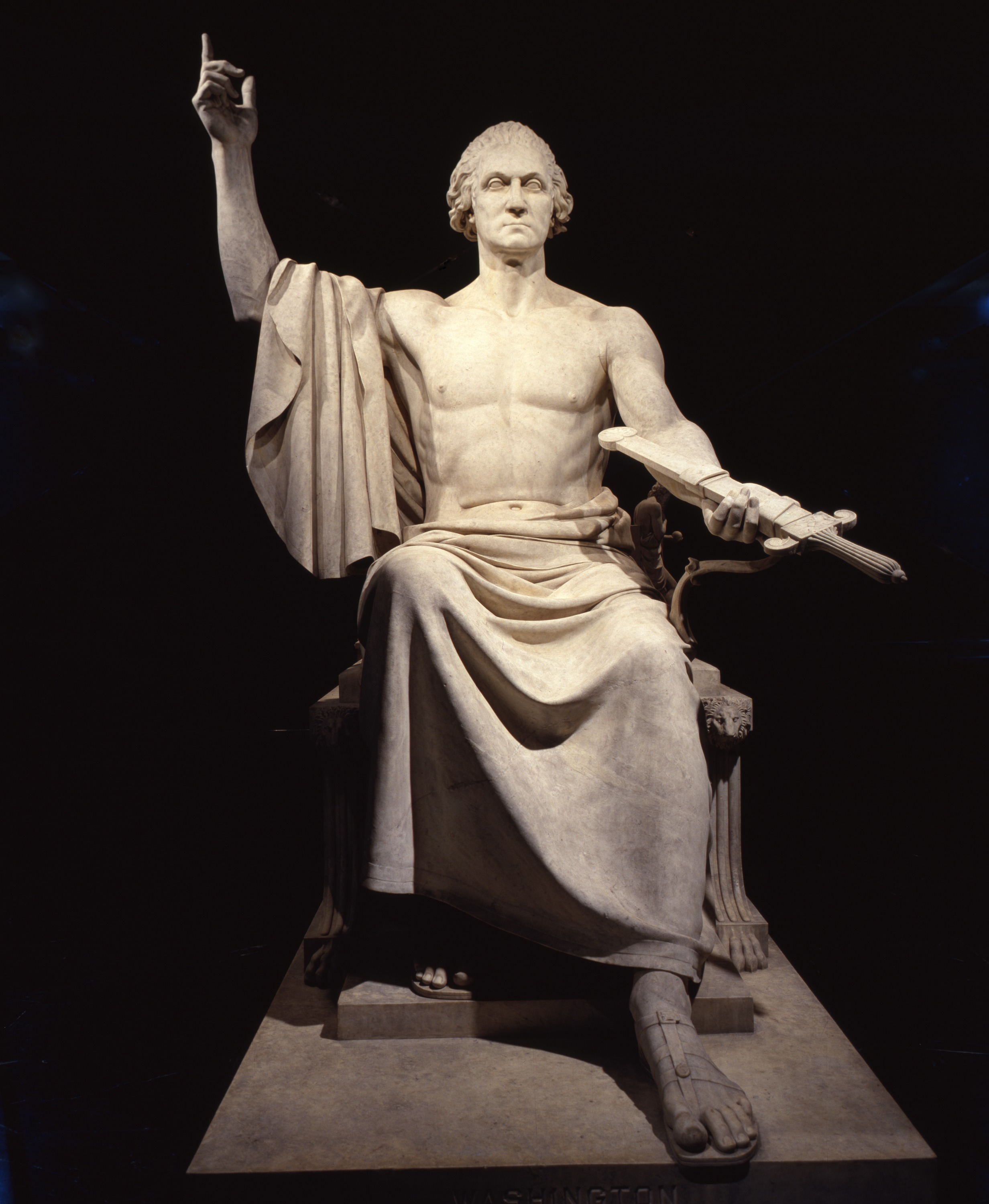
What's The Big Deal About George Washington?

Well, you know what they said about another famous general: Look at those eyes, cunning and keen,
Look at the size of those thighs, like a mighty machine!

Those are the mightiest thighs that I ever have theen!

And of course we do know that Geo Washington could depress a hyena.

And owned slaves.

But howza about those thighs?

They were thicc

You all laugh and mock, but a man doesn’t do many of the most important things in his life on horseback without developing some seriously impressive gams.

What’s really getting short shrift here, however, are Washington’s abs. Dude was ripped; among President’s, only Lincoln can really compete.

To the OP: Do you remember when Joe Namath beat the Colts in Super Bowl III, even though the Jets were 18 point underdogs, and how he’s still known as Broadway Joe, and people still ask him for an autograph? It’s sort of like that, except with world politics.

Frederick the Great, who knew a thing or two about both warfare and men’s thighs, sent Washington a sword with the accompanying message “From the world’s oldest General to the world’s best General. Friedrich.”

John Brown sent an accomplice on a four-mile side trip at Harpers Ferry to swipe it from Washington’s great-grandnephew, so he could wear it during the fight.

This deserves a link since it addresses the OP succinctly. Warning: profanity ahead.

Well, you know what they say about guys with big thighs…

I like thicc thighs and I can not lie
You other Fathers can’t deny
That when a pol walks in with an itty bitty wig
And round thighs oh so big
You get sprung
Wanna pull up? Tough
'Cuz you notice them thighs was stuffed
Deep in the breeches he’s wearing
I’m hooked and I can’t stop staring
Oh, Georgie I wanna get with ya
And paint your picture
My homeboys say I’m neurotic
But those thighs you got
Make me so patriotic
Ooh, thighs of smooth skin
You say you wanna be my Prez?
Well run with no opposition
'Cuz you ain’t that average politician

Roses are red,
Redcoats are skittish.
If it weren’t for George,
We’d all be British.

.

Two original GW poems in a row, what more can we Yanks ask for?

Thighs of steel
Yet teeth of wood
You’d take that deal
If you could

I am crying

Ditto. :rofl:

You think I corned wallis? 'ja hear the cries?
When I got him, between-a my thighs?

All of you know, I tell no lies!
'bout the size of my thighs, boys
And their sighs for my thighs

Ain’t nobody knows, how much I tries
Poundin’ my quads, 'cept 's no surprise
Centuries later, they’re praised to the skies
Long after I dies, boys
Long after I dies.

Ron Chernow’s Washington elevated the man in my mind, too. Washington was a born leader, a hero, and one tough hombre.

I thought it was common knowledge that George Thick-Thighs Washington put disagreeing cabinet members’ heads into a standing headscissors lock until they complied.

When I hit bottom, I was crushing man’s skull like sparrow’s egg, between my thighs… and I think, why you have to be so bad, George? Why can’t you be more like good guy? Then I have moment of clarity… if George is good guy, who will crush man’s skull like sparrow’s eggs between thighs? And I say, George, you are bad guy, but this does not mean you are bad guy.

Lol. This thread is making me wonder if I accidently took too much cold medicine.

You got that right.

He’s got that chiseled look.

A more serious response to the OP:

[I Am Not An Historian, so all of the following is As Far As I Know, and As I Understand It, and I could be wrong.]

George Washington was, initially, actually not that great a general. He made a lot of tactical and operational mistakes. But, and this is critical, he learned from his mistakes, and improved his performance as the war went on.

“It takes 15,000 casualties to train a major general.”
- Ferdinand Foch

But beyond that, as discussed upthread, he had an excellent strategic vision. Many of his contemporaries were thinking in terms of defeating the British Army in detail on the battlefield. Washington was thinking in terms of avoiding being defeated in detail on the battlefield by the British Army. He correctly realized that the Colonies’ only real hope of victory was to maintain the Continental Army as a cohesive fighting force that was capable of credibly threatening the British Army, an army-in-being. And he managed that strategic task brilliantly, and at times seemingly by sheer force of will.

As also discussed upthread, it was after the defeat of the British that George Washington had what was probably his finest moment. A group of officers were upset over back-pay they were owed, and were plotting mutiny. Some of them probably just wanted to extort payment by threat of force, but others seemed to want an actual coup against the Continental Congress. At that point, Washington could have done what so many generals before and since have done. He could have harnessed those officers to install himself as a military strongman. Or just stood aside and let himself be used as a figurehead for an armed mutiny.

Instead, Washington addressed the disgruntled officers, and talked them down. He defused the situation, convinced the officers to lay down their arms, disband, and go home, and lead the way by example.

“Gentlemen, you will permit me to put on my spectacles, for I have not only grown gray but almost blind in the service of my country.”
- George Washington, addressing members of the “Newburgh Conspiracy”

After that, when it became clear that the Articles of Confederation were dysfunctional, and a new Constitutional Convention was called, George Washington was the consensus pick to preside. He doesn’t seem to have been a particularly active presiding officer. But what he did do was vital. Despite being a pretty literal embodiment of the Virginia planter aristocracy, he was widely viewed by the members of the convention from all sections of the country as a fair and capable presiding officer. And there were a lot of deep-seated and highly contentious sectional conflicts in the new country. And a lot of big egos representing those sections. George Washington was probably the only person in the country who both had the stature to wrangle all of those egos and the perceived equanimity and fairness to convince them that their sectional interests were being duly considered.

And then he was elected the first President of the United States.