Okay, you’re going to have to explain that one to me.
Five Easy Pieces: Bobby wants toast with his breakfast at a diner with a “no substitutions” policy, so he orders a chicken salad sandwich on toast…hold the lettuce, hold the mayo……
Hey, you get the three brightest stars, two extra naked-eye galaxies, and the only naked-eye supernova in the past few centuries. Let us have this.
I’ll always remember looking up in awe during the Penguin Parade at the Magellanic Clouds and Orion standing on his head instead of the literal march of penguins in front of me.
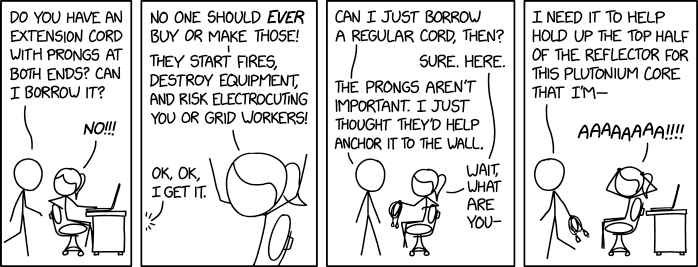
“‘Oh, and can I borrow 50 sacks of loose flour, a pile of lithium-ion batteries, a bucket of bleach, and a bucket of vinega–’ ‘NO!!!’”
Now if he’d mentioned a tank of chlorine trifluoride then she should have been worried.
I’ll take “high energy chemistry trivia” for $200, Alex.
I don’t know anything about chlorine trifluoride, but just the name scares me.
You don’t need a cord. A simple screwdriver will work fine.
It’s that dihydrogen monoxide you’ve got to watch out for. A single spill of that stuff back in 1889 killed over two thousand people in Pennsylvania.
The name doesn’t scare me because it sounds chemical-y and I don’t understand what it means. It scares me because I do understand what it means.
Well I don’t. Please explain.
If you know anything about gaseous (molecular) fluorine, then here’s a factoid: Chlorine Trifluoride has been described as a more powerful oxidizer than molecular fluorine.
Yikes!
There is a wikiarticle about chlorine trifluoride, a compound that mixes two halogens, highly reactive (oxydising) compounds. From that article, a nice quote:
It is, of course, extremely toxic, but that’s the least of the problem. It is hypergolic with every known fuel, and so rapidly hypergolic that no ignition delay has ever been measured. It is also hypergolic with such things as cloth, wood, and test engineers, not to mention asbestos, sand, and water—with which it reacts explosively. It can be kept in some of the ordinary structural metals—steel, copper, aluminum, etc.—because of the formation of a thin film of insoluble metal fluoride that protects the bulk of the metal, just as the invisible coat of oxide on aluminium keeps it from burning up in the atmosphere. If, however, this coat is melted or scrubbed off, and has no chance to reform, the operator is confronted with the problem of coping with a metal-fluorine fire. For dealing with this situation, I have always recommended a good pair of running shoes.
Nazi Germany had a pilot plant to produce it but it was considered “too dangerous” to use, unlike 85% concentration hydrogen peroxide, or fuel mixtures containing hydrazine.
To put it in simplest terms: It’s a molecule of one atom of chlorine and three atoms of fluorine. All four of those atoms would very much prefer to be in molecules with pretty much anything else.
as a southerner, who is also fighting ignorance, I’d like to show you my appreciacion for not calling an aurora … ahem … northern lights … b/c we have them too … just in the south
sounds like something, Derek Lowe would write …
It was John D. Clark. There are similarities, but he is no longer among us. He was an American rocket fuel developer (thus the quote), chemist, and science fiction writer. He was instrumental in the revival of interest in Robert E. Howard’s Conan stories and influenced the writing careers of L. Sprague de Camp, Fletcher Pratt, and other authors. He had an interesting life.