Oh, and “neutralizing” a reactive substance is easy. When it reacts with anything, what’s left won’t be that substance any more. And since ClF3 reacts with almost everything, almost anything will serve to neutralize it.
This is sort of like saying that if you’re stuck in some high place, it’s easy to get down. What’s difficult isn’t getting down; it’s getting down gently.
Typically it only stops reacting because you’ve run out of reactant, either the chlorine trifluoride itself or whatever it’s reacting with. If the chlorine trifluoride is uncontained (e.g. such as being spilled on a concrete floor), you’re never going to run out of the latter, so the reaction is going to continue until all of the chlorine trifluoride is gone.
There’s not much that chlorine trifluoride won’t react with*, including water and carbon dioxide. That’s why the standard fire-fighting technique is to back off and let it react with everything in the vicinity until it is all consumed.
*Exceptions include metal fluorides (which form a passivating protective layer inside metal storage containers), nitrogen gas, and some noble gases—specifically, the ones with a lower atomic number than xenon: helium, neon, argon, and krypton. Xenon will react with it, forming various xenon fluoride compounds, as will radon.
Yes, but whatever it’s reacting with isn’t just annihilated. If you take a big tank of ClF3, and introduce a small amount of, say, hydrogen, it’ll react with the hydrogen until the hydrogen is all used up, forming HCl and HF. And then it’ll stop. But the HCl and HF is still there, meaning that the ClF3 doesn’t react with those substances.
Not exactly. In this situation, with an excess of chlorine trifluoride, the HF will indeed be unaffected, but the HCl will be further oxidized to produce HF and chlorine gas.
In the case of more energetic exothermic (read “explosive”) materials, like many ClF3 reactions, it’s more the sudden start at the beginning that gets you.
Yes, agreed. Besides the substances I noted upthread that don’t react with ClF3, it also doesn’t react with these end products of its reaction with compounds containing hydrogen.
The literature on chlorine trifluoride doesn’t make this point explicitly for whatever reason. Maybe they think it goes without saying, or maybe it’s because the end products in this case (HF and Cl2) are highly toxic gases.
The literature does mention metal fluorides not reacting with ClF3, probably because this is useful in that they form a protective passivating layer in metal containers. Of course they are also an end product of the reaction of ClF3 with the metal in question.
Balancing the reaction is rather trivial as long as you know the reactants and the reaction products; they teach that in undergraduate gen chem. When you have the balanced reaction equation, there are several sources for each component’s enthaply of formation (let’s call it “inherent chemical heat energy”), and you can calculate the overall heat of reaction. Example:
C + O2 → CO2, or CH4 + 3/2 O2 → CO2 + H2O (g)
Enthalpies of formation:
C: 0 kJ/mol
O: 0 kJ/mol
CH4: -22.9 kJ/mol
CO2: -393.5 kK/mol
H2O (g): -241.8 kJ/mol
H2O (l): -285.8 kJ/mol
The reaction enthalpy (ΔH) for the first reaction is -393.5 - (0 + 0) = -393.5 kJ, i.e. you get roughly 400 kJ when you combust 1 mol (12g) of carbon. The reaction enthalpy for the second reaction is [-393.5 + (-241.8)] - (-22.9 - 0) = -612.4 kJ, i.e. you get a little more than 600 kJ when you combust 1 mol (16 g) of methane.
The problem with the reactions of ClF3 is that it isn’t that easy to know all the reaction products. We have a few plausible reactions, though:
The major problem with ClF3 fires is that when something burns with oxygen, water is inert and adding water cools down the system so the fire is put out. When something burns with ClF3, water also burns with the ClF3 and just adds trouble at the tune of 150 kJ for each 90 g of ClF3 (and 18 g of water). Just for comparison, 150 kJ is enough to boil roughly 70 g of water.
Here (PDF warning) is a rather recent study on ClF3, where they tested its reactivity to lots of different stuff, including PPE, plastics, raw chicken, cotton, paper and water.
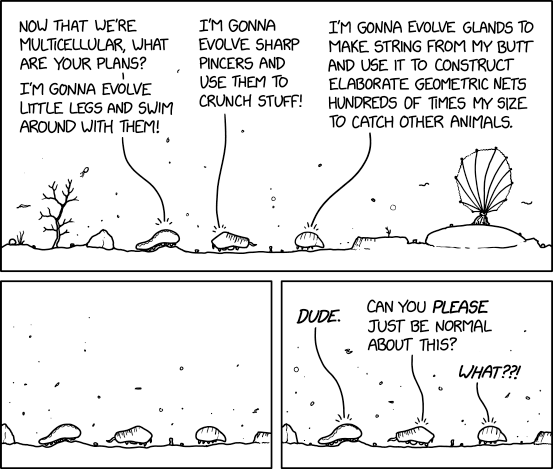
“‘Ugh, I’m never going to be like spiders. My descendants will all just be normal arthropods who mind their own busines and don’t do anything weird.’ --The ancestor of a bunch of eusocial insects”
FWIW, spiders aren’t the only arthropods to do this. Plenty of insects like silkworms do this in their larval/ caterpillar stage. Anal glands of all sorts seem to be a pretty common independently evolved feature.
The silkworms I had as a child did not use anal glands to weave their cocoons. Their silk gland was beneath their mouth. I think anal glands are spidery. And cool. Very complex too.
YouTube for once supports my memory (sorry for the soppy music, I recommend muting the video before watching).
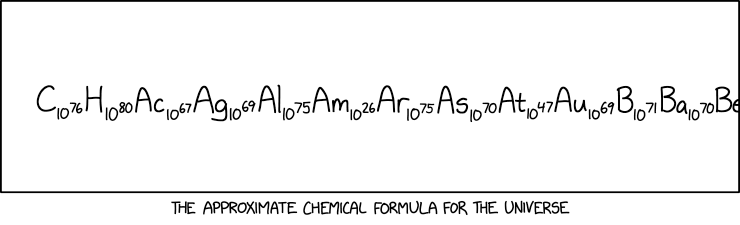
My comment makes (a little) more sense if you know I was viewing @dtilque 's post of the comic on my phone which doesn’t scroll left/right. So about 2/3rds of the comic and the lettering under it was clipped off on the right. All I saw was the elements and subscripts up through Al and “The approximate …”
Otherwise my post looks even more Captain Obvious than usual.
C & H are the vast bulk of the universe. The whole rest of the formula is a mere rounding error compared to those two. No reason not to list it in alphabetical order. In fact doing so emphasizes the fact it is a rounding error.
Although it would be fun to have listed them in decreasing abundance. Which would be H, He, O, C, …