I suppose it’s bad mostly in the sense it’s both similar and unfamiliar. It’s close to what we’re used to, except where it isn’t. So sort of a fun house mirror version of the typical Mercator or whatever.
Something radically different at least makes you stop and really think while you try to use it. This subtly misleads.
I agree it’s not standout wacky like some of his others.
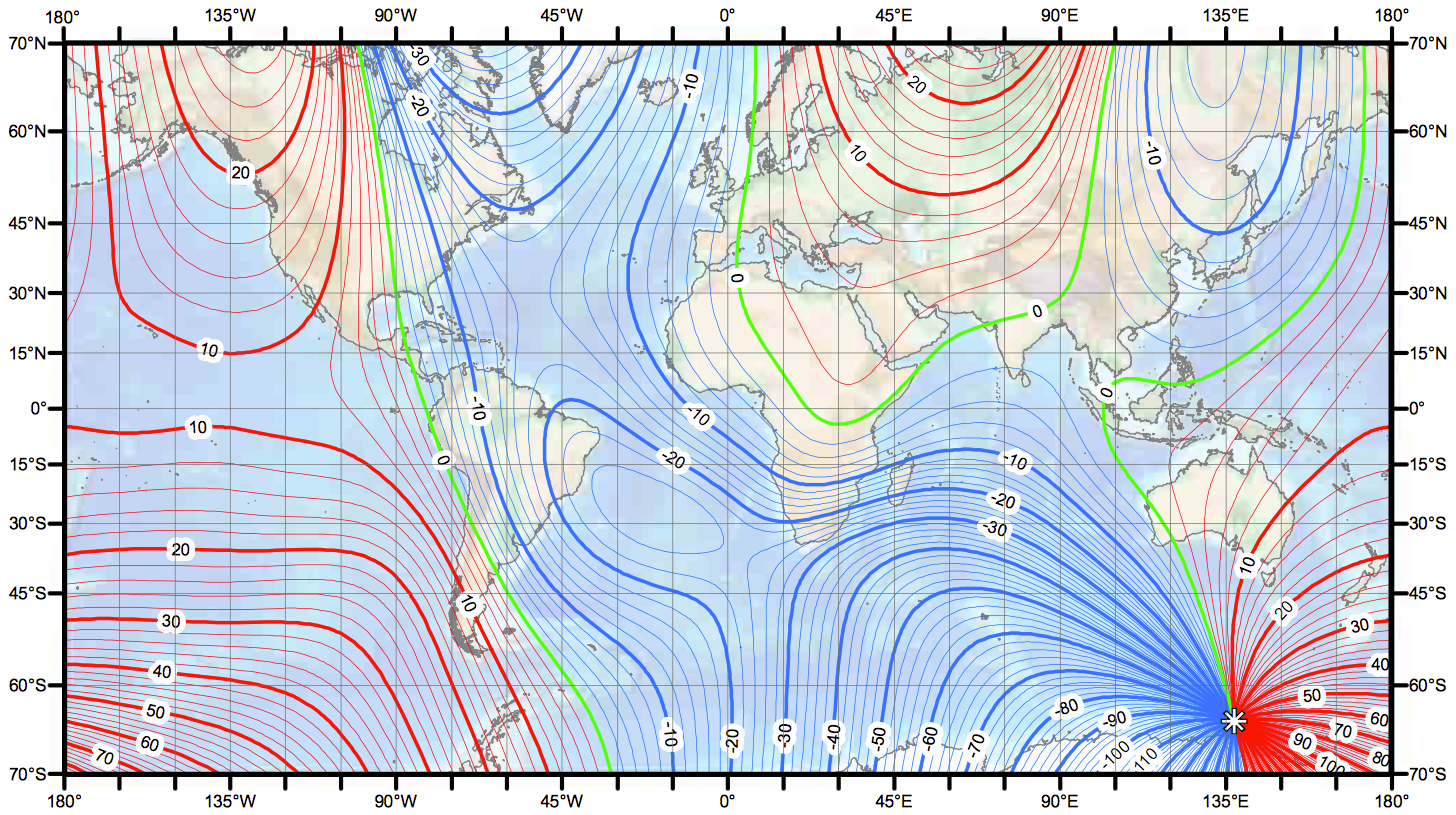
That is close to what I think, but not exactly. Here is a map with the magnetic deviation from true north/south according to location:
You see one zero line passes through France, the other through the middle of America. There are no red arrows there in xkcd’s drawing. On the other hand big distortions are found in Alaska (~20° E, red lines), East of Norway (~20° E, red lines), which both rotate counter-clockwise according to the arrows in the drawing, and around Madagascar and South Africa (~20°-30° W blue lines) and Japan and Kamchatka (~10° W, blue lines) which both rotate clock-wise.
Now in the corrected map the different parts of the world are aligned both with the geographical north and the magnetic north, which is supposed to have rotated with the land below. And it is different everywhere in a way that is not as easy as rotating the map to put the “poles” of the cylinder where the magnetic poles are, also because the poles are not even opposite each other! See the star below Australia, that would be the magnetic south pole. The coresponding magnetic north pole is not even in the picture, where it should be 45° W and 65° N, more or less north-east of Labrador, if it was opposite the magnetic south pole. As it is, it is outside the map, north of Greenland.
And calculating that shit and which parts of the world lie in the normal map less than 5° away from magnetic north and how many people live there would surely take a lot of time you could waste more productively. Reading the Dope, for instance.
Yeah, it’s more complicated than what I said, because the real magnetic field of the Earth isn’t just a dipole.
One could even argue that this map is better than maps based on the rotational pole, because the tool that we use most often with a map, for finding directions, is the compass, which doesn’t actually point towards rotational north. On this map, the direction the compass points is always towards the top of the page.
Indeed, but you would have to adjust the map every few years, as the magnetic poles wander around. That is what 2025 indicates in WMM2025. WMM stands for World Magnetic Map, I reckon.
My map, for instance, is already wrong, as I did not find a newer one on the net. The green line though France now passes through the UK.
And some day there will be a magnetic inversion again. Then all maps will have to be rotated 180°! Nobody knows when that will happen, but it will be interesting.
For a long time the North magnetic pole stayed close enough to (EDIT Prince of Wales) Island that you could fudge a degree or two. Now old-fashioned Boy Scout map and compass orienteering is a hassle when you have to toss your magnetic declination maps every few years.
I mean, on a Boy Scout scale, pretty much all you need is a single number, and you can just pencil that in and erase it every couple of years. Boy Scouts generally deal with areas small enough that the magnetic deviation is basically constant over the area.
[Aside / technical quibble]
The difference between true and magnetic north at any given location is commonly called “declination” in geoscience and “variation” in navigation. At least in navigation, “deviation” is a different reserved word for a different issue, essentially compass indication error versus the actual surrounding magnetic field.
[/Aside / technical quibble]
There’s a pretty wide tolerance on runway numbers.
It’s already +/- 5 degrees just from rounding. Then they often use adjacent sets of numbers for runways that are actually parallel. e.g. at Atlanta there are runways 9/27 and 8/26 that are absolutely positively parallel. O’Hare has 9/27s and 10/28s that are parallel. etc. So until the mag course and the runway number are more than ~15 degrees off, there’s no need to change.
The ILS approaches used to find runways in crap weather have radio transmitters that are physically aligned with the actual pavement and don’t inherently care at all what the magnetic alignment is, nor how it may change over time.
But the aircraft instruments that display the info to the pilots are magnetically aligned with the real world as it is at the moment. So one of the required parameters to configure the airplane for an approach is the magnetic course of the approach path. As variation changes over time the course numbers on the approach maps are changed to keep up, and pilots flying older manual airplanes dial in the revised course as part of their set up for landing.
But … modern airplane nav systems (“FMS”) also include internal deviation “maps”. So given a position, it can look up the relevant variation. Before I retired some of our oldest airplanes were no longer certified to do certain approaches because the FMS were so old the latest deviation maps available for them were too far out of tolerance versus the current magnetic variation.
Acceptable tolerance enroute was fairly large, but acceptable tolerance for very low weather approaches was a lot tighter. And in the areas where variation had changed a lot in the last ~20 years, sometimes that change was too much for the old gear to handle.
I was a Scoutmaster in eastern Minnesota. Luckily we didn’t even cover this for the most part, except to say if you if you are hiking elsewhere you need to make adjustments.
“My icebox plum trap easily captured William Carlos Williams. It took much less work than the infinite looping network of diverging paths I had to build in that yellow wood to ensnare Robert Frost.”