Before microprocessors made artificial stability possible, flying wing designs were bedeviled by the lack of conventional tail surfaces. Even some delta wing designs ended up needing canards for adequate stability.
And with a half-life of over a billion years, a large block of isotopically pure potassium-40 wouldn’t give off enough energy to do anything but register on a Geiger counter.
If it weren’t for potassium-40, we wouldn’t have any argon in the atmosphere and not have an important way to measure the age of rocks. So let’s not be denigrating this isotope.
When odd little experimentation with plane wing design comes up it always makes me think of the F-104 with its stubby little wings and ‘T-tail flutter’. I guess they were very good at certain things, but from my only semi-educated seat they really come off as a dog overall. Little wonder Lockheed was bribing government officials to buy them.
Ah, yes, der Witwenmacher (widow maker). Further down the page you linked to:
A total of 116 pilots were lost in West German F-104 accidents, including 1 ground-crew passenger and 8 USAF instructors.
The pilot began his walk-around inspection of his Rutan Long-EZ. “Duck!” yelled the mechanic. But the pilot spoke only French, and banged his head on the canard.
I laughed.
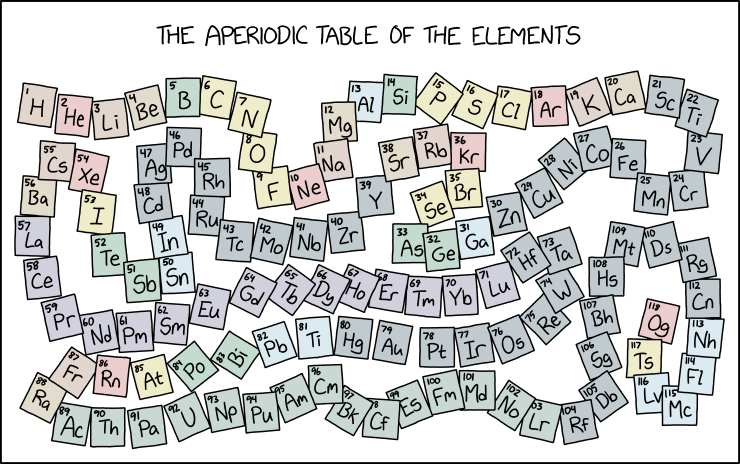
“Scientists occasionally invent alternative periodic table layouts, which is usually a sign that they don’t have enough enrichment in their enclosures.”
In that heady era USAF had no problem asking for the impossible. Then when the engineers got sorta close on some parameters and really missed some others, there’d be a negotiation to move the goalposts close to what the engineers built, have them gussy it up a bit more, then USAF would declare victory and order a couple hundred (or a thousand) of them.
The state of the art was moving so fast, and frankly being pushed by USAF’s nutty Musk-like demands, that it wasn’t really such a bad technique for industrial technology base management. But the few models USAF kept longer than a couple years before superceding / scrapping mostly developed a reputation for being problems.
Selling those kinds of machines to countries that didn’t have the resources to throw them away for something else a couple years later was not a nice thing to do to allies. Especially those in countries with shitty weather & small air bases.
I was motivated to actually see what the graphite rod out of an expended battery is like, if maybe it was usable as a large pencil “lead”. I was expecting it to be on the soft and crumbly side, but to my surprise it’s much harder than #2 pencil; apparently lots of ceramic was added to make it strong enough to withstand rough handling.
I think that a typical banana has a lot more radioactivity from carbon 14 than from potassium 40.
And I think that pencil leads also have additives to make them softer. Clay, I think?
No, the clay definitely makes them a lot harder. 8B is around 90% graphite, while 2H is around 60% graphite (and 35% clay, 5% wax)
The little, skinny leads in mechanical pencils – 0.5 to 0.9mm – have polymer plastic as a stiffener instead of clay.
I have heard of, but not tried, using battery graphite electrodes for arc lamps.
Would depend on the abundance of C-14 in your typical banana; but quite possibly.
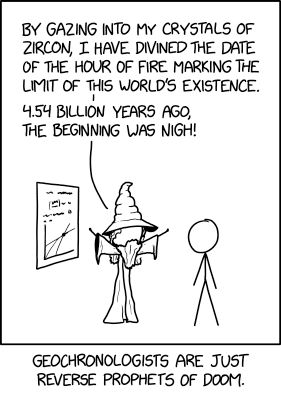
“‘Beyond that lies a vale of fire through which my vision cannot penetrate’ is the kind of fun thing geologists, heliophysicists, and early universe cosmologists have a lot of opportunities to say.”
Now I wanna be an early universe cosmologist.
Yet another cool occupation the guidance counselor in high school completely forgot to mention. Dang!
The Beginning is nigh! 
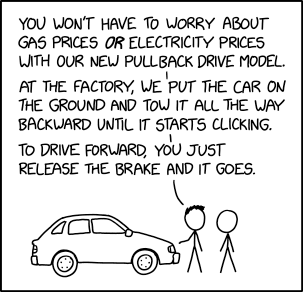
‘“How does the spring not run out almost immediately?” “We pull it back REALLY far.”’
They gloss over what the tow truck fees will be.
If you use a pullback tow truck, then it’s free.