One of my favorite YT streams when I’ve something else to do is at an artificial waterhole in Nambia. The camera points not quite due south but since the location is south of the equator, not quite at the Tropic of Capricorn, the shadow of the tower the camera is on sweeps from right to left in the middle of the day, a bit odd the first time you see it. A crescent moon must look equally odd.
Those must be the same tourists who are convinced that speakers of every language but their own “talk SOOOoooOOO FAST!”
Mainly that in the Southern hemisphere the crescent moon you see after sunset actually does have the horns point to the right, as huge numbers of depictions of the crescent moon usually mistakenly do.
I occasionally think about having a conversation with a famous scientist (Isaac Newton, for example) from the past and how I would explain astronomy†, chemistry, or electricity. And I won’t even consider Relativity or Quantum Mechanics; those are beyond my pay grade.
† Solar system astronomy would be fairly easy, since Newton has the basics. Stellar astronomy, on the other hand…
Oh, and on the current one, I’ve never picked a table in a restaurant on this basis, but I have picked a parking place based on where a tree’s shadow will be in a few hours.
I also once woke up in the middle of the night, and had to do the all-too-familiar calculation of “what time is it? Should I go pee now, or just wait until I’ll be getting up anyway?”, but didn’t have access to a clock readable from bed, so I figured out the time based on the position of the Moon. And when I determined that, yes, I’d better get up, and did get a chance to check a clock, I was within about 15 minutes.
I’ve picked a picnic bench, a parking spot, and a place on the floor (at a square dance) for my square to start the set based on where i expected the sun to be soon. I’ve picked a parking spot based on where i expected the sun to be many hours later. (At a hotel parking lot.)
At least Franklin would be familiar with the idea of progress. He wrote:
“I wish it were possible, from this instance, to invent a method of embalming drowned persons, in such a manner that they might be recalled to life at any period, however distant; for, having a very ardent desire to see and observe the state of America an hundred years hence, I should prefer to an ordinary death, the being immersed in a cask of Madeira wine, with a few friends, till that time, to be then recalled to life by the solar warmth of my dear country! But since in all probability we live in an age too early and too near the infancy of science to hope to see such an art brought in our time to its perfection, I must for the present content myself with the treat which you are so kind as to promise me, of the resurrection of a fowl or a turkeycock.”
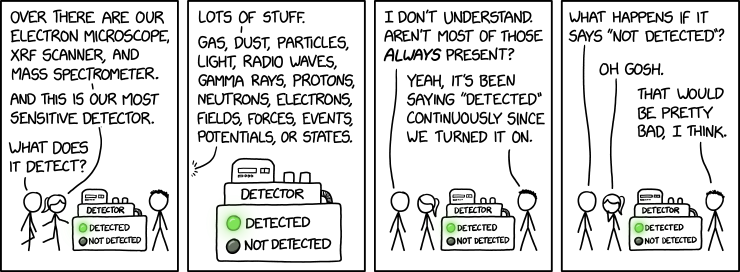
“No other experiment has a lower false negative rate.”
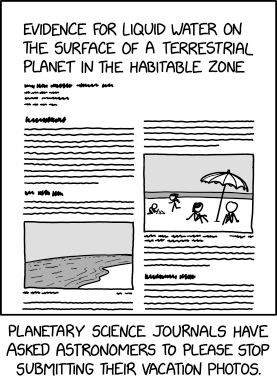
Right now there is a legit crisis in the scientific paper publishing universe. Between rampant faked data to be able to publish something, anything to avoid the dreaded academic perish, and now papers churned out by AIs, the ore to dross ratio is rapidly destroying the entire idea of published research.
I suppose vacation photos might be a net gain.
See here for more if curious: Stemming the AI Preprint Flood | Science | AAAS.
I mean, it is pretty conclusive evidence for liquid surface water on a potentially-habitable planet.
Do these have the same problem of bogus citations that AI-produced legal documents have? I expect they do, which would be a way to separate the bogus from real. Likely just checking one citation will reveal the bogosity.
Yep, same problem.
Plus of course pretty soon they’re all citing each other. Which are actual cites to actual destinations, not “404 errors”. But it’s gibberish citing gibberish as support for its gibberish.
The article I cited covers a bunch of that in just a handful of paragraphs.
Long before LLMs were good enough to produce text that could be mistaken for real writing from a real human, they were being used to produce fake scholarly papers. Some of which actually got published. Which says something about the quality of the peer review at those journals (which was the purpose for which those papers were submitted).
When you start with that abysmal level of peer review, and now toss in papers written by good, modern LLMs, one can imagine just how bad the situation has gotten.
There’s an unholy alliance of institutions that grade their researchers largely or entirely on number of published papers, researchers churning out oceans of dreck in response, and publishers who exist solely to collect the fees to have them publish your paper with zero meaningful review. Which in turn impresses the institution where those researchers work.
Then ultimately its up to the institutions to demand quality over quantity. If they don’t then science goes down the tubes. Of course then it has to be asked what pressures are they under?
It’s hard to evaluate people on things like effectiveness in teaching or skill in research, but it’s easy to evaluate people on things like “scores in student surveys” and “number of papers written” - and an easy metric that measures the wrong thing is almost always preferred to a difficult metric that measures the right thing.
See also
Then first you eliminate all those papers with bogus citations and then recursively keep removing them until no more papers are removed.
Would that there was a global authority with that power.
And the integrity to use it only accurately and unbiasedly.
Further, should your good paper be removed because you believed that an AI paper with a bad cite you never checked also provided genuine data and insight anyhow?
Think hard before answering; that cite tree is exceedingly deep.
Great!
And then you repeat that with the several thousand papers that have been published while you were working your way through the previous papers.