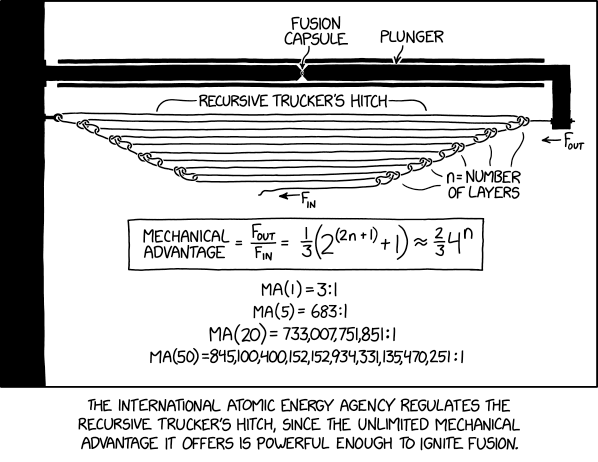
“As if the americium smoke detector incident wasn’t enough, now nuclear regulators have ANOTHER reason to worry about the Boy Scouts.”
“As if the americium smoke detector incident wasn’t enough, now nuclear regulators have ANOTHER reason to worry about the Boy Scouts.”
Every now and then there’s an XKCD that I haven’t the slightest idea what even a single element of it means.
This is one such example.
The Truckers Hitch is a knot that acts kind of like a block and tackle without requiring an actual block and tackle. It provides a theoretical 3-to-1 mechanical advantage using idealized frictionless rope. In real life the advantage is more like 2-to-1 or less because of friction.
Munroe has designed a multi-level knot that would theoretically produce an enormous mechanical advantage, like a block and tackle with many pulleys. In reality, the friction of the rope against itself would probably make the knot totally immovable after a couple of levels.
I suspect that it wasn’t his invention, but that it usually only has two or three levels of recursion.
Also, if I’m following that diagram correctly, the maximum force would be limited to a few times the ultimate tensile strength of the cord, before the top one broke.
It’s like those multiple layer gear boxes that in theory could produce enough torque to crush matter into neutronium; of course the material limits could never come close to that.
“Well, the invention works. Now it’s up to the materials engineers to figure out how to make it.”
Okay, so a trucker’s hitch is sort of like a pulley made of rope. Got it.
Why is it funny?
Same as many other XKCDs, because he’s taking something normal to a ludicrous extreme. A 3-fold trucker’s hitch that gives you a 43:1 mechanical advantage might be useful sometimes. A 50-fold one to crush a fusion pellet isn’t.
It’s sometimes represented as a sword in an anvil, with the anvil embedded in stone. This might symbolize a sword made of meteoric steel, which is ridiculously unlikely but would also be wicked awesome
Of note, the Pratchett knightly sword is forged of meteoric steel. Because of course when he was knighted, he decided, first, that that meant that he needed a sword, second, that he ought to make it for himself, and third, that he ought to make it the right way.
But did he finish by chopping the anvil it was made on in half?
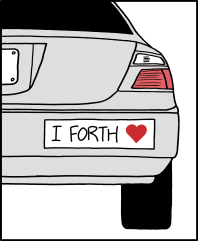
“I NOTATION POLISH REVERSE  ”
”
So is a binary or quarnary operator?
I don’t judge
This makes me really want to post some APL. Which I was once good at. But I’m not quite up to making a clever enough English statement out of it. Yet. The day is still young.
I don’t get it.
We usually write operators (at least, binary operators, which take two inputs and which are the only kind most folks encounter regularly) in between their two inputs, like “2 + 2”. But in the Forth programming language, and in Reverse Polish Notation calculators, the operator goes at the end, and operates on the things before it. One benefit of this is that an operator can operate on any number of inputs, as long as it knows how many inputs it’s supposed to take (in fact, a bare number can itself be considered as an operator, that takes zero inputs). So in RPN, you would instead type “2 [enter] 2 +” (the [enter] is needed between numbers, so you can tell the difference between a pair of 2s and the number twenty-two, but can be skipped with most inputs).
So for the bumper sticker, you would ordinarily write something like “I Fortran”, but since, in Forth, the operator goes at the end, it’s instead “I Forth ”. Here, the operator is implied to be a binary operator, with two inputs, that’s connecting the “I” and the “Forth”.
But in the mouseover text, it looks like the is taking four inputs,“I”, “Notation”, “Polish”, and “Reverse”.
Thanks. I figured something like that was going on — that is, that it was some sort of programmer joke — but had no idea what.
Thanks! I’m not familiar with Forth. I do like reverse polish notation, though, and still use it on my phone calculator.
Thank you. I’d not heard of the Forth language. I do remember my HP-48s with the reverse Polish notation, though. I had programmed it to play blues riffs.