My grandmother said she was going to leave me her Thorne–Żytkow object, but when I finally got it, it turned out to be just an ordinary red giant.
I see Randall has also read Glenn Chandler’s short story “Bobo’s Star.”
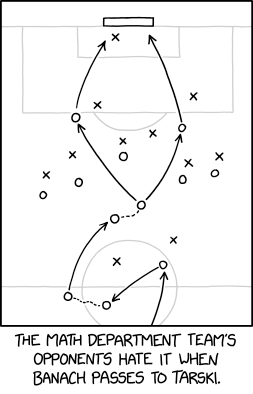
For those who don’t get this one, the Banach-Tarski Paradox is a mathematical theorem that states that it is possible to divide a ball into five pieces which can be reassembled to make two balls, each the same size as the original ball.
What’s surprising about this is the fact that it can be done with a finite number of pieces. It’s fairly trivial to do it with an infinite number of pieces, since one ball contains the same number of points as two balls, so you can just divide the ball into its individual points and reassemble them into any number of arbitrary objects. But doing it with just five pieces is surprising and nontrivial.
I wonder whether someone has kept a list of all the people and entities that have blocked his number or the hat man’s number. This was strip nr. 3282, just for numerical context.
But the theorem relies on assuming the Axiom of Choice, an “optional axiom”: The rules of set theory are equally consistent with or without it. Most mathematicians prefer to use it, since it enables you to prove many more things, but I think that that’s a reason not to use it, because among the things it enables you to prove is absurdities like the Banach-Tarski Theorem. Axioms that allow you to prove too many things are a dime a dozen. And it’s also completely counterintuitive.
What’s counterintuitive, the BT paradox or the axiom of choice? The problem is that, to me, the BT paradox is indeed quite counterintuitive, but the AC is completely obviously true.
No, the Axiom of Choice is completely counterintuitive.
“And now, I will select one element from each of these sets, and…”
“OK, which ones did you choose?”
“Well, obviously I don’t know, but I picked them.”
“How can you have picked them if you don’t know what you picked?”
The only cases where the Axiom of Choice are intuitive are the cases where it’s not needed.
Don’t the pieces have to be so infinitely convoluted that their volume isn’t conserved?
Yes. The initial ball has a well defined volume and the two final balls have a well defined (but different) volume, so the intermediate pieces do not have well defined volumes.
And as I recall, it takes a minimum of five pieces
Yes, five are necessary and sufficient. I’ve never studied the proof to understand why. It seems like a weird number to me. I guess two pieces go in one ball and three go in the other? But if one ball can be constructed with two pieces, why can’t both of them? I guess I’ll have to look at the proof sometime.
Q: What’s an anagram of Banach-Tarski?
A: Banach-Tarski Banach-Tarski.
Good one! That’s like the question:
The “father of fractals” is Benoit B. Mandelbrot. What does the B. stand for?
Benoit B. Mandelbrot.
It’s Benoit B. Mandelbrots all the way down.
IIRC, it’s the points right at the centers of the spheres that cause the problems, and if you’re not worried about those, you can do it with four.
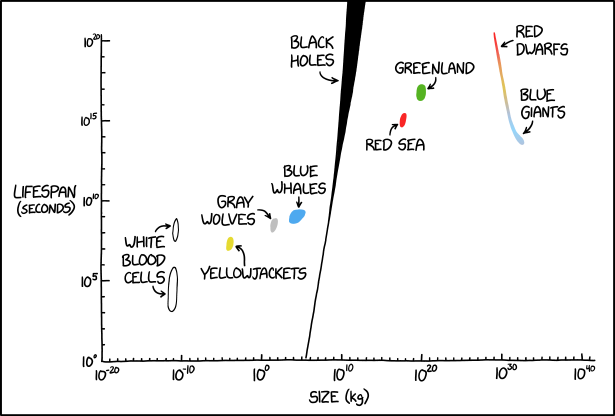
With their 13 years recording and performing together and two humans worth of mass, the White Stripes are sandwiched neatly between gray wolves and blue whales.
The Red Sea still opening and is actively forming oceanic crust. How does its lifespan end?
I’d like to see Hawaii on the chart. I forget the numbers, by the lifespan of each Hawaiian island can be estimated based on the age of the various atolls and seamounts along the chain.
Why do black holes have a spread in their lifespan/mass ratio? I would have thought it a linear function.
It’s not linear (even on a log-log plot) because as the temperature crosses various thresholds, more particle types become available to radiate.
I was thinking that maybe the spread reflected theoretical uncertainty, but that should be larger at the low end.
Can’t; it doesn’t have a color.