It’d either be able to move back out but not in again, or it’d instantly teleport out to the nearest open space. Depends on the engine reality is running on.
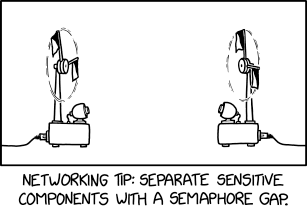
“The speed of light in air is 50% faster than in fiber, but it’s a challenge to get the arms to move fast enough to realize the latency advantage.”
It’s a prototype of
Stick to your little rings and leave Earth-shattering kabooms to us experts.
Totally aside from the silliness of a semaphore-to-digital and back interface, how is this supposed to prevent unauthorized access to either computer?
Where’s a hacker gonna get ahold of flags in this day and age?
I think there’s a rabbit in your Uranium PU-36 Explosive Space Modulator.
The same way as any other airgap, of course.
It’s not about security sensitivity, but about electrical sensitivity.
He may have borrowed/stole the idea from the Clacks in the Discworld book Going Postal.
I have to break it to you that semaphore was absolutely non-fictional:

Also, so are opto-isolators:

My husband says there was a news item recently (that i looked for, but didn’t find) about traders getting a microsecond advantage by using encrypted radio instead of sending their trades over glad phone lines. I suspect that was part of the inspiration.
Yeah, Pratchett based his semaphores on the real ones that were all over the world in the 19th century
Telegraph Hill in San Fransisco is named for the optical telegraph that was there
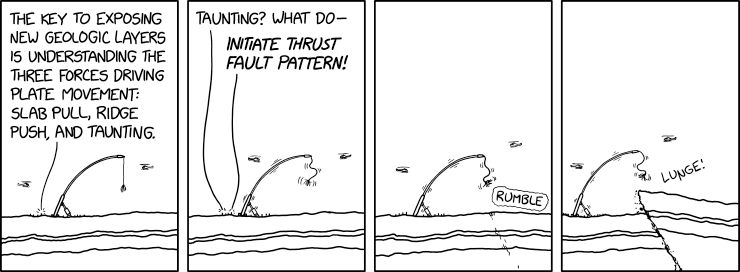
“One of the first things they teach you is to NEVER play with the geology toy over a mantle hotspot.”
Another nice geology one, I feel seen.

“To access distant parts of the project, I ended up building a regular-scale passenger train inside each rail.”
That’s probably in violation of the zoning —
It would slow it down, but they are still connected, unlike a proper airgap.
Proper airgaps are still connected, too. Computers are useless if they’re not connected. You have to have some way of getting input to the computer, and getting output from the computer, in order for it to do its job (whatever that is), and so long as there’s input and output, there exists the possibility to use those inputs and outputs to compromise the computer.
Yes, but the standard air gap involves a mandatory human vetting of the input/output process.