The Japanese refer to screwdrivers as either “plus” or “minus” in – of course – Japanese.
I am surprised you did not link to your post over there in the Pit:
ETA: Hm, did not link as I inteded. But the link is fine.
ETA 2: Now it does. Misterious ways and so on…
There actually were certificates issued with private keys that were integers less than 256.
That has the makings of a really big disaster.
I’m told that if you update your browser, it probably won’t affect you. (unlike the PHP bug, which is a big deal. If you manage a website that uses PHP, and you haven’t addressed it, you should take your site offline until you have.)
“Forget it, Par. It’s Discourse.”
Here’s a more accessible article on it:
eMudhra is getting out of the certificate business. Ars Technica replies, “don’t let the door hit you on the butt”.
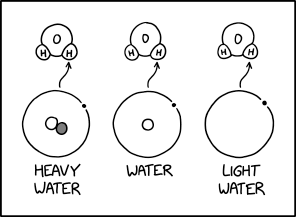
“The ‘light’ refers to bremsstrahlung.”
You might have trouble defending the argument that oxygen bonded with the element that has the atomic number zero can be called “water”.
It’s just one of the hydrogen atoms that’s lacking a proton. That makes the molecule HO with an extra electron.
Well, if heavy water is D2O and light water is H2O, BOTH hydrogens in the heavy water have an extra neutron even if Randall only points to one of them.
If your argument were correct, Randall would’ve had to include HDO and H0O in his diagram
Are both hydrogen atoms in heavy water deuterium? I didn’t know that.
They are; though you can have semi-heavy water.
Heavy water (deuterium oxide, 2H2O, D2O) is a form of water in which all hydrogen atoms are hydrogen-2 isotope or deuterium (2H or D, also known as heavy hydrogen) rather than the common hydrogen-1 isotope (1H, also called protium) that makes up most of the hydrogen in normal water.
Deuterium is a heavy hydrogen isotope. Heavy water contains deuterium atoms and is used in nuclear reactors. Semiheavy water (HDO) is more common than pure heavy water, while heavy-oxygen water is denser but lacks unique properties.