Randall, and we, are witnesses to history. No exaggeration. No hyperbole.
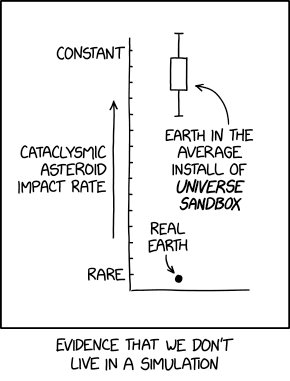
“No matter what I initially open Universe Sandbox to do, I always end up just mashing planets together like a small child making toys kiss.”
I dunno. It seems like there were a lot more cataclysmic asteroid impacts at the beginning. Maybe the kid running the simulation got tired of it after the first billion years or so.
Especially after the first really big one that created the Moon. It must have taken forever for things to settle out and for the crust to solidify again.
Heck, after pulling that one off just right, any other plausible collision would be anti-climactic. So the kid decided: “Don’t mess w success.” 
Irony is that the anthropic principle would predict that we would indeed be significantly lower than the box and whiskers plot would indicate. Yes (after perusing explain XKCD) I get that it is actually a joke on the bad actors running the asteroid sim in question.
If the planet in question were bombarded sufficiently to prevent any civilization from arising (for any suitable species note), then the sim runners wouldn’t get to experience the secret amusement of observing said simmed beings trying to analyse and then explain the data in question.
But of course the alien sim runners, like Randall himself, are assumed to have the sense of humor of a human 8yo. The nonstop destruction is the whole point.
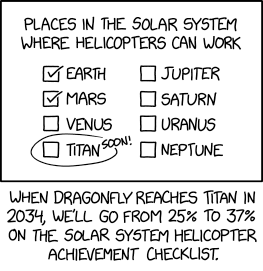
“I’m excited for Dragonfly, because on the list of places in the solar system that I desperately want more pictures from, ‘Titan’s surface’ is right up there at the top with ‘Jupiter’s atmosphere.’”
Aren’t there some other outer moons with atmospheres?
And for that matter, there’s no inherent reason why the working medium for a helicopter must be gaseous. One could have an underwater vehicle that maintained vertical position via thrust rather than buoyancy. So add at least Europa, too.
AFAIK, no. There may be some with trace atmospheres, but Titan is the only one that’s dense enough for helicopters.
One could.
But the energy budget suggests bouyancy is the better pick. Especially in liquids with density an appreciable fraction of your vehicle’s.
Atmospheric blimps or dirigibles are trouble because the supporting fluid = atmosphere is so un-dense vs the structure, so the lifting bag needs to be comparatively ginormous.
Would a hydrogen blimp be practical for exploring the denser atmosphere of gas giants like Jupiter?
Seems like there are several physics-based constraints on helicopters:
Yes, the atmosphere cannot be too hot, or too cold, else the machinery seizes up or crucial parts melt/get brittle, or the fuel ignites, freezes, or something. If however we assume advanced phlebotinum then that would presumably no longer be concerns.
It also cannot be too thin, else there are not enough molecules to maintain lift.
Gravity must also be taken into account, natch, so Jupiter would be the most challenging on those grounds. Have sufficiently-large blades tho and…
Doesn’t Venus have a layer which has moderate temps and a workable density? No such layers in the 4 gas giants no matter how high or low you go? Yes he had a diagram awhile back showing which celestial bodies could allow airplanes to fly and maintain their altitude (I recall the one in Jupiter’s atmosphere plummeting to its doom), but helos are a somewhat different beast, right?
Jupiter is mostly hydrogen, too. I guess there are some impurities, so theoretically pure hydrogen would provide buoyancy, but it’d be very difficult. You’d be better off with hot hydrogen.
Which given the lack of oxygen, is not quite as dangerous as one might think.
Venus’s atmosphere is mostly carbon dioxide, so air is a lifting gas on Venus. This has not escaped the attention of people who think “cloud cities” on Venus might be a possibility.
Well, depends on just HOW hot you get it.
All these worlds are yours, but Europa you will not touch.
Arthur C Clarke proposed exactly that in 1971
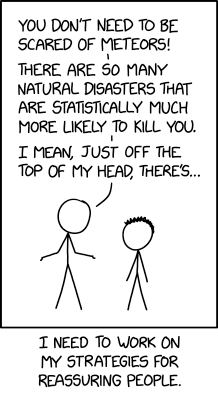
“Don’t worry–even though small and potentially deadly meteors hit the ground all the time, statistically you’re actually much more likely to die from a rare large one that destroys your whole area!”
At least there’s no chance of being killed by an asteroid! Not while you are on earth, anyway.
Handy that, considering how many more asteroids there are. And how big some of them are. Fast too.
Great post. Very clever!