I was vaguely aware of it for as long as I can remember, like I have always known about pierogis and tap-dancing and other things. But it never mattered to me until I moved to Hawai’i.
Now I am a big fan of Two Ladies Kitchen, a hole-in-the-wall mochi place that always makes the “best mochi in the State of Hawai’i” lists, nearby where I live.
Mochi, for those who didn’t grow up with it, is … odd. Made of sweet rice flour, it is spongy, resilient, dense, chewy, and intense. It can be anything from basic - just a sweet, chewy rice flour ball or cake - to inovatively flavored and filled (with blue food coloring in the rice flour dough, and a center of chopped peanut butter cups, for example).
I recently made a lemon mochi cake recipe from the New York Times, the first time I’d tried making mochi at home. At the first few bites, I was disappointed, but it quickly grew on me. Now, I’m loving it and craving more.
I will be delighted if I can agree with that. I had to freeze a lot of the New York Times recipe as it was way too much to eat within two or three days. I’ll find out later if the stuff I froze is still good.
It might be fun to try mochi if you get a chance, but my personal feeling is that it doesn’t belong on a bucket list of “must try” foods. It’s very good, but while I wouldn’t call it an “acquired taste” exactly, it’s also not (for me at least) a food that makes me say OH MY GOD WHERE HAS THIS BEEN ALL MY LIFE?
I’m Japanese-American, so mochi is a part of my personal history.
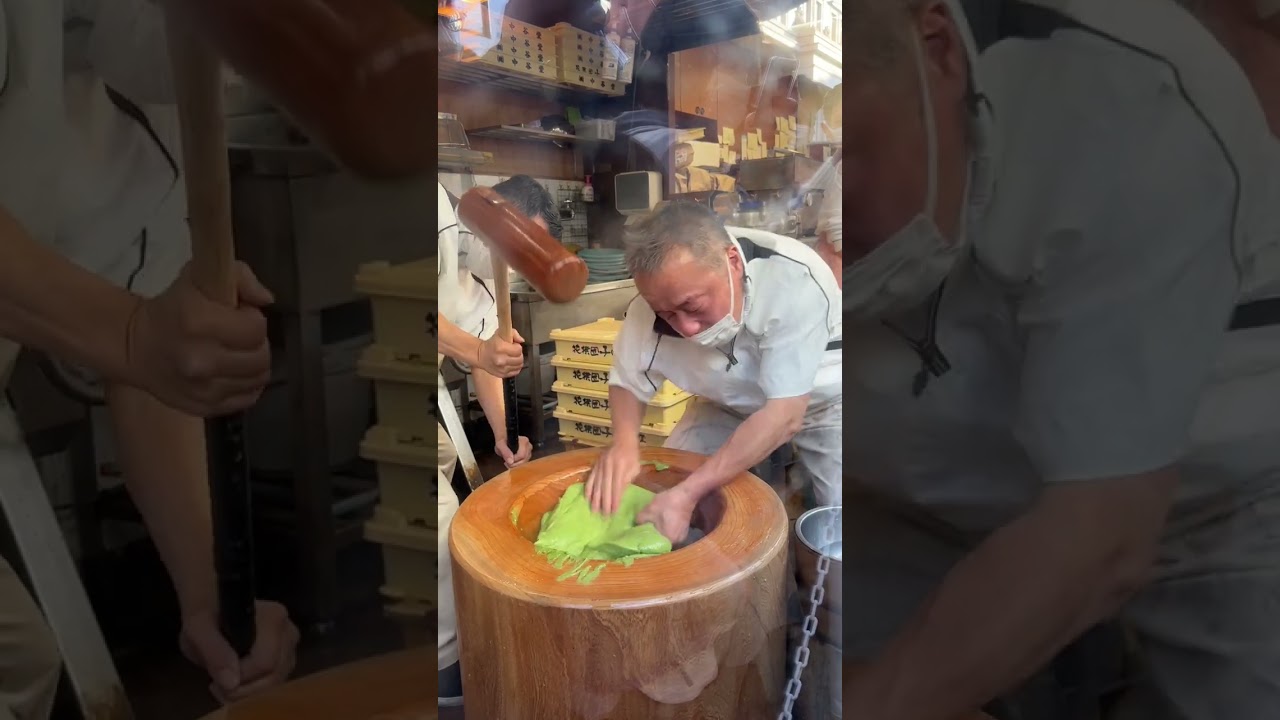
Real mochi, which starts as steamed short grain rice which is pounded in a huge mortar with a huge wooden hammer into a sticky resilient paste. Anything that claims to be mochi but comes by any other method is to sneer at.
This video is the preparation of matcha mochi for daifuku, a tender mochi dumpling filled with sweet red bean paste (anko) and rolled in roasted soybean flour (kinako).
I tried it once, maybe something from Trader Joe’s? It was ok. I think it was frozen mochi which really is just ice cream covered in mochi.
I think something like a mochi cake or a mochi “mix-in” like you described would be a whole different experience!
I’d like to try a piece of the mochi mix-in, or a slice of the mochi cake. But I have not been moved to buy a second box of TJ’s mochi ice cream, even though it’s only 6 little buns.
That’s about how I feel about it. IMO it’s more about the presentation and cultural significance than any particular flavor or texture aspect. The gummy texture, I care not for.
Mochi is in essence, taking a mallet and hammering a few hundred rice grains into one gigantic rice grain, which can be wrapped around other stuff, or flavored or ornamented or whatever.
The trick to pronouncing basically all Japanese is to say the consonants in English and the vowels in German. Then to realize it’s broken up into regimented syllables that generally have a regular pronunciation and a requirement that all syllables are either a vowel, end in a vowel, or is an n (this can change based on other sounds, with a classic example being suki being spoken to elide the u and said as ski.) So it’s mo-chi, two syllables, sounding rather like mow-chee (for a bad attempt from me).
Anyway, I rather like it and am way too lazy to make it properly from scratch. I just cheat with rice flour. It’s a nice change of dessert for something that is chewy and generally not too sweet.
In Hawai’i, when making mochi at home people usually use this already-ground sweet rice flour. That’s what the recipe I used called for.
@gnoitall , I think it’s very possible that mochi in Hawai’i has become its own home-grown variant, not necessarily the same as the traditional Japanese stuff. Certainly, the well known place I mentioned in my OP, Two Ladies Kitchen, is famous for their innovative varieties (my personal favorite is filled with sweet bean paste and white chocolate; usually I detest white chocolate but it really works in this particular dish).
I don’t think our mochi here in Hawai’i should be “sneered at,” when it’s delicious and Hawai’i-authentic, but maybe it needs to be acknowledged that it’s a different experience than the traditional Japanese mochi. I’ll have to find out! (I have two friends here who are bi-cultural; one who grew up in Japan and another who got her PhD at a Japanese university - both are fluent in Japanese and very at home there. They would both know. I’ll report on what they say!)
I actually like mochi - both the traditional, the semi-traditional, and the ice-cream versions. But I suspect the texture can be challenging for many Americans.
On many occasions I’ve made my own, which apparently is a derivative created in @CairoCarol’s home state:
(though I leave out the coconut topping)
I’ve also made the above but added instant matcha powder (tastes great but the color can raise eyebrows) or batches with various extracts (lemon being my favorite).
Oh yes, that recipe is very much like the one I followed! Substitute lemon for coconut and it’s the same idea. And now that I think about it, “butter mochi” is a specific type of mochi we can get here.
(Given that it is a sensitive topic in Hawai’i, I should probably note that Hawai’i isn’t my “home state” in any true meaning of the phrase - I wasn’t born and raised here, I’m a late-life transplant, having only lived here full-time for 8 years.)
I love it. A friend introduced me to it 20 years ago, and now it’s a must-buy for me whenever I go to an Asian supermarket, with the sweet red bean filling. I’ve got a few pieces in the fridge now.