Pic. Found in a musical (movie) recently.
Google Translate - the top is yiddish, the bottom is Hebrew:
CHORUS
She looks like a Niderrechtiner person for fun. Anthem protect!
She was afraid of the new moon and she saw it in our house and I went there to see her and she was very happy and she was very happy.
What movie is this from? Do you know approximately how far into the movie it was?
Well, I was trying to avoid the movie lest I poison the translation well, but you can see the frame and the purported translation starting at @1:19:57, but here: King of Jazz (1930).
Where do you see any Hebrew??
It’s interesting, because even before your post, AI strongly suspected the Google Translate of being wrong and ran a bunch of statistical, historical, and musical tests on it and suspected it of being a movie prop, likely a partially and poorly translated illustrated song slide for old-timey vaudeville.
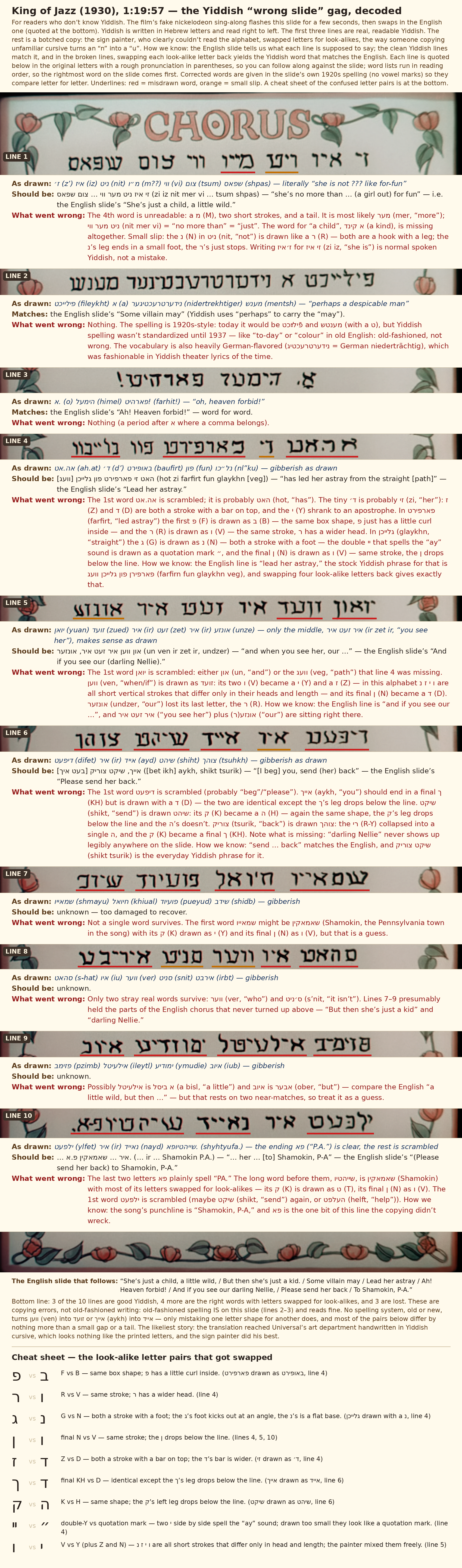
It thought the first 3 lines were plausibly legitimate, albeit older German-style Yiddish, with a few errors. But the remaining lines were out of order and had increasing errors that made them altogether unreadable and not plausibly real.
Then with your link, it read the transcript and saw the English version of the same slide, in context, a few seconds later:
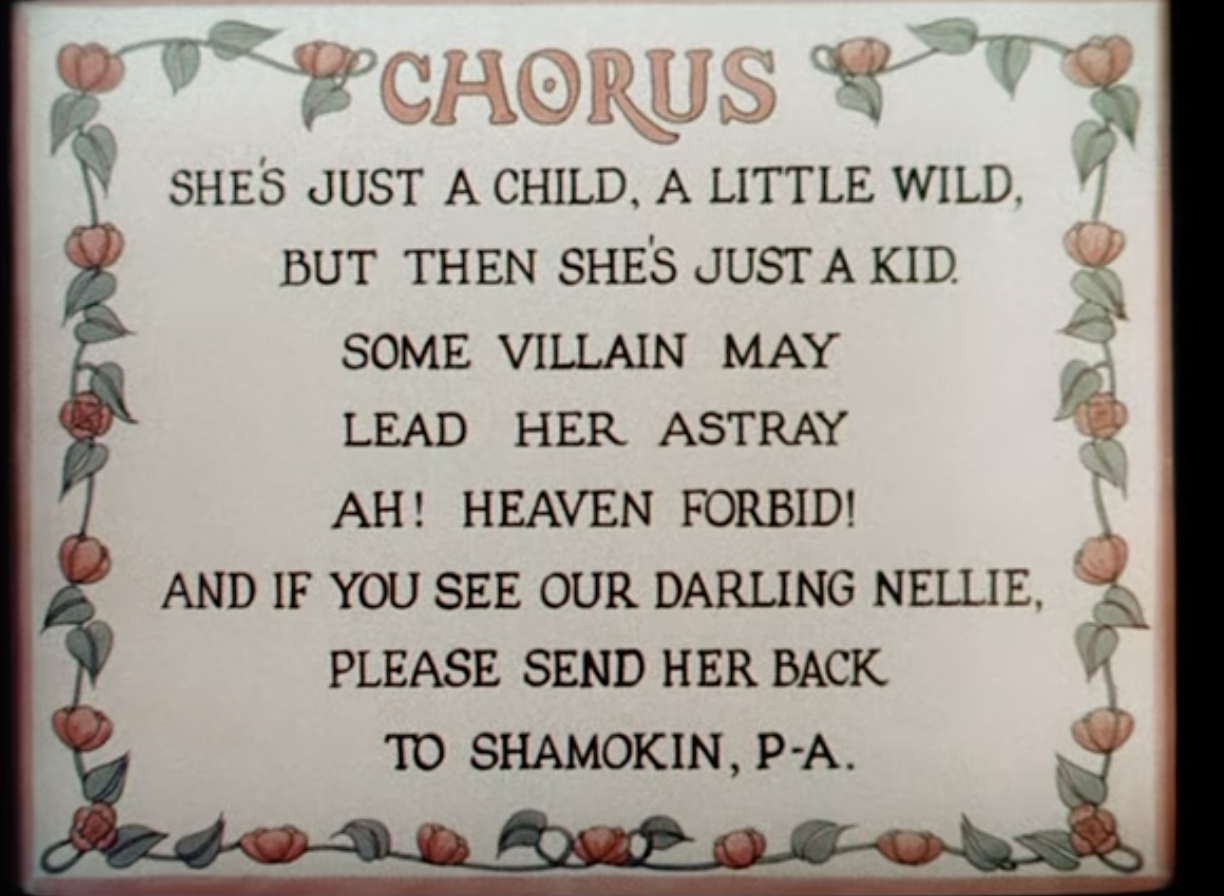
Even with that, the translation still wasn’t quite plausible. There were some transcription errors — verses that only made sense if you swapped some lookalike letters, which would then make them match the English translation.
It might’ve just been a “good enough” prop that someone made without checking all the way…?
An annotated translation/explanation:
Also, TIL that English, Yiddish, German, Hebrew, Arabic, Greek, Latin, Cyrillic, and Aramaic are all related in written form… their scripts all descend from Proto-Sinaitic script - Wikipedia and Phoenician alphabet - Wikipedia and that’s why they’re so similarly alphabetical/abjadic.
I had no idea some of those scripts were even written in letters… I thought Arabic was something totally different.
So, just to be clear, it is AI slop? From the 1930s?
That is interesting; back then one could probably find people around who spoke Yiddish.
Heh, basically! The 2020s AI’s theory (I’m just paraphrasing here; I’m not a linguist in any way, shape, or form) is that a Yiddish speaker might’ve provided the translation in handwritten cursive to a sign-maker who might’ve not known the language very well, or at all. This was at a time when Yiddish in America was gradually changing from a German-heavy version to a more standardized one, with slightly different spelling. Maybe the sign-maker spent more time on the first few lines, resulting in only a few errors, and then got sloppier with the following lines until, by the end, it was completely nonsensical.
In the movie, that sign is only on-screen for a few seconds. Maybe they figured no one would have time to read the whole thing anyway? It gets swapped out with the English version.
I can confirm that none of that is Hebrew.
Yeah, I realized later that if it meant anything, it would more likely be Yiddish.
I’m still a bit wary of the AI explanation (even though I provided it). I was hoping a native speaker would’ve chimed in by now.
Should we check in with one of the other posters in the Yiddish thread from earlier this year?
I don’t speak Yiddish, but I took Hebrew and German in university. It looked like a reasonable explanation, although it doesn’t seem to have all of the information in the Wikipedia article on Yiddish orthography. For instance, in the first line’s translation, it seems to be suggesting that having two yods in a row is a typo but the wiki article says that’s a way to write the “ei” vowel sound.
I read only a little Hebrew, but the placement of the letters (like the yods) cues me that it’s not Hebrew.
FWIW, when the OP first posted this on sunday I ran his picture through 3 different AI programs and got 3 totally different and unrelated translations. So I didn’t respond since I assumed none of them were accurate. Hopefully someone who natively speaks can translate what it is.
It looks superficially like Hebrew because both Hebrew and Yiddish are written using the same Assyrian/Aramaic alphabet, but there is no resemblance beyond that. By analogy, you can write both English and Mongolian using the Latin alphabet.
Yes, a naive translation didn’t make any sense. However, the main clue was from the YouTube video and the English slide a few seconds after the Yiddish one. With a few transcription errors corrected, the first three sentences plausibly became something resembling the Yiddish of that time and place, matching the English translation for a little while at least. That seemed too precise and particular a type of correctable error to be a hallucination…
(Side note: This was the only time I’ve ever seen it struggle on a translation. The lesser models considered it for a few seconds to minutes and then gave up. It took the strongest one, at max effort, something like 20-30 min to reason through it, even with the English slide, to come up with a plausible explanation.)
But the rest of the sign, after the first 3 lines, are pretty much still just guesswork. AI thinks it’s just garbled, but maybe whatever the sign meant back then just never made it into its training…
Yeah, that would be really cool to see!