(Quoted by @Skywatcher, not written by Skywatcher.)
So what was the conductor’s response? The article doesn’t say.
(Quoted by @Skywatcher, not written by Skywatcher.)
So what was the conductor’s response? The article doesn’t say.
What any conductor would/should do - sounded the horn repeatedly and started slowing the train. Nothing especially noteworthy but also didn’t make things worse or freeze up, either.
It’s just one of those quirks of modern society. Everybody directly involved in a situation is a hero, a villain, or a victim. Nobody can just be Joe Average Guy, doing the right thing like any normal person would.
Flashback memory! Our drivers were doing that in the 70s. Open the door, even in January in Wisconsin. Stop - look - listen. I hadn’t thought about that in 50 years.
The conductor is not the train driver. Two different people with two different roles.
Seems the article is sorta confused about most of the details.
However, on a modern freight train, the conductor would almost undoubtedly be riding in the cab of the lead locomotive, along with the engineer.
I see that more and more. Somehow the public thinks the conductor drives the train. What do they think the engineer does? Design it?
When I was a kid on a bus (suburban NJ, not out in the boonies) in the mid-70s, we got stopped at a crossing when the gates never went up after the train passed.
Somehow, I got off the bus, and was able to lift the gate up so we could cross, and driver did so.
I didn’t get in much trouble, and I don’t think he did, either. Looking back, we probably should have.
For us, it was just the lights. Flashing forever.
Turned out some local smart ass put a conducting cable across the tracks. Don’t know how long it took someone to remove it. Maybe they didn’t know how it worked and were waiting for the CNW to fix it.
Agreed that everyone of the crew is in the lead engine cab. It’s just a terminology pet peeve of mine.
Long haul big trains are more like ships than planes: there’s a Captain & a helmsman. The person driving is not in charge.
Urban / suburban light rail or streetcars tend to have just a driver. Who’s perforce in charge.
I don’t know what the division of labour is between the engineer and conductor on a freight train but I wonder if either is back on the job yet. That must have been terrifying!
Probably. Isn’t that what would make sense for an engineer to be doing, in other fields? Nobody calls the person driving a car the car’s engineer.
ETA: and the conductor on a bus generally does drive the bus.
For several months, there was a crossing on a main road near me which would go down and stay down with no train anywhere near. People who lived in the area got used to this, and would do a full stop, open a window, do a really hard look and listen, and then drive around the gates (which have a big enough gap between the two sides to angle a car through) and across the tracks.
One day I came up to those closed gates with a state trooper behind me. I did my stop look and listen; no train; but I wasn’t going to jump those gates with a police car right behind me. So I sat there.
After about two minutes the cop figured out my problem, pulled out around me, drove around the gates and across the tracks and went on their way. After which (and after one more look and listen, just in case a train had shown up in the meantime) so did I.
I think in some jurisdictions, the railroad company can be cited for blocking traffic when there’s no train. But the fines are so tiny that it doesn’t incentivize timely repair.
They fixed it, eventually. I don’t know whether they were fined.
And our idea of a main road is less busy than most people’s.
As least it wasn’t one of those times with miles long trains stopped in the middle of important roads for hours on a regular basis.
Nowadays railroad crossings have a blue sign with a number to call for not only stuck crossings but also a vehicle stuck on the crossing. It includes an intersection or code number to identify the specific location.
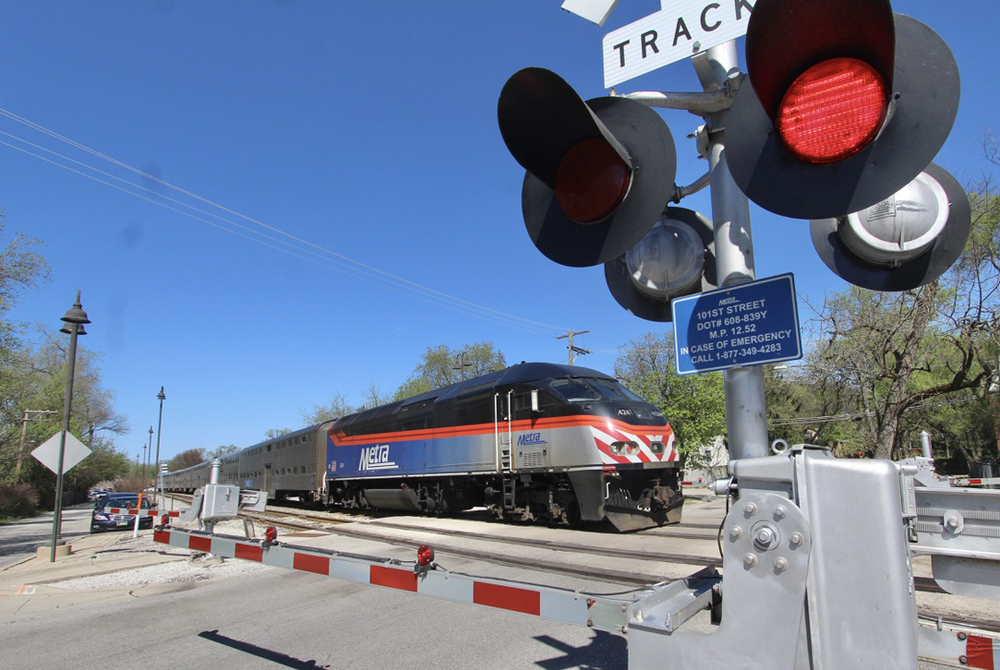
I’ll have to look, next time I’m through there, if I remember. Though if there’s such a sign there now, that won’t tell me if there was one there maybe fifteen years ago.
And I’d probably have assumed that somebody who went down that road more often than I do would have already called them.
I’ve seen that sort of thing at a pair of crossings just outside New Orleans, between the waterfront and two railyards. They’re on a busy six lane boulevard so no gates, just lights.
Near as I can figure, a shunt train periodically stops right on a trigger but out of sight.
Fifteen years ago certainly not. Incidents like yours likely triggered the FRA mandate for them in 2008. Here is the Trains article I got the photo from.
“Hooking up words and phrases and clauses!”

But what does incentive a timely repair is that if there’s too many false positives WRT a train actually crossing, people will get used to driving around the barricades. That’s going to make it much more likely to cause an accident.
Grady from Practical Engineering mentioned this in one of this video. Starting at 8:06