Thank you. I had no idea. I doubt it was ever US slang; I know I’ve never read of it being so.
The hotel in question was in a former British colony, so that’s a pretty good match too.
Thank you. I had no idea. I doubt it was ever US slang; I know I’ve never read of it being so.
The hotel in question was in a former British colony, so that’s a pretty good match too.
All words for urination-and-defecation spaces are buried under layers of euphemism of varying degrees of thickness.
“Toilet”: the place where you primp your appearance, originally performed at your “toilet table”, so called because it was covered by a “toile” or cloth drapery.
“Lavatory”: the place where you wash (Latin lavo, to wash or bathe). See also “bathroom”.
“Cloakroom”: the place where you store your cloak.
“Restroom”: self-explanatory.
“Loo”: from French lieu, “the place”.
“WC”, “water closet”: see, it’s a small room like a closet, but has water vessels and/or running water in it. We don’t talk about what you use the water for.
…Oh, this is the Stupid MFers in the news thread, not Random Linguistic Oddities? Um, nevermind. 
Well it’s not exactly news, but humans’ stupid desire to circumlocute around excretory functions deserves a loud fart-like noise of disapproval.
So ya’ done good there. 
Come to think of it, there are also words like “pissoir” and “shithouse” which are more literal about the purpose of the space so designated. But nobody’s putting those words up on signs over doors in public places. 
I know this a bit late, but she may as well be using a Ouija board.
There are actual electronic assistive devices that autistic people can use to communicate, but anything that depends on the caregiver to “interpret” is pretty much bullshit.
I cannot imagine how frustrating it would be to not only not be able to communicate all you are thinking and feeling, but to then have someone you depend on put words into your mouth.
Don’t forget “crapper”.
Because elementary students don’t know or care about why rooms are called what they are called. Cloakroom, closet, parlor, living room, great room, dining room, breakfast nook - they are all just things thrown at children as “this is what this is”. Sometimes some children get curious about a specific thing, but most of the time “that’s just what it’s called”.
But you missed the part where she can guess the word after the first couple of letters. Clearly the kid “typed”
SPinach, RiS(c)e, S(c)HiPS, Dessert.
I mean, what’s an occasional typo - the meaning is clear as day.
Yep. The word shit-hole is the Germanic original for where people defecate (as well as shit-house). Everything else is euphemism. I don’t know about other languages, but the avoidance of these terms in English is extremely high. And yet everyone knows exactly what it means. (Credit where it’s due: President Trump has made sure everyone knows the word.)
And or “Washroom” which isn’t used quite as often anymore, at least in the States
That one may be sort of a coincidence. While the word “crap” has its own separate origins, there’s a fair amount of evidence that the word “crapper” itself is after Thomas Crapper, who was a plumber and purveyor of indoor bathrooms, which were new at the time. His name almost certainly helped in his chosen profession
I’ve never heard of cloakroom as a euphemism for bathroom. I would assume it’s a coat closet.
That euphemism has been around for awhile
Every class requires students to have certain items: Nowadays a computer, often paper and pens/pencils, maybe a calculator, often some books, etc. And depending on where their locker is and where their classes are, they might not have time to go to their locker between every class. How do students carry all of that without any container large enough to fit a phone? And heck, what if they have a phone in their pocket? Banning backpacks and purses does nothing about the phone problem, but does impair the actual learning.
In Japan they changed many places from 便所 (ben-jo) which can be translated as excrement place to お手洗い (o-te-arai) Hand washing. I’ve seen places where they will have a newer sign with the hand washing kanji showing the direction to go only to then see the older excrement place sign on the door once you get there.
//i\\
The word “pee” in English is euphemistic for “piss”. People started just using the first letter to avoid saying the word, and then eventually it got spelled out phonetically.
Yes, “pee” from around the 1600s was just short for “piss”, which itself started around the 1300s and derived from French “pisser”, which itself came from the Latin term “pissiare”, which was probably just onomatopoeia for the sound made when you piss.
Also, “onomatopoeia” is a fun way to refer to urinating.
“Ssssssssssssssss,” Tom pissed onomatopoeically.
Being cultured, I prefer to micturate.
I have, on several occasions, matriculated in public.
Where birds go:
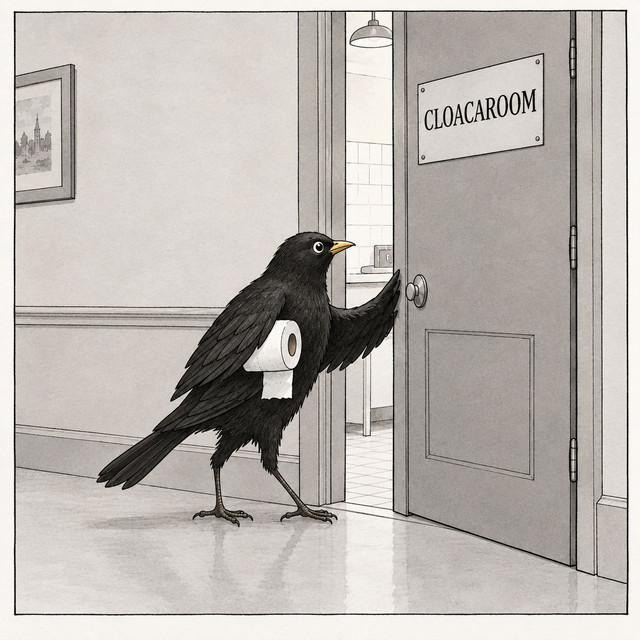
Funny. Upthread I typoed “cloak” as “cloack” and had the same “cloaca” thought when I was proofreading before posting.