This is not true. Super cooled water only exists in it’s pure state. When a contaminate comes in contact with it it freezes. When it hits a plane it will freeze to every surface instantly. And as it builds in a storm the size of the water droplets increase making the situation worse. SLD’s (Super Cooled Large Droplets) are much larger than regular droplets and will splash back as they freeze causing irregular surface buildup. This quickly disrupts airflow and subsequently lift. When this happens the stall-warning system cannot function as intended.
Here’s a video discussing it as it relates to aircraft. It shows real examples from test flights. About 20 mins in it shows a bottle of super cooled water and how fast it freezes. It then goes on to show actual buildup on aircraft.
this was an issue with Air France flight 447. It was an odd combination of events that happened at once, The pitot tube was scheduled to be replaced because it couldn’t keep up with icing. Then the Captain stepped out for a moment and all hell broke loose with the loss of pitot tube information. There’s a plan-B for this event and it’s a very narrow window of time to execute the steps needed to stabilize the plane. This window was missed without the Captain.
Basically a computer needs the information to manage the plane but a crew can fly without it by flying set trim and power levels. When I was learning to fly my instructor’s night instruction included landing without any instrumentation. He just turned the lights off. A much simpler scenario but it was based on the same premise. Fly it with known power and trim.
I was trying to be funny. (FWIW, I used the 8-inch floppies in the Techtronix computer we used to send rawinsonde data to JSC during the Shuttle missions. It also had a tape cartridge. I think it looked like this.)
As odd and incredibly old-fashioned as an 8" floppy disk would seem to be, its final format had a remarkable capacity: 1.2 megabytes as of about 1977. (5 1/4" floppy diskettes in the MS-DOS era also evolved into the same capacity because they replicated the format in a more compact medium.)
Interesting explanation of icing and tail plane stall. It points out that the horizontal tail plane is the reverse of the wing. It’s lift is downward and thus leverages the nose up. If it is torn off or stalls the nose is forced down.
What is the advantage of having your horizontal stabilizer and elevator at the top of the tail? I vaguely recall an aircraft with one (727?) that could get into trouble if the nose rose to the point turbulence from the wings could interfere with airflow over the stabilizer.
Required if the engines are attached to the fuselage near the rear end of the plane.
The horizontal tail plane doesn’t have to be at the top — it can be in the middle, like on the Sud Aviation Caravelle — but it can’t be on the bottom (i. e., the fuselage).
And, you’re right about “deep stalls.” I think they made these less likely through several modifications, including stick shakers and/or stick pushers that activate at a lower angle of attack than previously; pilot training; and maybe some modification to the wings (e.g., fences on certain models?) to alter the vortices.
Yeah, the original 727 had deep stall problems. In fact it as how the deep stall phenomenon was discovered. Oops.
Compared to other T-tailed airplanes the vertical fin was fairly broad fore and aft but not real tall. Which meant that at fairly moderate AOA’s short of stall, or just into stall, the horizontal tail got blanked. Later generations of T-tailed airplanes mostly solved that with comparatively taller vertical tails. Which meant the AOA had to get ridiculously post-stall high before the tail blanked.
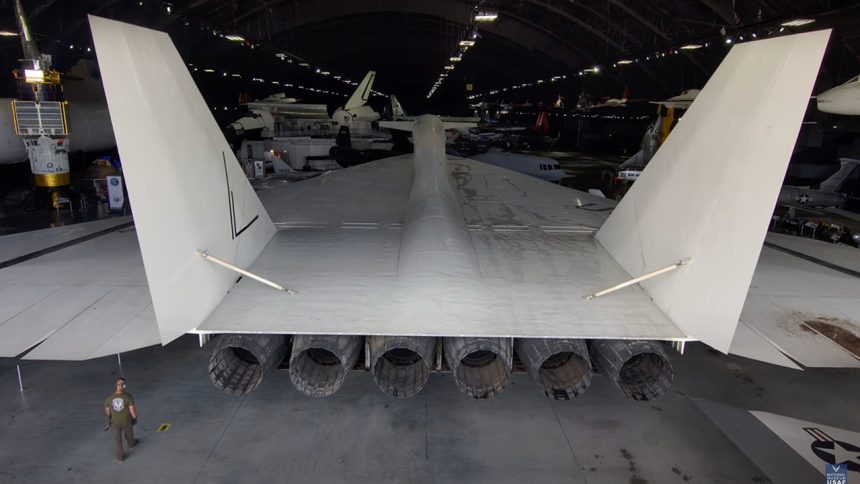
I went to an after-hours program at the AF museum the other day. Pretty neat. I got to crawl into a B-52 cockpit. Crawl is the operative word. A much tighter configuration than I expected. Also got to look into an XB-70 intake. It was monstrous.
That is awesome.
Such a shame that the other XB-70 and its crew were lost in a friggin’ photo shoot. Now anyone could create a perfect image on their phone in minutes, no risk and almost no expense.
At 52", the XB-70’s J93 engine is the largest diameter low- or no-bypass afterburning engine ever built by the US. At least that I could find. They started with the J79’s diameter of 39" and super-sized it from end to end.
By comparison, the SR-71’s J58 comes in at 50".
Modern fighter engines are much smaller, but more powerful. As one might expect from 60+ years of progress. The F100 & F110 that fit into the early F-15s & 16s is a mere 36" in diameter, albeit with a larger exhaust nozzle at 46". The later F110 variants for the later F-15s & F-16s are 46". The F119 & F135 for the F-22 & F-35 come in at 48".
Since area of a circle scales at the square of the radius, a 52" engine has just about double the crossectional area of a 36" engine. Makes for an impressive maw at either end.
From the outside you can clearly see the splitter that separates the left and right halves of the intake. Each side feeding three engines.
What I do not recall ever seeing a picture of, is whether that forward splitter extends all the way back so there truly are two separate 3-engine intakes, or whether there’s one large plenum back there behind the splitter feeding all 6 engines.
What did you see when you looked in one side or the other? 3 or 6 engine faces?
And yeah, you had a really neat opportunity on that visit. Color me envious. Congrats! And thanks for sharing.
Most of the complicated mechanical variable geometry stuff required to configure the inlet to support both low speed and high Mach operations are contained in the center section between the two halves.
At least when I hit that result page, a few of the pix are indeed looking down the intake. From which you have line of sight to only the outboard-most engine (#s 1 or 6) and in some shots a bit of the next inboard-most (#s 2 or 5); the rest are hidden behind the curve of the septum.
New video shows a small plane getting flipped over on the John Wayne Airport tarmac over the weekend after it was hit by a blast from a commercial jet.
Oops. That airport is notoriously small, overfilled w jets, and overfilled w light planes. Which don’t mix well. That looks to be a UAL 737-800. As we can see, there is construction around the area where they got flipped. But I question the assertion the construction forced the lightplane to follow too close & therefore get flipped.
I learned to fly at that airport back in Ye Olde Darke Ages. My dad owned a bunch of lightplanes and ran a flying school. One of ours was flipped over one day in a somewhat similar situation. Student unwittingly got too close dead astern of an old 737-200. When the jet powered up to get moving, over they went. No injuries and the airplane was repairable, but it was a mess for awhile.
That airport today is no larger than it was back then. But it has far more airliner traffic, lots more bizjet traffic, and some reduction in lightplane traffic versus the late 1960s - mid 1970s heyday. Definitely 10 lbs of stuff in a 3# bag.