It’s very expensive to use real ingredients. Real milk (fat) is expensive. Milk-like fluid is much cheaper.
And it’s a very tricky logistical thing to get real ice cream (that melts from a stern look) from where it’s made all the way to the grocery store without it losing it’s integrity (i.e., it melts, refreezes, melts, etc. = not good real ice cream to sell). Better more expensive logistics are usually needed.
The ultra-processing helps with all that. Delivers a cheap product that is creamy and yummy. But it ain’t ice-cream.
It’s Almost Pizza. Thought this 2min SNL skit captured the sentiment about “fake” food really well.
How occasional? My husband doesn’t like to eat anything that lived in water (fish or seaweed) so i didn’t eat a lot of these. But i like fish, shellfish, and seaweed, so there’s a little in my diet, mostly from meals we don’t share. I wonder if there’s enough.
Cream (higher fat) is expensive. Milk (lower fat) is much cheaper and the federal government regulates a minimum amount of fat if you want to call your product “ice cream”.
Right. Thats Big Dairy protecting their expensive fat. Thats why as mentioned above it’s not called ice cream (that needs % real cream/milk fat) but a “frozen dairy dessert” or something that’s not ice cream.
Your point is good. Whatever it is most ultra-processed food is on a sliding scale from pretty close to the real thing - nothing like the real thing.
There’s limited information on EPA requirements. It looks like at least 250mg of EPA+DHA combined, per day, is generally recommended with at least 200mg of DHA for pregnant women. Looking at breast milk composition for women in Japan and Korea (which still have a diet more similar to pre-Industrial times), I’m seeing that the ratio there is about 16.5:80 EPA to DHA, which would calculate out to 45mg EPA and 205mg of DHA to hit 250 - pretty close to the recommendation that we give pregnant women.
Here’s a table that breaks down different sources of DHA and EPA:
If you’re eating 6oz (170gm) of farmed Atlantic salmon (which is pretty cheap and readily available), then you’ll get about 2g of DHA and 1g of EPA. That gives you about a week of coverage. The yolks from about 3 eggs cover you for about 2 days. Pretty much any sea creature is liable to cover your DHA needs for about a day or two, if not better.
If your Omega-6 intake isn’t crazy (which can happen by eating either a lot of mammal fats or seeds and nuts that are largely Omega-6s), then you can also get ALAs and about 10-20% of that might get converted over to DHA and EPA. Here, you’d mostly be looking at chia seeds, flaxseeds, and hempseeds.
Chia are great, in general. They have a complete protein, good fibers, high ALA, and you can throw them into things like eggs, puddings, water, etc. and health them up without impacting the flavor hardly at all, if at all.
If “real sugar” is to mean anything, it’s pure sucrose. And then you have all sorts of impure sugar and invert sugar and so on. Invert sugar is most commonly referred to as either “high fructose corn syrup” or as “honey”: One is “ultra-processed” and the other is “natural”, but they’re almost exactly the same thing.
White rice isn’t a whole grain. And isn’t particularly good for you. Brown rice contains a ton of B vitamins, as well as some iron and some micro-nutrients. Eating about a 1/2 cup a day of brown rice instead of white, with no other diet change, solved the problem of people in the East getting beriberi.
However…
I had a supervisor when I worked at a different preschool, who complained constantly about processed food that was “just chemicals.” I once commented that all food is just chemicals, and got a blank look. She once praised a “good lunch” of a PB sandwich on whole wheat bread; a container of yogurt; fruit; and tap water, as being a “good lunch.”
I guess mixing yeast with flour, kneading it, and baking it isn’t processing, and neither is Pasteurizing milk, or fermenting it into yogurt. Or pulverizing peanuts to make PB. Or treating water to make it safe to drink and good for your teeth. The only completely unprocessed thing was the fruit, honestly-- but considering the time of year, there was a very good chance it was hydroponic and hothoused.
I prefer to think of one as processed by humans; and the other as processed by bees. The one processed by bees tends to be contaminated with a type of botulinum; it doesn’t produce serious disease very often-- except in very small children and babies, which is why children under 2 should not be given honey.
The one produced by humans has a non-zero chance of being contaminated as well, but it is not so likely that whole swaths people must avoid it to stay alive.
That’s what it means to me. Bonded glucose + fructose. The important part is it takes longer to metabolize.
Honey aside, I’m less clear on the specific meanings of the rest, except that they are much more processed. They are not bonded and they absorb much easier. Usually much sweeter. So more addicting and quicker insulin spikes. Found in most ultra-processed foods.
I think refined sugar is actually still bonded sucrose. I need to learn my words. What I casually call refined or bleached, etc., I am attempting to imply not bonded sucrose - things that I think of as pre-digested (unbonded). High fructose corn syrup is not bonded sucrose. I guess I need to use invert sugar - is there other terminology that is more common for an invert sugar?
In the end, it’s all sugar. It’s the quickness in the sugar spikes and how it’s metabolized that I try to steer clear of if given a choice.
Technically, there’s an issue that rice that was grown in water tends to pull in arsenic that has accumulated over the years, and store that in the husk.
Most likely, our bodies can deal with the amounts but 1) it’s probably good to vary your grains, anyways, so if you throw in oats, barley, quinoa, etc. that’s probably better than mainlining on rice, and 2) there are some dry-grown rices and native American rice that don’t have that concern, for anyone who is worried.
I’m not that crazy about rice unless I’m having Chinese or Indian food, in which case I get vegetable fried rice at the Chinese place, and brown rice if the Indian place offers it, but they usually don’t. This is maybe a 4x/year occasion.
For grains, I have oatmeal, and not the instant kind, a few times a week, and I always bake with whole wheat flour, so that’s what the bagels and bread have.
I’m not crazy about much else, but I’ll make bread with buckwheat, rye, millet, and spelt (like, 1/3 flour of another variety, 2/3 whole wheat, and a 1/2 teaspoon of high gluten flour for every cup of flour in the recipe, just for the variety you suggest.
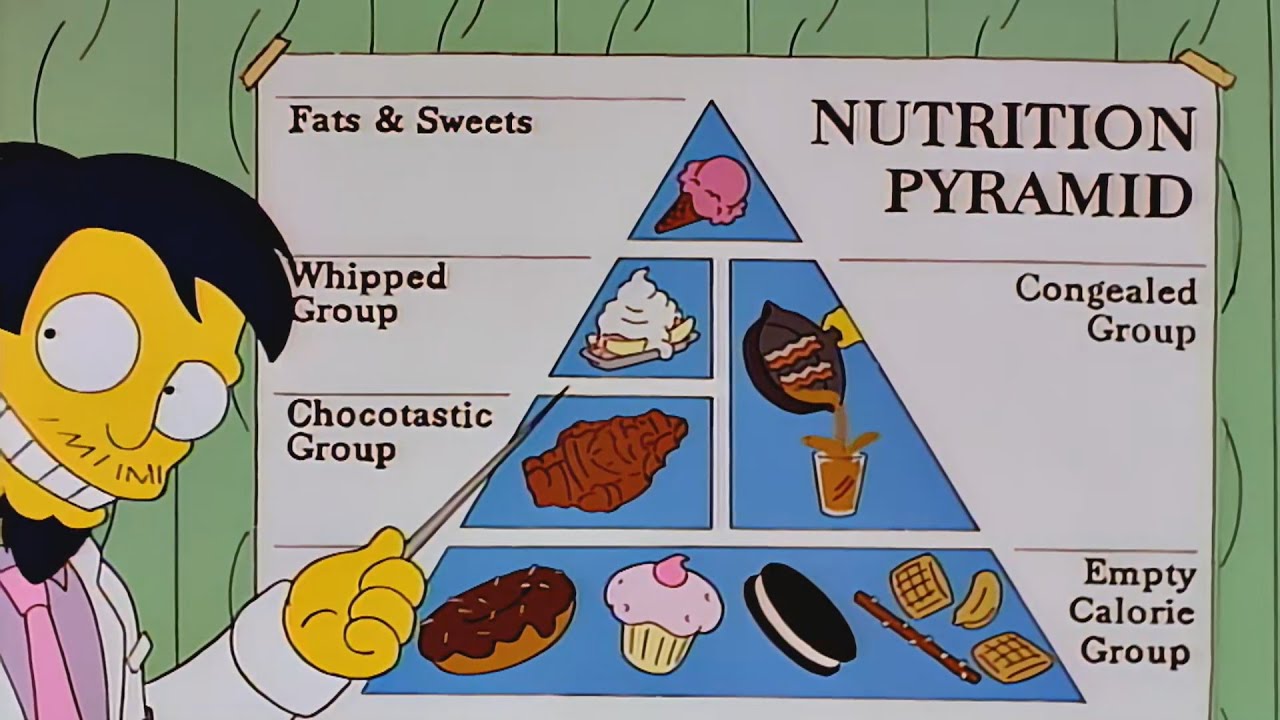
But as a practical matter when this guidance hits the American public, and more importantly, the American food-like substance producing conglomerates, the emphasis will be all about the “Empty Calorie Group”. That’s the least healthy and most profitable.
Has anyone ever cared about the food pyramid? I think I remember learning it in high school home ex class, and never heard or thought about it again until I was reading books about how corrupt government dietary guidance is. But it’s not like people look to the government to tell them what to eat. There are influencers for that.
The Food Pyramid Scheme does not influence the eating habits of most adults. But it might have some influence on what children define as healthier foods.
I think there is merit to the “plate” diagram.
I don’t much mind somewhat more emphasis on red meat or healthy fats. Red meat^ has environmental costs, and most Americans already get enough protein, which has not in the absence of exercise yet caused an epidemic of muscularity. There is a big difference between healthy starches and unhealthy sugars - more discussion on carbs is needed. Eating whole fruit instead of drinking juice is reasonable. Emphasizing a reduction in alcohol and processed foods is reasonable. Since most Americans will continue to enjoy sweet foods, I think modest amounts of sweeteners are a reasonable to high levels of fructose from corn syrup or table sugar sucrose.
Changes in vaccination advice concern me much more than this mixed update of nutritional recommendations, which have always been watery. Things like eating nuts and beans might deserve more prominence. They really should have discussed fibre more. Very few people (6%?) eat the amount recommended by research: 16g of fibre per 1000 food calories consumed.
^ The evidence labeling saturated fats, dietary cholesterol, full fat dairy and eggs as villainous seems weaker than most would have surmised. Greatly reducing trans fats, however, was a very meaningful improvement. While seed oils are also healthier than some assume, they differ in ω6/ω3 ratio. I personally eat mostly olive oil or canola.
WTF are you talking about? Sugar is sugar. Have you ever taken a tour of a sugar mill? There’s very little difference between “raw” sugar and the refined stuff, and the refining steps are pretty basic stuff- crystallization, charcoal filtration, flocculation, etc…
That’s probably a legal definition, which are often extremely specific. For example, you’ll see stuff labeled as “fruit spread”, not because they’re inferior products, but because they have too much fruit to be labeled as jam, preserves, or jelly.
In the case of “frozen dairy dessert”, it’s most likely because they have less than 10% milkfat, which is part of the legal definition for labeling ice cream. (what @crowmanyclouds points out).
But it’s not worse health-wise than regular old ice cream.
Some kind of silly woo-ish definition that probably varies by who’s defining it. I mean, I’d say that bread is “real food”, even if it’s NOVA category 3. And I’d go so far as to claim that a real hot dog made with real meat, smoked in a smoker, and with additives limited to sodium nitrite and salt, would qualify as well, even though it’s almost certainly NOVA category 4.