The Portuguese were big players in India in the 16th century, guarding their interests from their seat in Goa. Some of the language intermixed, of course; one example is the dish called “vindalho”, sometimes spelled “vindaloo”. The word in Portuguese is a combination of the words carne de vinha d’alhos (literally “meat in garlic wine marinade”). The letter “h” following another consonant in Portuguese is usually pronounced as a “y”, so ‘vinha’ is veen-ya and ‘alhos’ is al-yoose.
Merchant ships of the 16th century typically had an average of 250-500 tons cargo carrying capacity with some warships as high as 1,000 tons. Enough to carry the world’s largest ball back to Portugal.
The world’s largest ball of twine is in Cawker City, Kansas. Started in 1953, it reached 5,000 pounds in about four years. It’s been added to every year since. As of September 2013, the Giant Ball weighed 19,873 pounds.
Unrolling balls of twine (well, two of twine, one of yarn) to see which is largest is a competition in the novel Homer Price by Robert McCloskey.
Robert McCloskey’s book Make Way for Ducklings won the 1942 Caldecott Medal for McCloskey’s illustrations. Set in the Boston Public Garden, the book is the official children’s book of the Commonwealth of Massachusetts. A bronze statue of the ducklings by Nancy Schön is a popular attraction in Boston Public Garden. It is said the ducks never need professional polishing because children sit on them so often. A replica installed in Moscow was a gift from United States First Lady Barbara Bush to Soviet First Lady Raisa Gorbachev.
(Dendarii Dame, I remember reading selections from Homer Price but hadn’t thought of it in years! Your post brought back good memories.)
The Peabody Hotel in Memphis, Tennessee, is probably best known for its’ “Duck March”, where a group of Mallard Ducks parades through the hotel each morning to the fountain where they are on display from 11:00 am to 5:00 pm. The rest of the time they live in special quarters in the penthouse area of the hotel.
One of the first US B-17 bombers of WWII to complete 25 combat missions with her crew intact was the Memphis Belle. The aircraft and crew returned to the United States to sell war bonds. As of 2016, the aircraft is undergoing extensive restoration at the National Museum of the United States Air Force at Wright-Patterson AFB in Dayton, Ohio with plans to put it on display by 2018.
Many aircraft formerly used by U.S. Presidents are on display at National Museum of the United States Air Force at Wright-Patterson AFB in Dayton, Ohio. The Museum has already requested one of two customized Boeing 747s currently used as Air Force One, which are expected to be replaced in the next five years or so.
http://www.nationalmuseum.af.mil/Visit/MuseumExhibits/PresidentialGallery.aspx
WAFB is the CBS affiliate on Channel 9 in Baton Rouge, LA
NM
WAFB radio changed its call sign to WAIL in 1957. Top DJs were Pappy Burge and C. B. “Country Boy” Cutrer.
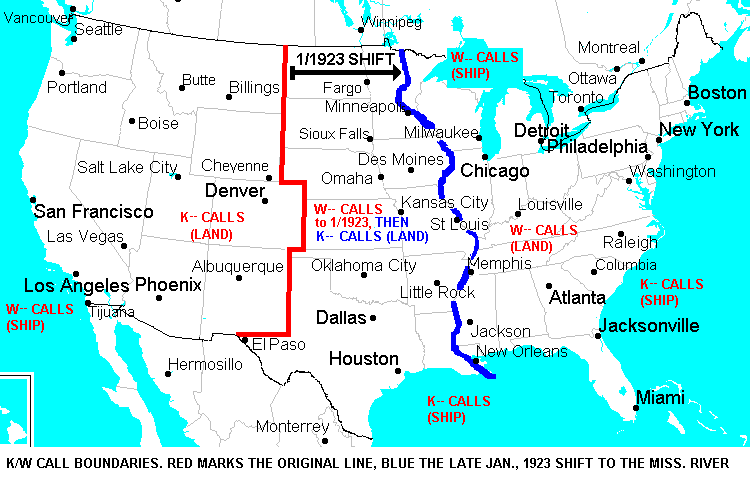
The original K/W radio call sign switchover boundary ran north from the Texas-New Mexico border, so at first stations along the Gulf of Mexico and northward were assigned W calls. It was only in late January, 1923 that the K/W boundary was shifted east to the current boundary of the Mississippi River. With this change, K’s were assigned to most new stations west of the Mississippi, however, existing W stations located west of the Mississippi were allowed to keep their now non-standard calls.
Here is a map from earlyRadioHistory.us: http://earlyradiohistory.us/kwbigmap.gif
One kilowatt (kW) is defined as energy consumption of 1000 joules for 1 second. It represents 1,000 watts, named after the Scottish scientist James Watt.
Andrew Lloyd Webber’s Starlight Express’s final song “There’s a Light At The End of The Tunnel” contains the lyrics:
It’s the power of James Watt, the steaming Scot
The man who watched the pot and said "Hey, I’ve got
A brilliant plot: when the steam is hot
It seems to make a lot of power
It could turn a wheel …Lots of power …
It could drive it down a track …
Clickety clack, clinkety clack…
It could drive it with a beat …
Choo-choo-choo…
With enough left over for a
Whoo-whoo!
He saw the light at the end of the tunnel
I said he saw the light at the end of the tunnel
Thanks James Watt (thank you Mr Watt)
For watching the pot
He saw a light at the end of the tunnel
He saw a light at the end of the tunnel
The inside might be s black as the night
But at the end of the tunnel there’s a light.
Another James Watt, Secretary of the Interior during the Reagan Administration, initially denied the Beach Boys permission to perform on the National Mall, but reversed his decision when it became known that First Lady Nancy Reagan was a Beach Boys fan.
On December 28, 1983, 24 days after his 39th birthday, Beach Boy Dennis Wilson drowned at Marina Del Rey, Los Angeles, after drinking all day and then diving in the afternoon, to recover items he had thrown overboard at the marina from his yacht three years prior. On January 4, 1984, the U.S. Coast Guard buried Dennis’ body at sea, off the California coast.
The U.S. Coast Guard is led, like the Marine Corps, by a Commandant. He holds the rank of a four-star admiral. The title of “Commandant” dates to a 1923 Act of Congress that apportioned all commissioned line and engineer officers of the Coast Guard in grades. Before 1923, the rank and title of the head of the Coast Guard was “Captain-Commandant.”
On August 4, 1789, the Revenue Cutter Service, an armed maritime law enforcement service in the US, was established by law. It was the forerunner of the US Coast Guard.
The Canadian Maritimes still consist of only three provinces: New Brunswick, Nova Scotia and Prince Edward Island. When Newfoundland joined confederation in 1947, the 4-province region was redesignated “Atlantic Canada”, and the word Maritimes is rarely used anymore.
::Interesting historic note: The Revenue Cutter Bear did service in Alaskan waters under Captain Michael Healy. Michael Healy was the son of a white planter and a slave, but passed for white his entire life. He was hugely successful as Captain and served 20 years in Alaska waters under extreme conditions. He was posthumously recognized as the first Black ship’s captain in the Service.::