Offset by the amount of loco weed. 
Usually these things have about a third of the entries being fictional, but I’m pretty sure that all of those telescope types are in actual use (maybe not under those names).
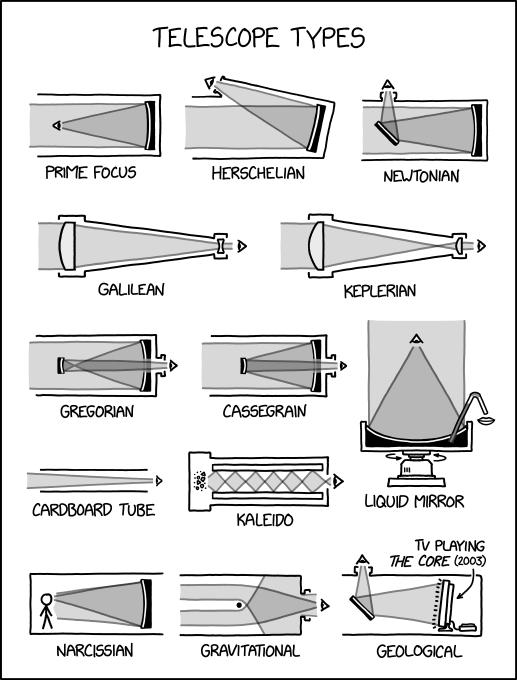
I don’t think anyone’s using a cardboard tube or kaleidoscope for research. And the ones in the bottom row – two are jokes and the other has only been proposed.
Kaleido is pretty much how the Chandra X-Ray Observatory works (though with much smaller angles). And nobody’s ever deliberately set up a gravitational telescope, but fortuitous gravitational lensing has certainly been used to study astronomical objects.
I would guess the hard part is to keep the tube from collapsing.
That is why they resort to Dobsonian truss tube telescopes.
ETA: This list will have to be updated to include the Kaleido, Narcissian, Gravitational and Geological telescopes. With a footnote referencing xkcd/3182/
While liquid mirror telescopes do exist, they rarely have a drinking straw attachment. Not only because of the mechanical difficulties, but also because drinking mercury is generally not advisable.
“My goal in life is to be personally responsible for at least one sports rule change.”
Doesn’t the vaulter need to be able to carry the thing?
That is, I don’t know the actual rules, and I doubt they say that in so many words, but isn’t there something that says that in effect?
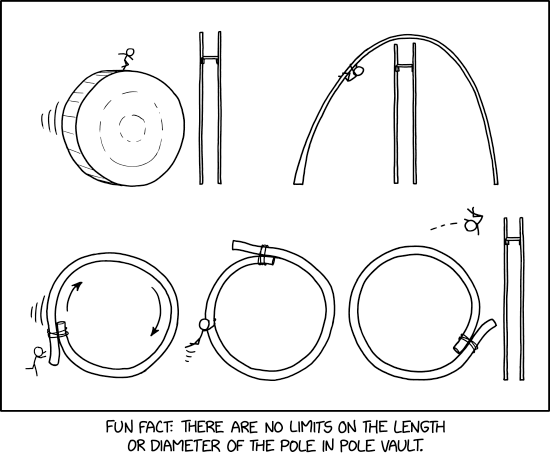
Once you launch (leave the ground), you are not allowed to move your hands higher on the pole. So that would eliminate the top right method of crawling over the top.
But I don’t know what happens if you never grip the pole, as in the first method. I would think the practical difficulty of how to get on top of it would make that a challenge.
I’d also think the first version might have a rather high risk of knocking down the bar, disqualifying your jump.
I think the disc is just small enough to roll under the bar, between the uprights.
As long as you can jump off the top without making it wobble or veer enough to collide w either upright while trying to roll between them.
Might be harder than it seems.
Both of those big wheels might have an issue getting you close enough before they hit that sunken vaulting box?
The sports rule I’d like to change is weightlifting. All of the top competitors wear “lifting shirts” that are so stiff, that they can’t even lower their arms without the weight on them. Well, if that’s allowed, it wouldn’t be too hard to build a spring arrangement that produces a steady force of, say, one ton, plus or minus a few percent, so that one can benchpress a ton by exerting a muscle force of, say, 40 pounds.
mass is your friend here … so forget HOLLOW and go SOLID
(you might have to work on your “after jump reflexes”, tho …)
Mass can be your friend. Until you try to accelerate the thing from a standstill.
For equivalent mass, something like a hoop has much more inertia per unit mass. A steel hoop might be much better than a plastic disk even though they weigh the same.
You’d want to be able to store up enough energy in the rolling wheel that, at the end, when you grab onto it, it’ll be able to lift you up to the top of the wheel. That’d be easier with both a high moment of inertia and a high mass. And while a ring has more moment of inertia per mass than a disk, it’s the total of both that we want, so might as well fill it in completely.
I was going to say that you’d need a long enough run-up to be able to store the required energy, too, but on thinking about it, it’s the same energy requirement as for a boring, old-fashioned pole vault, so that shouldn’t be a problem.

“In 1899, people were walking around shouting ‘23’ at each other and laughing, and confused reporters were writing articles trying to figure out what it meant.”
I am ashamed to admit I had to look two of those numbers up. 