I asked both ChatGPT and Grok and their answers agreed. They showed their work, and all the algebra/trig steps looked legit. In the process I learned a new math term, “sagitta” which isn’t just a constellation.
Cool. Now I learned something too; never heard the term before. Thank you.
My comment about a long table dragging the ground in the middle is an example of a saggita viewed from the perspective of outside the arc.
While microns, though requiring an anal-retentive level of precision relative to the task at hand, would not be inconceivable using precision measurement tools.
ETA: I regularly do a cardboard craft project that requires surprisingly high precision in order for pieces to fit properly– down to about 1/64 inch or about 0.4 millimeters.
I assume you use a laser cutter for that? I can’t see getting that kind of precision using any sort of hand tools.
Fortunately it involves folding not cutting; but yes a fold a mere 1/64" off will make the difference between two edges meeting cleanly versus leaving a gap. I end up faking it by hand-adjusting the fold until it’s good enough.
Has anyone (more chess-learned than I) looked at the actual chess situations depicted? In particular the right board has a white pawn on row 8 that has apparently not been made a queen? No wonder middle-bottom guy is intrigued!
I believe that is a bishop, and the yellow squares indicate the path it took across the boards. That’s why they have to be so precisely aligned, otherwise it does not work.
ETA: And middle bottom guy is not intrigued: he just played that bishop into the other board. He is playing there too, not only on the middle board. He loses one bishop in his original board, but helps white in the other board.
I think it is a bad move. He weakens himself with no gain in the other board. The bishop can now be taken by the rook.
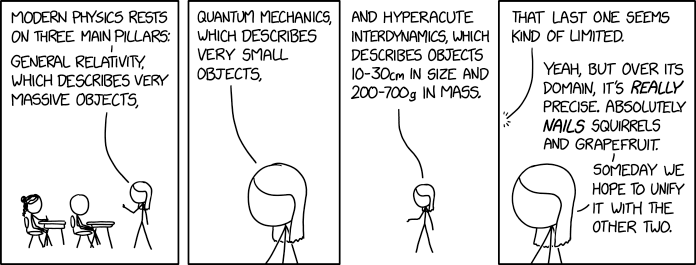
“Our models fall apart where the three theories overlap; we’re unable to predict what happens when a nanometer-sized squirrel eats a grapefruit with the mass of the sun.”
They should have asked me, I would have told them that they become a black hole. In fact, the sun mass grapefruit already was a black hole.
ducks and squirrels away
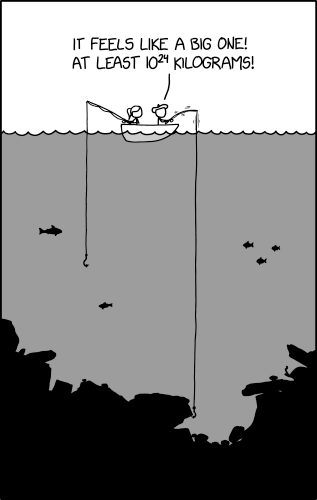
“‘That’s definitely above the catch-and-release size minimum for planetesimals.’ ‘I’m going to throw it back anyway.’”
You should have seen the one that got away!
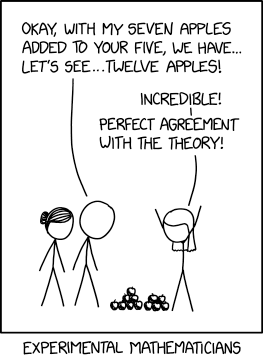
“The experimental math department’s budget is under scrutiny for how much they’ve been spending on trains leaving Chicago at 9:00pm traveling at 45 mph.”
Can they divert attention by pointing out how much the Physics Department’s budget is spent on spherical cows?
Of course, there is such a thing as experimental mathematics. It deals with things like testing the Collatz Conjecture or the Goldbach Conjecture for ever-larger numbers (we think that both are true for all numbers, but nobody’s ever been able to prove it, and some suspect that proof is actually impossible).
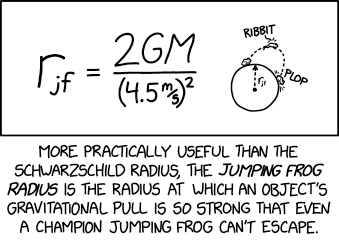
“Earth’s r_jf is approximately 1.5 light-days, leading to general relativity’s successful prediction that all the frogs in the Solar System should be found collected on the surface of the Earth.”
Prediction checks out. 
Without doing any math, I’m going guess that 1.5 light-days is somewhere around the orbit of Sedna. Which means you’d actually have to compute the r_fj for the Sun. Not that that would make a lot of difference.
Damned few (unboiled) frogs on the surface of the Sun though.
That one is an interesting concept, but the execution falls apart as soon as you consider the Sun, or Jupiter, or …
Doesn’t it depend on how much lead shot the frog has eaten?
That’s only in Calaveras County.