
“Communication is one of the most popular ways to transmit information, ahead of rivals such as”
“Communication is one of the most popular ways to transmit information, ahead of rivals such as”
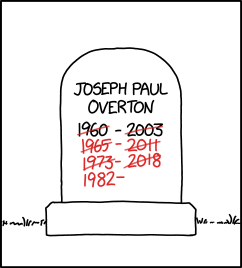
“I think I accidentally installed an Overton window in my bedroom. A few months ago, the sun wasn’t in my face in the morning, but now it is.”
Is there any significance to the dates on that stone? I mean, not that they are moving, but the actual numbers.
Maybe that he changes from a Boomer to Gen X to a Millennial?
The original dates (1960-2003) are Overton’s actual birth and death years. He died young in a crash.
So much for facts. On to bald conjecture.  …
…
The other intervals are a couple years off his actual lifespan of 43 years. ISTM 1965 and the Viet Nam escalation and protests was a bit of a political watershed. 1973 with the oil shocks, advent of compact cars, etc. was another “wake up and change” moment in US history.
1982 is less obvious to me, but I note that applying the same rough lifespan suggests the 1982-to-whenever era will draw to a close in the next couple of years.
The political implications of the end of trump (if not trumpism) will be yuge. Which way the Overton jumps post-trump remains to be seen. But jump it will.
I think that’s what the headstone is depicting and predicting.
There is also the meta-joke that the point of Overton’s theory is that the width of the window is more or less constant based on the small elasticity of collective human nature. But where the window is located can (and does) jump around a lot. So the headstone year intervals are all about the same width, but jump in large increments.
I don’t know whether the fact the interval between start dates is also increasing is meant to be significant or is just an accident of real history and the moments he chose to use as cultural inflection points. I could argue either side of that one.
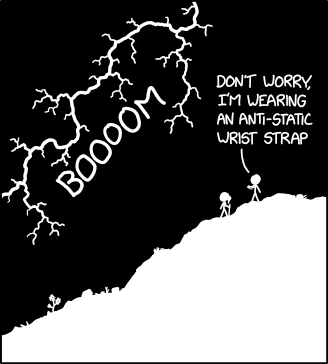
“Maybe you should wear one too? I guess I’m taller than you, so as long as I have one we’re fine.”
Actually, wouldn’t anything that dispersed static electricity from you make your body a conductive path between the atmosphere and the ground? That’s how lightning rods work: they mostly work to disperse charge before it can build up; but when lightning strikes anyway they become the preferred path for the discharge.
At the power levels of lightning, everything is “a conductive path between the atmosphere and the ground?”.
If a human attached an anti-static strap to themselves and to a proper ground stake driven into the ground, they would measurably reduce the effective resistance between the top of their head and the dirt. OTOH, they’d have a negligible effect on the effective resistance between the atmosphere ~8 miles up and the dirt. And that ~8-mile gap is what the lightning is crossing. Percentagewise, the last 5 feet don’t matter squat no matter how conductive or not they are.
Not too different from putting a grain of sand on a railroad track and expecting that one grain to affect the oncoming freight train. IMO the humor is entirely in that scale difference. And in the inversion that anti-static straps reduce the risk of shock, while this idea serves to, at least “techincally”, slightly increase the risk. Which gives the usual xkcd payoff of “Hmm. Wait … what?  ”
”
Which discussion of affecting freight trains with sand makes me think of this gem: BB Gun - What If - xckcd.com .
This would seem to indicate that lightning rods can’t work because it’s only the last few feet.
You have a leader coming down from the charged area of the cloud and a streamer going up from the earth/building/rod. When they meet, you get the flash/bolt. The lightning rod is a convenient conductor for the gathering potential discharge at the ground.
See " How lightning works" for an indepth explanation.
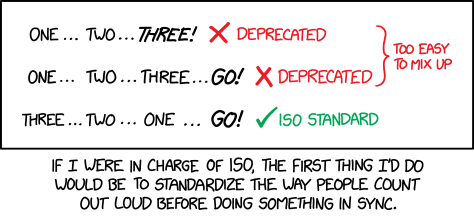
“Anyone who is caught counting ‘three … two … one … zero … GO!’ will be punished with a lifetime of eating only ISO standard food samples.”
Doubly funny since we just had a famous rocket launch. One where the countdown goes 3, 2, 1, 0 … pause … then something happens. Evidently yet another way NASA and ISO don’t play nice together. Furlongs per fortnight and all that customary units of measurement stuff. 
That’s how we lost MCO.
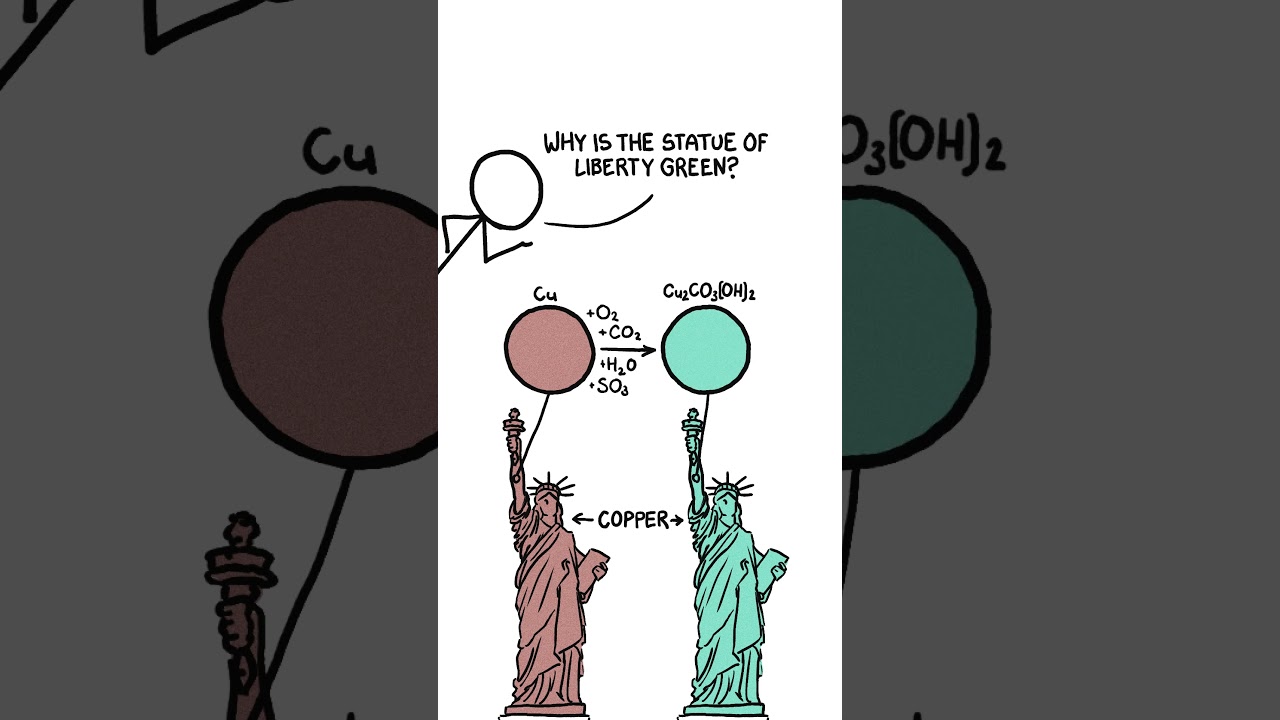
New What-if short Why is the Sky Blue
Was it my imagination, or were they still reading things like planned burn parameters out over the radio in feet-per-second during Artemis II (in 2026)?
I’d always heard that it IS Rayleigh scattering and not any intrinsic color of air. (Although liquid and solid oxygen is distinctly bluish).
Randall’s point is that all color can be described as preferential scattering, reflection, and absorption. But we don’t say a rose is colorless and it’s only reflection that makes it look red. So why is air the one thing we describe differently?
If my understanding is correct, the claim is that the sky would be almost entirely colorless if there were no suspended particles in it to scatter sunlight.
The problem with “the sky is blue because air is blue” is that, by the same logic, we must also say “the sunset is red because air is red”. When color is due to a pigment, like copper sulfate, it’s always that color: Look at light reflecting off of copper sulfate, and it looks the same as light passing through copper sulfate. No matter how you look at copper sulfate, it looks blue, so we’re on solid ground in saying that copper sulfate is blue. But if we look at air illuminated from the side, it’s blue, but illuminated from beyond, it’s red. Air looks different depending on the lighting. So there’s no unambiguous “color of air”.