Note that the deepest holes drilled by mankind are only a kilometre or so deeper below sea level than the bottom of the Marianas Trench, so we haven’t got that far into the Earth yet,
Hence the lack of balrogs.
I hope you like Balrogs, because that’s how you get Balrogs.
I also note that the two deepest boreholes are very close to the same depth; based on the limitations of drilling technology perhaps?
Which makes me wonder: if the mechanical challenges of drilling can be handwaved away for purposes of discussion, what would the deepest hole be that steel pipe could keep open?
Complete WAG, but I think it would be determined by the fusion point of steel (when it gets too hot and it bends) and/or the tensile strength of steel (when the pressure gets too high and it buckles), probably a combination of both.
If they started drilling at the bottom of the Marianas trench, (a cold location [~4 celsius] where steel doesn’t buckle because of heat), how deep do you think they could drill before the heat and pressure became too much?
I’d guess at much more than an extra kilometre, but I really don’t know if that is correct or not.
My guess would be that the cooling effect of the overlying water would not extend very deep, maybe a few hundred feet at most? After that, the temperature would be the same as anywhere else at that depth in the crust.
Yes, the crust is a very good insulator. I wonder if there is any way to test this theory out; oceanic crust is completely different to continental crust, so anything might happen. The heat in the lower crust and mantle has to go somewhere, but it doesn’t seem to make much impression on abyssal temperatures.
The sand may be annoying, but rainbows would be cool:
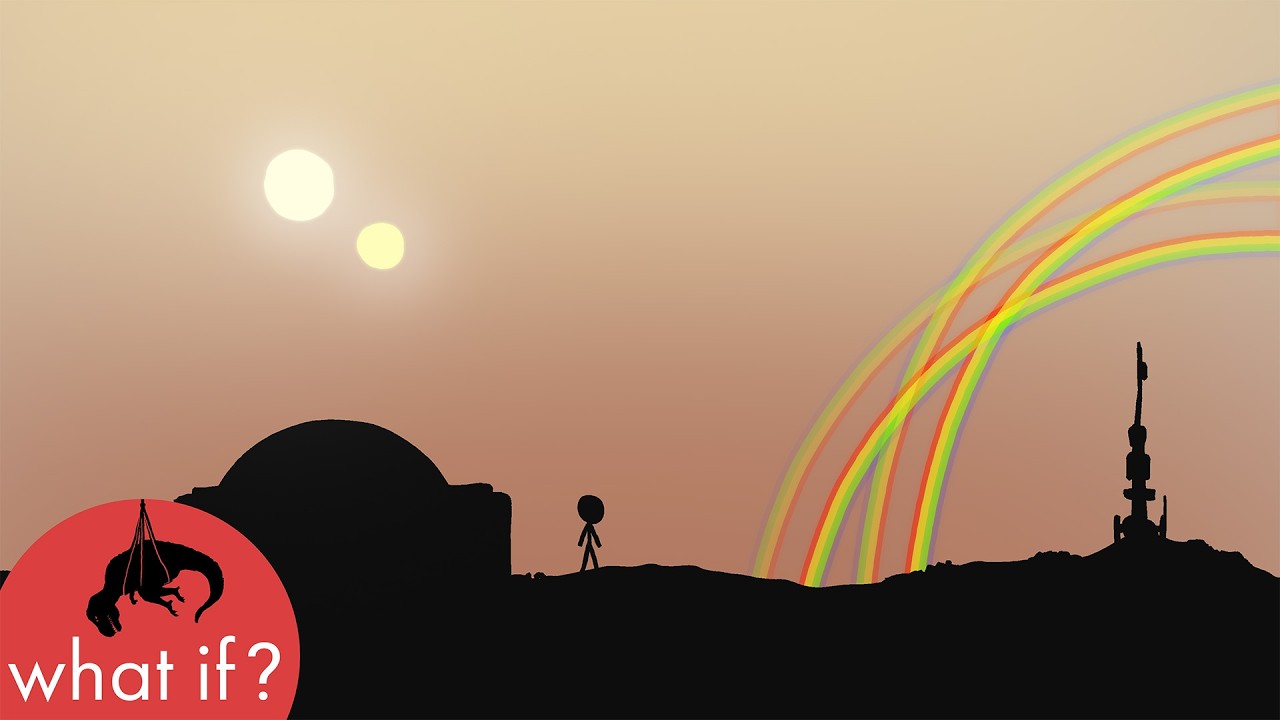
Brian
Of course, that also relies on it actually, you know, raining on Tatooine.
You can also get multiple rainbows by reflecting sunlight on a lake.
Incidentally, circumbinary planets are in so-called p-type orbits, whereas planets that orbit only one star in a binary pair are in s-type orbits, so ‘the other kind’ of planet could be called ‘s-type’ planets if we really need a name for them.
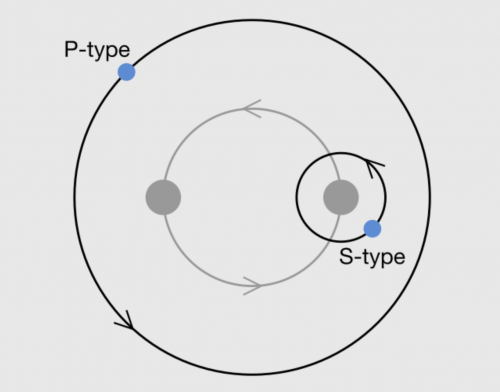
https://en.wikipedia.org/wiki/Habitability_of_binary_star_systems#Non-circumbinary_planet_(S-Type)
I’ve been down Mponeng Mine.
VERY improbable, but could the right combination of masses and orbital parameters for a binary star system have a planet with a chaotic orbit without either being ejected or crashing into either star?
I mean, for any given configuration and any given desired lifespan, there’s going to be a nonzero probability of a planet lasting that long.
But if we’re looking at timescales of billions of years, that probability is going to be really, really low.
Not the only ones. There are two species in Karelia, one in Russia and one in Finland. And a subspecies of a seagoing one in Canada.
The Russians lied to me when I was there? Inconceivable!
TIL.
I’ve been thinking about this one. There are quite a few ‘chaotic orbit’ situations in astronomy; the Sun follows a somewhat chaotic orbit around the galaxy, because the matter (and dark matter) in the Milky Way is not distributed evenly. Similarly the stars inside a globular cluster all follow chaotic orbits around their mutual centre of gravity - they are far enough apart so that they rarely collide (but this does happen, on a timescale of millions of years, and the collision creates a new single, bright star called a ‘blue straggler’). Most of the time the stars in a globular cluster are relatively safe and ‘stable’. I think that even the objects in our own Oort cloud follow somewhat chaotic orbits, but rarely encounter each other.
So I think some binary stars might be distantly accompanied by a little cloud of planets in orbits that are chaotic, but not particularly dangerous. Especially some bright stars; for instance Albireo A and Albireo B are separated by more than the distance between Earth and Pluto, in eccentric orbits around each other. Any S-type planets orbiting these stars could be frequently perturbed by their eccentric movement, making the climate on those planets unpredictable.
ISTM the relevant measure of time for the survival of perturbed orbits is not years or even millions of years. It’s number of orbits.
e.g. the Sun takes ~240M years to make one orbit around the galaxy. If it takes 10,000 orbits before the chaotic perturbations build to “eject from galaxy” magnitude, well, then for all practical purposes the orbit is stable since the time required to eject exceeds the life of the star and perhaps the whole galaxy.
OTOH, the Earth has completed 10,000 orbits of the sun just since shortly before the last ice age ended. Any chaos in our orbit that manifested in a mere 10K orbits would have killed us, and perhaps the whole biosphere long ago.

“Although it was a setback for physics, I’m glad the particle naming rights issue led to the cancelation of Pizza Hut’s Superconducting Super Collider in the early 90s, so the Double Stuffed Extra Cheese Topping Quark ended up just being named ‘top quark.’”